
When preparing for the IELTS exam, many candidates focus on achieving their target band score but do not fully understand how IELTS scoring works. This is a common oversight because understanding the assessment criteria helps learners identify their strengths and weaknesses and develop a more effective study strategy.
This article covers:
- The meaning of the IELTS band score scale from 0 to 9.
- How IELTS Listening, Reading, Writing, and Speaking are scored.
- How to calculate the IELTS Overall Band Score according to the official scoring rules.
- How to estimate your IELTS score at home.
What Do IELTS Band Scores from 0 to 9 Mean?
IELTS uses a band score scale from 0 to 9 to assess English language proficiency.
- Band 9.0: Expert user.
- Band 8.0–8.5: Very good user.
- Band 7.0–7.5: Good user.
- Band 6.0–6.5: Competent user.
- Band 5.0–5.5: Modest user.
- Band 4.0–4.5: Limited user.
- Below Band 4.0: Extremely limited proficiency.
In general:
- IELTS 5.5 may be suitable for learners with basic communication skills.
- IELTS 6.5 is a common score requirement for graduation or employment.
- IELTS 7.0 or above often meets the English language requirements of many international universities.
- IELTS 8.0+ demonstrates a very high level of English proficiency.
How Is IELTS Listening Scored?
Listening is one of the easiest IELTS skills to score because its marking system is straightforward.
The test consists of 40 questions, and each correct answer earns one mark. After the test, the total number of correct answers is converted into an IELTS band score.
IELTS Listening raw score conversion:
- 39–40 correct answers: Band 9.0.
- 37–38 correct answers: Band 8.5.
- 35–36 correct answers: Band 8.0.
- 32–34 correct answers: Band 7.5.
- 30–31 correct answers: Band 7.0.
- 26–29 correct answers: Band 6.5.
- 23–25 correct answers: Band 6.0.
- 18–22 correct answers: Band 5.5.
How Is IELTS Reading Scored?
Like Listening, Reading is scored according to the number of correct answers.
The test consists of 40 questions covering various question types, including:
- Matching Headings.
- True/False/Not Given.
- Multiple Choice.
- Sentence Completion.
- Summary Completion.
IELTS Reading raw score conversion:
- 39–40 correct answers: Band 9.0.
- 37–38 correct answers: Band 8.5.
- 35–36 correct answers: Band 8.0.
- 30–32 correct answers: Band 7.0.
- 27–29 correct answers: Band 6.5.
- 23–26 correct answers: Band 6.0.
IELTS Writing Assessment Criteria
Unlike Listening and Reading, IELTS Writing is not scored by simply counting correct answers.
Examiners assess writing performance based on four main criteria.
1. Task Achievement / Task Response
This criterion evaluates how well candidates address the requirements of the task.
A high-scoring response should:
- Address all parts of the question.
- Develop ideas clearly.
- Include relevant arguments and examples.
Many candidates lose marks not because of weak grammar but because they fail to address the task directly and stay focused on the question.
2. Coherence and Cohesion
This criterion assesses the logical flow and connectivity of ideas in a piece of writing.
Examiners consider:
- How ideas are organized.
- How paragraphs are structured.
- How linking words and cohesive devices are used.
A clear and logically organized essay often performs better than one that uses complex vocabulary but lacks coherence.
3. Lexical Resource
This criterion evaluates a candidate’s vocabulary range and accuracy.
A high score does not come from using as many difficult words as possible. Instead, it depends on:
- Accurate vocabulary use.
- The ability to paraphrase.
- Appropriate word choice for the context.
4. Grammatical Range and Accuracy
Grammar is assessed based on:
- Grammatical accuracy.
- Variety of sentence structures.
- The ability to control grammatical errors.
Essays achieving Band 7.0 or above typically demonstrate flexible use of simple, compound, and complex sentences.
IELTS Speaking Assessment Criteria
IELTS Speaking is also assessed using four criteria.
1. Fluency and Coherence
This criterion evaluates the ability to speak fluently and develop ideas logically.
High-scoring candidates typically:
- Speak naturally.
- Avoid excessive hesitation.
- Develop their answers with relevant details.
2. Lexical Resource
Examiners assess the ability to use a wide range of vocabulary accurately and appropriately.
Using the right words in the right context is more important than trying to use overly academic or complicated vocabulary.
3. Grammatical Range and Accuracy
Grammar in Speaking should be both accurate and flexible.
High-band candidates typically use a variety of tenses and sentence structures naturally.
4. Pronunciation
Clear pronunciation is an important factor in IELTS Speaking.
A common misconception is that IELTS favors British or American accents. In reality, examiners assess how clearly candidates can be understood rather than awarding marks based on a particular accent.
How to Calculate the IELTS Overall Band Score
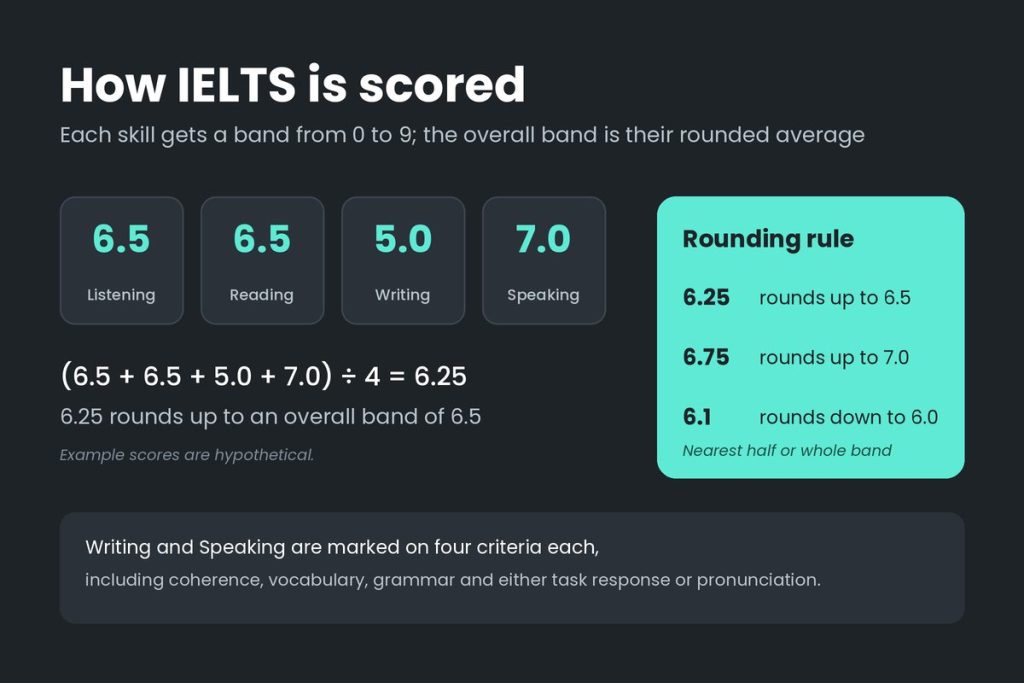
Once you have the scores for all four skills, the IELTS Overall Band Score is calculated by taking their arithmetic mean.
Example:
- Listening: 7.0.
- Reading: 6.5.
- Writing: 6.0.
- Speaking: 7.0.
Calculation:
(7.0 + 6.5 + 6.0 + 7.0) ÷ 4 = 6.625.
The Overall Band Score is rounded to 6.5.
IELTS rounding rules:
- X.25 → rounded up to X.5.
- X.75 → rounded up to the next whole number.
- X.50 → remains unchanged.
Understanding these rounding rules helps candidates calculate the scores they need in each skill to achieve their target Overall Band Score.
Understanding IELTS scoring is an important step toward developing an effective preparation plan. By learning the assessment criteria for each skill, candidates can identify exactly what they need to improve to increase their band scores as efficiently as possible. Instead of studying without a clear strategy, practise systematically and monitor your progress regularly to move closer to your IELTS target.
Frequently Asked Questions
What is the IELTS scoring scale?
IELTS uses a band score scale from 0 to 9 for each of the four skills and the Overall Band Score.
Is IELTS Writing scored by AI?
IELTS Writing tests are assessed by trained examiners according to standardized assessment criteria.
How many correct answers do you need to get IELTS Band 6.5?
Typically, candidates need approximately 26–29 correct answers in Listening or 27–29 correct answers in Reading to achieve Band 6.5. The exact conversion may vary depending on the test.
How is the IELTS Overall Band Score calculated?
The Overall Band Score is calculated by taking the arithmetic mean of the four skill scores and rounding the result according to IELTS rules.
Keywords:
- How to calculate the IELTS Overall Band Score.
- Online IELTS Overall Band Score calculator.
- IELTS score calculator website.
- IELTS Writing assessment.
- IELTS Listening scoring.
