
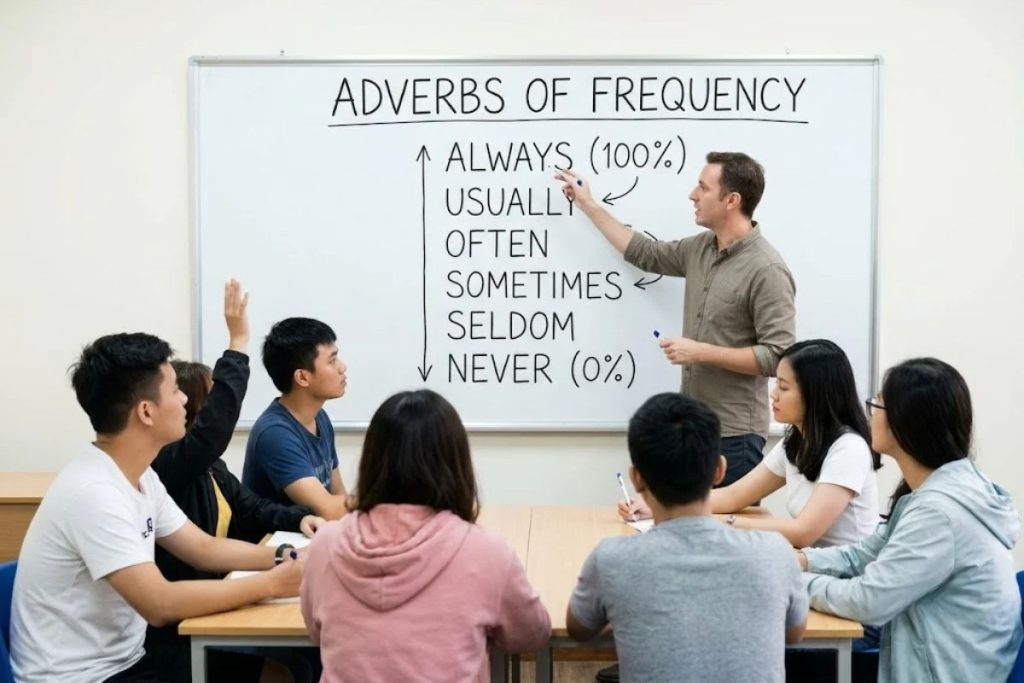
In English, when we want to describe how often an action happens, we use adverbs of frequency. These adverbs are common in everyday conversations and help us talk about routines, habits, and repeated activities more clearly.
For example, the sentence I go to the gym tells us about an activity but does not explain how often it happens. Adding an adverb changes the meaning: I usually go to the gym. This sentence tells the listener that going to the gym is a regular habit.
To use adverbs of frequency correctly, you need to understand their meanings, where they appear in sentences, and how they work with different types of verbs. This guide covers the most common adverbs of frequency, their grammatical rules, useful examples, common mistakes, and practice exercises with answers.
What Are Adverbs of Frequency?
Adverbs of frequency are words that describe how often an action or event occurs. They indicate whether something happens all the time, regularly, occasionally, rarely, or never.
These adverbs are particularly useful when talking about daily routines, personal habits, work schedules, and repeated activities.
Examples:
- I always brush my teeth before bed.
- She usually drinks coffee in the morning.
- We sometimes eat out on weekends.
- He never arrives late for work.
In these sentences, always, usually, sometimes, and never describe how frequently the actions happen.
Adverbs of frequency are especially common in the present simple tense because this tense is used to describe habits and regular activities. However, they can also appear with other tenses depending on the context.

Common Adverbs of Frequency and Their Meanings
English has several adverbs of frequency, each expressing a different degree of regularity. Some describe actions that happen almost every time, while others indicate that something happens only occasionally.
The following table introduces commonly used adverbs of frequency and their approximate meanings.
| Adverb | Meaning | Approximate frequency |
| Always | Every time | 100% |
| Usually | In most cases | 80–90% |
| Normally | Under ordinary circumstances | 80–90% |
| Often | Many times | 60–70% |
| Sometimes | On some occasions | 40–50% |
| Occasionally | From time to time | 20–30% |
| Seldom | Not often | 10–20% |
| Rarely | Almost never | 10–20% |
| Hardly ever | Almost never | Near 0–10% |
| Never | Not at any time | 0% |
Note: These percentages are illustrative rather than fixed grammatical values. The actual frequency depends on the situation and the speaker’s intended meaning.
How to distinguish common adverbs of frequency
Although some adverbs have similar meanings, they express slightly different levels of frequency.
- Always: Describes an action that happens every time or almost every time. Example: She always checks her email in the morning.
- Usually: Describes something that happens in most cases or is part of a normal routine. Example: I usually walk to work.
- Often: Indicates that an action happens many times, without necessarily following a fixed schedule. Example: They often go swimming.
- Sometimes: Describes an action that happens on certain occasions but not regularly. Example: He sometimes cooks dinner.
- Rarely / seldom: Indicates that an action does not happen very often. Example: We rarely watch television.
- Never: Expresses that an action does not happen at all. Example: I never smoke.
Understanding these differences helps you choose the most appropriate adverb when describing habits and routines.
Where Do Adverbs of Frequency Go in a Sentence?
The position of adverbs of frequency depends on the type of verb and the sentence structure. In most cases, they appear before the main verb, after the verb to be, or after the first auxiliary or modal verb.
Before the main verb
With ordinary verbs, adverbs of frequency usually appear before the main verb.
Structure:
Subject + adverb of frequency + main verb + …
Examples:
- I usually get up at six o’clock.
- She often reads before going to bed.
- They sometimes play football after school.
- He rarely eats fast food.
In these sentences, the adverb comes before the main verb to show how frequently the action occurs.
After the verb to be
When a sentence contains a form of to be, such as am, is, are, was, or were, the adverb of frequency usually comes after the verb.
Structure:
Subject + to be + adverb of frequency + …
Examples:
- She is always friendly.
- I am usually busy on Mondays.
- They are often late for meetings.
- He was never interested in sports.
This word order differs from the pattern used with ordinary verbs. Therefore, remember to place the adverb after to be rather than automatically putting it before the verb.
After an auxiliary or modal verb
When a sentence contains an auxiliary or modal verb, such as can, will, should, must, or have in a perfect tense, the adverb of frequency usually appears after the first auxiliary or modal verb and before the main verb.
Structure:
Subject + auxiliary/modal verb + adverb of frequency + main verb + …
Examples:
- She can always help you.
- We will usually arrive early.
- You should always check your answers.
- He has never visited Japan.
When a sentence contains more than one auxiliary verb, the adverb usually follows the first one.
For example:
- She has always been helpful.
This structure places always after has and before been.
At the beginning or end of a sentence
Some adverbs of frequency, particularly sometimes, often, usually, and occasionally, can appear at the beginning of a sentence to add emphasis or improve the flow of a paragraph.
Examples:
- Sometimes, I walk to work instead of taking the bus.
- Usually, we have dinner together.
- Occasionally, she works on Sundays.
Some adverbs can also appear at the end of a sentence in suitable contexts. This is especially common with sometimes and often.
Examples:
- We go to the cinema sometimes.
- I see him quite often.
However, not every adverb sounds natural in every position. Words such as always and never generally appear before the main verb or after to be. For learners, these standard positions are the best starting point.
Which Tenses Are Used with Adverbs of Frequency?
Adverbs of frequency are most commonly used with the present simple tense because this tense describes habits, routines, and repeated activities.
Examples:
- My father always drinks tea in the morning.
- We usually go shopping on Sundays.
- She rarely takes a taxi to work.
However, adverbs of frequency are not limited to the present simple. They can also be used with other tenses when the context requires them.
Present perfect
The present perfect can describe experiences or situations that have or have not occurred up to the present.
Example:
- I have never tried Korean food.
Past simple
The past simple can describe repeated habits or activities during a period in the past.
Example:
- He often visited his grandparents when he was young.
Future forms
Adverbs of frequency can also describe actions that are expected to happen repeatedly or consistently in the future.
Example:
- We will always remember this experience.
When using an adverb of frequency with a particular tense, make sure its position matches the verb structure.
Common Mistakes When Using Adverbs of Frequency
Although adverbs of frequency are relatively easy to learn, certain errors occur frequently. Understanding these mistakes can help you write and speak more accurately.
Placing the adverb in the wrong position
With ordinary verbs, adverbs of frequency usually come before the main verb rather than between the verb and its object.
- Incorrect: She drinks coffee always in the morning.
- Correct: She always drinks coffee in the morning.
With to be, the adverb usually comes after the verb.
- Less natural for a neutral statement: He never is late.
- Standard word order: He is never late.
Confusing adverbs with frequency expressions
Adverbs such as always, often, and sometimes indicate how frequently something happens. Expressions such as every day, once a week, and twice a month also describe frequency, but they are phrases rather than single-word adverbs.
Examples:
- I often exercise.
- I exercise three times a week.
Both sentences describe a habit, but often is an adverb, while three times a week is a frequency expression.
Using two negative expressions together
Words such as never and hardly ever already express a negative or near-negative meaning. Avoid combining them with another negative in standard English.
- Incorrect: I don’t never eat breakfast.
- Correct: I never eat breakfast.
- Correct: I don’t ever eat breakfast.
The correct choice depends on the intended meaning, but double negatives of this kind should generally be avoided in standard English.
Forgetting subject–verb agreement
Adverbs of frequency do not change the rules for verb agreement. In the present simple, a main verb still takes -s or -es with third-person singular subjects.
- Incorrect: She always go to school by bus.
- Correct: She always goes to school by bus.
Remember that the adverb does not affect the form of the verb.

Adverbs of Frequency Exercises with Answers
Practice is an effective way to remember the meanings and positions of adverbs of frequency. Complete the exercises below to check your understanding.
Choose the correct sentence
Select the sentence with the most appropriate word order.
Question 1: I go to the gym. (usually)
- I go usually to the gym.
- I usually go to the gym.
- I go the gym usually.
Question 2: She drinks coffee in the morning. (always)
- She always drinks coffee in the morning.
- She drinks always coffee in the morning.
- She drinks coffee always in the morning.
Question 3: He is late for class. (never)
- He never is late for class.
- He is never late for class.
- He is late never for class.
Question 4: We go to the park on weekends. (sometimes)
- We go sometimes to the park on weekends.
- We sometimes go to the park on weekends.
- We go to the park sometimes on weekends.
Question 5: I am tired after work. (often)
- I often am tired after work.
- I am often tired after work.
- I am tired often after work.
Put the words in the correct order
Rearrange the words to make complete, grammatically correct sentences.
- usually / breakfast / eat / I / early
- often / she / reads / books
- never / late / he / is
- sometimes / we / movies / watch
- always / homework / do / they / their
- often / play / they / football / after school
- rarely / eats / she / fast food
- usually / we / dinner / have / at 7 p.m.
- sometimes / I / music / listen / to
- always / he / helps / his parents / at home
Exercise answers
Choose the correct sentence
- Question 1: B
- Question 2: A
- Question 3: B
- Question 4: B
- Question 5: B
Put the words in the correct order
- I usually eat breakfast early.
- She often reads books.
- He is never late.
- We sometimes watch movies.
- They always do their homework.
- They often play football after school.
- She rarely eats fast food.
- We usually have dinner at 7 p.m.
- I sometimes listen to music.
- He always helps his parents at home.
Adverbs of frequency help you describe habits and repeated actions more naturally in English. To use them correctly, learn the meanings of words such as always, usually, often, sometimes, rarely, and never. Pay particular attention to their positions with ordinary verbs, the verb to be, and auxiliary verbs. Practicing with everyday examples will help you use these expressions more confidently in conversations and grammar exercises.
Frequently Asked Questions About Adverbs of Frequency
Do adverbs of frequency go before or after to be?
Adverbs of frequency usually appear after the verb to be, including am, is, are, was, and were.
Examples:
- She is always happy.
- They are usually busy.
With ordinary verbs, however, the adverb generally comes before the main verb, as in He often plays football.
Can adverbs of frequency appear at the beginning of a sentence?
Yes. Some adverbs, including sometimes, often, usually, and occasionally, can appear at the beginning of a sentence for emphasis or to improve the flow of a paragraph.
Example: Sometimes, I work from home.
However, the most common positions are before an ordinary main verb and after the verb to be.
Which tense is most commonly used with adverbs of frequency?
The present simple is the most common tense used with adverbs of frequency because it describes habits and repeated activities.
Example: She usually walks to school.
Adverbs of frequency can also appear in other tenses, such as the present perfect and past simple, depending on the context.
What is the difference between always, usually, and often?
- Always describes something that happens every time or almost every time.
- Usually describes something that happens in most cases or is part of a normal routine.
- Often indicates that something happens many times, but not necessarily according to a fixed schedule.
For example, I always have breakfast at home, I usually take the bus, and I often meet my friends after work express different levels of frequency.
Are adverbs of frequency the same as frequency expressions?
No. Adverbs of frequency are words such as always, usually, often, and never. Frequency expressions indicate how many times something happens or how often it occurs over a particular period, such as once a week, twice a month, and every day.
Both can describe habits, but they differ in grammatical structure.
Keywords:
- adverbs of frequency examples
- adverbs of frequency rules
- adverbs of frequency word order
- adverbs of frequency exercises with answers
- frequency adverbs in English
