
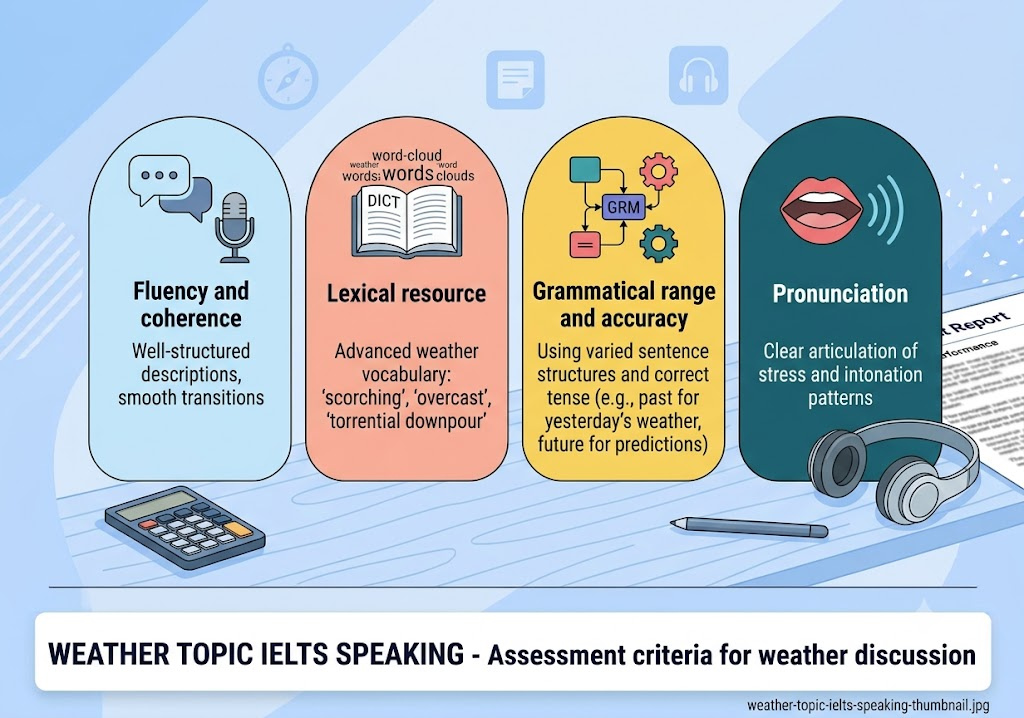
Weather is a familiar topic that frequently appears in everyday conversations and can also feature in IELTS Speaking Part 1. Although many candidates consider it an easy subject, they may struggle to avoid repetitive vocabulary or develop their answers naturally.
Preparing for the weather topic IELTS Speaking can help you build confidence, improve your fluency, and demonstrate a wider range of vocabulary. By learning useful expressions and practising relevant questions, you can give more detailed and natural responses during the exam.
This guide explores essential weather vocabulary, sample answers, common mistakes, and effective preparation strategies to help you improve your IELTS Speaking performance.
Why Is Weather a Common IELTS Speaking Topic?
Weather is a familiar subject that people often discuss when making small talk. Questions about sunshine, rain, temperature, and seasonal changes allow candidates to demonstrate their ability to communicate about everyday experiences.
In IELTS Speaking, examiners assess your speaking performance rather than your knowledge of meteorology. You should therefore focus on expressing your opinions clearly, explaining your preferences, and describing personal experiences using appropriate vocabulary.
Common Challenges Candidates Face
One common problem is relying too heavily on basic adjectives such as hot, cold, and rainy. Although these words are correct, repeatedly using them may limit your lexical range.
Another difficulty is giving answers that are too short. Responding with only one or two words may prevent you from demonstrating your grammatical range and fluency.
To improve, learn useful expressions, practise expanding your answers, and choose vocabulary that fits the context naturally.

Essential IELTS Speaking Topic Weather Vocabulary
Building a varied vocabulary is an important part of preparing for the weather topic IELTS Speaking. Rather than memorising isolated words, learn expressions in meaningful groups and practise using them in complete sentences.
Vocabulary for Sunny and Hot Weather
These expressions can help you describe warm weather more precisely:
- Boiling hot: Extremely hot.
- Scorching heat: Intense, burning heat.
- Sunny spells: Short periods of sunshine.
- Heatwave: A period of unusually hot weather.
- Mild climate: A climate without extreme temperatures.
- Warm and pleasant: Comfortable and moderately warm weather.
For example, you could say:
“Summers in my hometown can be boiling hot, especially during a heatwave. I prefer mild weather because I can spend more time outdoors without feeling exhausted.”
Vocabulary for Rainy and Windy Weather
Use these expressions to describe wet or stormy conditions:
- Downpour: A sudden, heavy fall of rain.
- Pouring with rain: Raining heavily.
- Torrential rain: Extremely heavy rain.
- Get caught in the rain: Be outside when it starts raining unexpectedly.
- Get drenched: Become completely wet.
- Breezy: Having a light, pleasant wind.
- Gusty winds: Strong, sudden bursts of wind.
For example:
“I once got caught in a downpour on my way home from work. I was completely drenched, so I had to change my clothes as soon as I arrived.”
Useful Weather Idioms for IELTS Speaking
Idioms can make your answers more expressive when used appropriately. However, you should not force them into every response.
- Under the weather: Feeling slightly unwell.
- As right as rain: Feeling healthy again.
- Come rain or shine: Regardless of the circumstances.
- A ray of sunshine: Someone or something that brings happiness.
Example:
“I sometimes feel a little under the weather when it rains for several days in a row because I find it difficult to stay active.”
Remember that idioms should fit your intended meaning. Natural, accurate language is more valuable than using expressions simply to sound advanced.
How to Answer IELTS Speaking Part 1 Topic Weather Questions
In Part 1, the examiner asks familiar questions about your life, preferences, and experiences. You should answer directly and expand your response with a reason or a relevant example.
A useful approach is to give your main answer, explain why you feel that way, and add a personal detail when appropriate.
Sample Answers: IELTS Speaking Topic Weather with Answers
Question 1: What’s the weather like in your hometown?
“I live in a tropical country, so the weather is generally warm throughout the year. We have a dry season and a rainy season, and the temperature can become quite uncomfortable during the hottest months.”
Question 2: What’s your favourite type of weather?
“I really enjoy cool and breezy weather, especially in autumn. It makes me feel refreshed, and I can go for a walk or spend time outdoors without worrying about the scorching heat.”
Question 3: Do you prefer hot or cold weather?
“I’d definitely choose cooler weather because I find it easier to concentrate and stay active. Extremely hot days tend to make me feel tired, particularly when I have to travel around the city.”
Question 4: Does the weather affect your mood?
“Yes, definitely. Sunny weather usually puts me in a good mood because it encourages me to go outside. On the other hand, several days of continuous rain can make me feel less energetic.”
These answers demonstrate how to combine direct responses, explanations, and personal details without making your answers unnecessarily long.
How to Extend Your Answers Naturally
If you tend to give very short responses, try adding one or two supporting details.
For example, instead of saying, “I like sunny weather,” you could explain that sunshine makes you feel happier and allows you to enjoy outdoor activities.
You can also compare different seasons, describe a memorable experience, or explain how the weather influences your daily routine.
Avoid memorising entire sample answers. Use them to learn useful expressions and practise expressing your own ideas.
Common Mistakes to Avoid in the Weather Topic IELTS Speaking
Even familiar topics can reveal weaknesses in vocabulary, grammar, and pronunciation. Recognising common mistakes can help you improve your performance.
Repeating Basic Vocabulary
Using hot, cold, and rainy repeatedly may make your answers sound limited. Expand your vocabulary with appropriate alternatives, such as scorching, chilly, breezy, and overcast.
However, do not replace every simple word with a complicated expression. Choose vocabulary that communicates your meaning accurately.
Using Idioms Inappropriately
Some candidates memorise idioms without understanding their meanings or contexts. For example, under the weather describes feeling unwell, not the weather conditions themselves.
Learn the meaning and usage of each expression before including it in your answers.
Making Pronunciation and Grammar Errors
Pay attention to word endings, sentence stress, and the pronunciation of words such as breeze, drenched, and humid.
You should also practise grammatical structures for describing habits and past experiences. For example, use the present simple for regular weather conditions and the past simple for a specific event.

Effective Preparation Strategies for the Weather Topic IELTS Speaking
Consistent practice can help you recall vocabulary more quickly and express your ideas with greater confidence.
Learn Vocabulary Through Collocations
Instead of memorising individual words, learn common combinations such as heavy rain, strong winds, pleasant weather, and extreme temperatures.
These collocations make your speech more natural and reduce the time you spend searching for words while speaking.
Practise with Different Questions
Prepare answers about your favourite weather, seasonal changes, extreme weather, and the effects of weather on your daily life.
Record yourself answering several questions and listen to the recording. Identify repeated words, grammatical mistakes, and pauses that interrupt your fluency.
Reuse Vocabulary Across Related Topics
Weather vocabulary can also be useful when discussing holidays, travel, outdoor activities, and memorable experiences.
For instance, when describing a holiday, you could explain how unexpected rain affected your plans or how pleasant weather made a trip more enjoyable.
Using vocabulary flexibly helps you prepare efficiently without memorising a separate set of expressions for every topic.
The weather topic IELTS Speaking can be manageable when you combine relevant vocabulary, clear explanations, and regular speaking practice. Rather than relying on memorised answers, focus on communicating your ideas naturally and accurately.
Start by learning useful collocations, practising common Part 1 questions, and recording your responses to identify areas for improvement. With consistent preparation, you can develop greater confidence and demonstrate your English-speaking ability more effectively.
Frequently Asked Questions (FAQs)
1. Should I use advanced meteorological vocabulary in IELTS Speaking?
No. Everyday expressions and natural collocations are usually more appropriate. Focus on using vocabulary accurately and explaining your ideas clearly rather than memorising technical terms that do not fit the conversation.
2. What should I do if I cannot remember a weather-related word?
Explain the idea using simpler words or describe the weather in another way. The examiner assesses your communication skills, so maintaining fluency and conveying your meaning are more important than recalling a particular word.
3. How can I extend my answers about weather naturally?
Give a direct answer, explain your reasons, and add a personal example. You can also describe how particular weather conditions affect your mood, activities, or daily routine.
4. Are idioms necessary to achieve a high IELTS Speaking band score?
No. Idioms are not compulsory. The examiner evaluates your vocabulary according to the official assessment criteria, so accurate word choice, natural expressions, and appropriate language use are more important than forcing idioms into every answer.
5. How can I improve my pronunciation when discussing weather?
Practise saying weather-related vocabulary aloud, paying attention to individual sounds, word stress, and sentence rhythm. Recording your answers and listening critically can help you identify pronunciation problems and monitor your progress.
6. How often should I practise the weather topic?
Practise for 10–15 minutes several times a week. Answer different questions, review your recordings, and reuse new vocabulary in context to improve your fluency and confidence over time.
Keyword:
- Ielts speaking topic weather
- Ielts speaking part 1 topic weather
- Ielts speaking topic weather vocabulary
- Ielts speaking topic weather with answers
- Weather topic for ielts speaking
- Weather topic ielts speaking
