
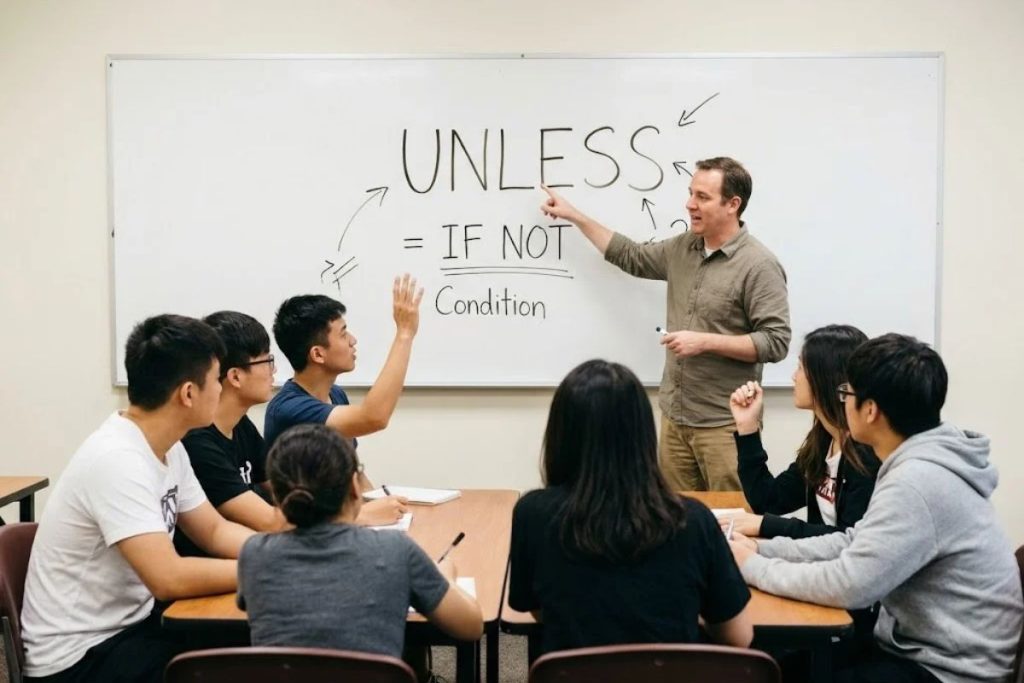
The unless structure is an important part of English grammar, especially when expressing conditions and their possible consequences. Unless means “if not” or “except if” and is commonly used to explain what will happen if a particular condition is not met.
Although many English learners remember that unless is equivalent to if not, using the two expressions correctly requires more than simply replacing one with the other. You need to understand the relationship between the condition and the result, choose the appropriate verb tense, and make sure the sentence retains its original meaning.
This article explains the cấu trúc unless (unless structure) in detail, including its common formulas, practical uses, differences from if not, and frequent grammatical mistakes. You will also find exercises with answers to help you practise and apply these rules confidently.
What is the unless structure?
Unless is a subordinating conjunction that means “if not” or “except if.” It introduces a condition that must be considered when describing a possible result.
For example:
- Unless you hurry, you will miss the bus.
This sentence means that you will miss the bus if you do not hurry.
The sentence can also be rewritten using if not:
- If you do not hurry, you will miss the bus.
Both sentences express essentially the same idea. However, unless presents the negative condition more concisely.
Here are some additional examples:
- Unless it rains, we will have a picnic.
- You cannot enter unless you have a ticket.
- Unless she apologizes, I will not talk to her.
- Unless we leave now, we will be late for the meeting.
In each example, the clause beginning with unless describes the condition, while the main clause explains the result.
The key rule: Unless generally introduces a negative condition equivalent to if … not. However, it cannot replace if in every sentence because doing so may change the original meaning.

Common formulas for the unless structure
Unless + present simple, will + base verb
This is one of the most common patterns for talking about future situations and their possible consequences.
Formula:
Unless + subject + present simple, subject + will + base verb.
Examples:
- Unless you study harder, you will fail the exam.
- Unless we leave now, we will be late.
- Unless he saves enough money, he will not be able to buy a new laptop.
- Unless they hurry, they will miss the train.
The clause beginning with unless describes the condition, while the main clause expresses the expected result.
An important grammatical rule is that the present simple is generally used in the unless clause when referring to the future. You do not normally use will in this condition clause.
Incorrect: Unless you will hurry, you will miss the bus.
Correct: Unless you hurry, you will miss the bus.
The same principle applies to other future expressions:
- Unless she finishes her work soon, she will have to stay late.
- Unless the weather improves, we will cancel the trip.
Unless + present simple, imperative
You can use unless with an imperative to give instructions, warnings, advice, or commands.
Formula:
Unless + subject + present simple, base verb.
Examples:
- Unless you finish your homework, do not go outside.
- Unless you have a reservation, please wait here.
- Unless you know the answer, do not guess.
- Unless you receive further instructions, continue with the current plan.
In these sentences, the main clause tells someone what to do or what not to do. Since it is an imperative, the verb normally uses its base form.
This pattern is useful in everyday conversations, workplace instructions, notices, and safety guidelines.
Unless + present perfect
The present perfect can follow unless when the speaker wants to emphasize that an action must be completed before a particular result can occur.
Formula:
Unless + subject + have/has + past participle, subject + will/can + base verb.
Examples:
- Unless you have finished your assignment, you cannot leave.
- Unless she has received the email, she will not know about the meeting.
- Unless they have completed the payment, we cannot process the order.
The present perfect highlights whether the required action has been completed by the relevant time.
In many everyday situations, the present simple may also be suitable. Choose the present perfect when emphasizing completion is important to the meaning.
Unless in the second conditional
Unless can also be used in second conditional sentences to describe hypothetical or unlikely situations in the present or future.
Formula:
Unless + subject + past simple, subject + would/could + base verb.
Examples:
- Unless he worked harder, he would not improve his English.
- Unless I had more free time, I would not join the club.
- Unless she had more experience, she would find the job difficult.
These sentences describe hypothetical circumstances rather than straightforward predictions about the future.
Because unless already carries a negative meaning, pay attention to the relationship between the condition and the result. In more complicated sentences, using if may make the intended meaning clearer.
How to use unless in different contexts
Understanding the formula is only the first step. You should also recognize the situations in which the unless structure is most useful.
Expressing a necessary condition
Use unless when an action or result depends on whether a particular condition is met.
Examples:
- You cannot pass the exam unless you prepare carefully.
- The company will not approve your request unless you provide the necessary documents.
- You will not understand the instructions unless you read them carefully.
- The website will not work properly unless you update the software.
In these examples, the condition introduced by unless is necessary to avoid the stated result or make the desired outcome possible.
Giving warnings
The unless structure is useful for warning someone about a possible consequence.
Examples:
- Unless you wear a helmet, you could get seriously injured.
- Unless we act quickly, the situation may get worse.
- Unless you back up your files, you could lose important information.
- Unless you leave soon, you might miss your appointment.
This pattern often appears in everyday conversations, safety instructions, and situations where the consequences of failing to act need to be emphasized.
Explaining rules and requirements
You can use unless to explain the conditions that must be met before someone can do something.
Examples:
- Visitors cannot enter the building unless they show their identification.
- You cannot access the account unless you enter the correct password.
- Employees cannot take leave unless their requests are approved.
- You cannot borrow the equipment unless you register your details.
This structure makes rules and requirements clear and concise.
Unless vs. if not: What is the difference?
Unless and if not often have similar meanings, and they can replace each other in many conditional sentences. However, their grammatical forms and usage are not always interchangeable.
| Feature | Unless | If not |
| General meaning | If not; except if | If a condition is not met |
| Structure | Unless + clause | If + negative clause |
| Style | Often concise and direct | Flexible and explicit |
| Common use | Negative conditions and exceptions | A wide range of conditional meanings |
| Main consideration | Check that the negative meaning is appropriate | Make sure the intended part of the condition is negated |
When unless and if not are interchangeable
Consider the following examples:
- Unless you call me, I will leave.
- If you do not call me, I will leave.
Both sentences mean that I will leave if you do not call me.
More examples:
- Unless we hurry, we will miss the train.
- If we do not hurry, we will miss the train.
- Unless she studies harder, she will fail the exam.
- If she does not study harder, she will fail the exam.
When rewriting sentences, preserve the original relationship between the condition and the result.
When you should not replace if with unless automatically
Not every sentence containing if can be rewritten using unless. The substitution works best when the original condition has a negative meaning equivalent to if not.
For example:
- If you study hard, you will pass the exam.
This sentence means that studying hard increases the likelihood of passing. You cannot replace if directly with unless and keep the same meaning.
The sentence Unless you study hard, you will pass the exam instead suggests that you will pass if you do not study hard, which is a different idea.
Another example:
- If you agree, we can start the meeting.
Replacing if with unless would change the condition from agreement to its opposite.
Therefore, before converting an if sentence into an unless sentence, identify exactly what the condition means and whether it needs to be expressed negatively.
Common mistakes when using unless
Using will after unless
A common mistake is using will in both clauses when describing a future situation.
Incorrect: Unless she will study harder, she will fail.
Correct: Unless she studies harder, she will fail.
In standard conditional sentences referring to the future, use the present simple in the unless clause and reserve will for the main clause when appropriate.
Adding not after unless
Because unless already expresses a negative condition equivalent to if not, adding not can reverse the intended meaning or make the sentence confusing.
Compare:
- Unless you hurry, you will miss the bus.
This means you will miss the bus if you do not hurry.
- Unless you do not hurry, you will miss the bus.
The second sentence expresses a different and potentially confusing relationship between the condition and the result. It is not the appropriate way to express the intended warning.
Instead, write:
- If you do not hurry, you will miss the bus.
- Unless you hurry, you will miss the bus.
Both correctly communicate the intended meaning.
Replacing if with unless in every sentence
As explained earlier, unless is not a universal replacement for if.
Incorrect substitution:
- If you study hard, you will pass the exam.
- Unless you study hard, you will pass the exam.
These sentences do not mean the same thing. The first connects studying hard with passing, while the second suggests that passing will happen if you do not study hard.
To avoid this error, check whether the original condition can naturally be expressed as if … not without changing the intended meaning.
Confusing unless with until
Unless and until may look similar, but they serve different grammatical purposes.
- Unless you call me, I will not come.
This means I will not come if you do not call me. - I will wait until you arrive.
This means I will continue waiting up to the time you arrive.
Use unless to introduce a condition and until to indicate a time limit or endpoint.
Exercises on the unless structure
Practise the rules above with the following exercises. Try completing each task before checking the answer key.
Exercise 1: Rewrite the sentences using unless
Rewrite each sentence using unless without changing its meaning.
- If you do not call me, I will leave.
- If he does not try, he will not succeed.
- If we do not hurry, we will miss the train.
- If she does not study harder, she will fail the exam.
- If you do not wear a jacket, you will feel cold.
- If they do not invite me, I will not attend the party.
- If you do not save money, you will not be able to buy that car.
- If he does not wake up early, he will be late for work.
- If we do not leave now, we will get stuck in traffic.
- If she does not follow the instructions, she will make mistakes.
Exercise 2: Choose the correct answer
Question 1. Unless you ______ now, you will miss the bus.
- will leave
- leave
- left
- leaving
Question 2. You cannot enter the room unless you ______ permission.
- have
- will have
- had
- having
Question 3. Which sentence is grammatically correct?
- Unless she will study, she will fail.
- Unless she studies, she will fail.
- Unless she does not studies, she will fail.
- Unless she studying, she will fail.
Question 4. Unless we leave early, we ______ the beginning of the show.
- missed
- would miss
- will miss
- missing
Question 5. Which word means “up to the time when”?
- Unless
- Although
- Because
- Until
Exercise 3: Find and correct the mistakes
Each sentence contains an error related to the use of unless. Rewrite it correctly.
- Unless you will hurry, you will be late.
- Unless of the weather improves, we will stay home.
- Unless she does not study, she will pass the exam.
- Unless he wakes up early, he will late for work.
- Unless you have a ticket, you can enter the concert.

Answer key
Exercise 1 answers
- Unless you call me, I will leave.
- Unless he tries, he will not succeed.
- Unless we hurry, we will miss the train.
- Unless she studies harder, she will fail the exam.
- Unless you wear a jacket, you will feel cold.
- Unless they invite me, I will not attend the party.
- Unless you save money, you will not be able to buy that car.
- Unless he wakes up early, he will be late for work.
- Unless we leave now, we will get stuck in traffic.
- Unless she follows the instructions, she will make mistakes.
Exercise 2 answers
- B. leave — Use the present simple in the unless clause when referring to a future condition.
- A. have — The present simple is appropriate for expressing a condition involving permission.
- B. Unless she studies, she will fail. — The verb study changes to studies with the third-person singular subject she.
- C. will miss — The main clause uses will to describe a possible future result.
- D. Until — Until indicates a time endpoint, while unless introduces a condition.
Exercise 3 answers
- Unless you hurry, you will be late.
- Unless the weather improves, we will stay home.
- Unless she studies, she will not pass the exam.
Note: This corrected sentence expresses the idea that she needs to study to pass. If the intended meaning is that she will pass when she studies, write: If she studies, she will pass the exam. - Unless he wakes up early, he will be late for work.
- Unless you have a ticket, you cannot enter the concert.
Another correct option is: You can enter the concert if you have a ticket.
The unless structure becomes easier to use once you understand that it generally expresses a negative condition equivalent to if not. Remember to use the appropriate tense, avoid adding will or not automatically, and check that replacing if with unless does not change the original meaning. Regular practice with sentence transformations and conditional examples will help you use this structure more accurately in everyday conversations and academic writing.
Frequently asked questions about the unless structure
What does unless mean?
Unless means “if not” or “except if.” It introduces a condition that must be considered when describing a possible outcome.
Example: Unless you hurry, you will miss the bus.
Can you use will after unless?
In ordinary conditional sentences referring to the future, you generally do not use will in the unless clause. Instead, use the present simple.
Correct: Unless you leave now, you will be late.
Incorrect: Unless you will leave now, you will be late.
Can unless replace if not?
Yes, in many conditional sentences, unless can replace if … not without changing the meaning. However, you should check the context before making the substitution.
Can unless be used in the second conditional?
Yes. Unless can be used in the second conditional to describe hypothetical situations. The common pattern is unless + subject + past simple, subject + would/could + base verb. Make sure the negative meaning of unless is consistent with the intended result.
What is the difference between unless and until?
Unless introduces a condition, while until refers to the time when an action ends or a particular event occurs.
For example:
- Unless you call me, I will not come.
- I will wait until you arrive.
Keywords:
- unless structure and usage
- unless vs if not
- unless structure exercises with answers
- how to rewrite sentences using unless
- unless in conditional sentences
