

Personal pronouns in English are an essential part of grammar. They help us refer to people, animals, and things without repeatedly using the same nouns. Understanding how to use pronouns such as I, you, he, she, it, we, and they correctly can make your speaking and writing clearer and more natural.
In this guide, you will learn what personal pronouns in English are, how they are classified, how to use subject and object pronouns, and how to distinguish them from possessive adjectives. You will also find practical examples, common mistakes to avoid, and exercises with answers to test your knowledge.
What Are Personal Pronouns in English?
Personal pronouns are words that replace nouns referring to people, animals, or things. They help avoid repetition and make sentences more concise and natural.
For example:
- Lan is my sister. She is 18 years old.
- Tom and I are classmates. We study English together.
- I have a cat. It is very cute.
In these examples, she, we, and it replace nouns or noun phrases mentioned earlier. Without personal pronouns, the sentences would sound repetitive.

How Many Personal Pronouns Are There in English?
English has seven basic subject pronoun forms: I, you, he, she, it, we, and they.
These pronouns can be classified according to grammatical person and number:
- First person: Refers to the speaker, including I and we.
- Second person: Refers to the person or people being addressed, represented by you.
- Third person: Refers to someone or something being discussed, including he, she, it, and they.
Although you can refer to one person or several people, its form remains the same. Some learning materials distinguish these two uses, but there are still only seven basic subject pronoun forms.
Personal Pronouns in English: Complete Table
Personal pronouns have different forms depending on their grammatical functions. Subject pronouns generally perform an action or identify the subject, while object pronouns receive the action or follow a preposition.
The table below summarizes the main forms you should learn.
| Person | Subject pronoun | Object pronoun | Possessive adjective |
| First-person singular | I | Me | My |
| First-person plural | We | Us | Our |
| Second person | You | You | Your |
| Third-person singular, masculine | He | Him | His |
| Third-person singular, feminine | She | Her | Her |
| Third-person singular, thing | It | It | Its |
| Third-person plural | They | Them | Their |
Note: Subject pronouns, object pronouns, and possessive adjectives have different functions. Also, his can function as a possessive pronoun when it stands alone, as in This book is his.
First-Person Personal Pronouns
First-person pronouns refer to the speaker or a group that includes the speaker.
- I: Refers to one speaker.
- We: Refers to the speaker and at least one other person.
Examples:
- I work in an office.
- We are learning English.
- I enjoy reading books.
- We usually have lunch together.
Remember that we can mean “we” or “us” depending on the context. It does not always include the person being addressed.
Second-Person Personal Pronouns
The second-person pronoun you refers to the person or people the speaker is addressing. It can mean “you” when speaking to one person or “you all” when addressing several people.
Examples:
- You are very kind.
- You need to finish this task today.
- Are you ready for the meeting?
Unlike some other personal pronouns, you does not change its form between singular and plural uses.
Third-Person Personal Pronouns
Third-person pronouns refer to people or things other than the speaker and the person being addressed.
- He: Used for a person who uses this pronoun, traditionally associated with males.
- She: Used for a person who uses this pronoun, traditionally associated with females.
- It: Commonly used for objects, animals when their sex is unspecified, and certain situations or ideas.
- They: Used for multiple people or things, and also for an individual who uses they or when a person’s gender is unknown or irrelevant.
Examples:
- He is my teacher.
- She enjoys reading.
- It looks beautiful.
- They are waiting outside.
Choosing the correct pronoun depends on the context and, when referring to a person, the pronoun that person uses.
How to Use Personal Pronouns in English
Using personal pronouns correctly requires understanding their position and function in a sentence. The two main forms to focus on are subject pronouns and object pronouns.
Subject Pronouns
Subject pronouns usually appear before the main verb. They identify the person or thing performing an action or being described.
Common structure:
Subject pronoun + verb + …
Examples:
- I like coffee.
- She speaks English fluently.
- They are students.
- He works every day.
In the present simple tense, verbs generally take an -s or -es ending when the subject is a third-person singular pronoun, except for certain irregular forms and special cases.
For example, She works in an office is correct, while She work in an office is incorrect.
Subject pronouns can also appear before linking verbs such as be.
Example: We are happy.
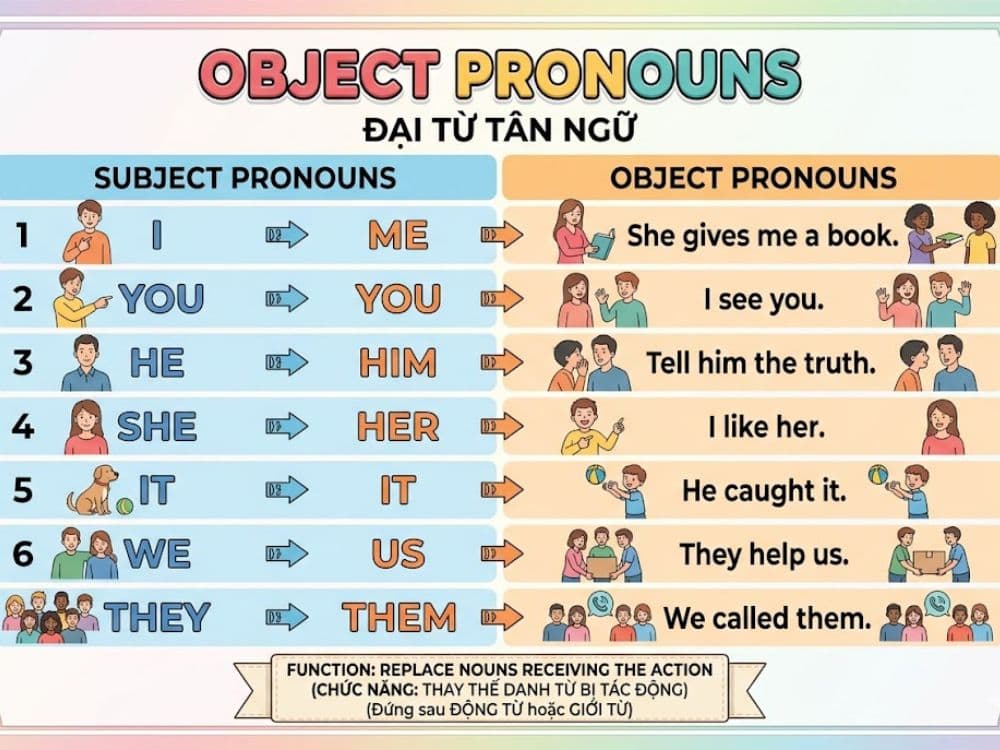
Object Pronouns
Object pronouns refer to the person or thing receiving an action. They usually appear after a verb or a preposition.
Common structure:
Subject + verb + object pronoun
Examples:
- My mother loves me.
- I called him yesterday.
- She invited them to her party.
- The teacher helped us with the exercise.
Object pronouns also follow prepositions such as to, for, with, and about.
Examples:
- This gift is for you.
- She is talking to him.
- I went shopping with them.
Using a subject pronoun instead of an object pronoun in these positions is a common grammatical mistake.
Incorrect: She likes I.
Correct: She likes me.
In this sentence, me is the object of the verb likes.
Personal Pronouns and Possessive Adjectives
Personal pronouns and possessive adjectives are related, but they serve different grammatical functions. Personal pronouns refer to people or things, while possessive adjectives indicate ownership and appear before nouns.
| Word type | Function | Example |
| Subject pronoun | Acts as the subject | She is my friend. |
| Object pronoun | Acts as the object | I know her. |
| Possessive adjective | Shows ownership before a noun | This is her book. |
| Possessive pronoun | Replaces a possessive noun phrase | This book is hers. |
Possessive adjectives include my, your, his, her, its, our, and their. They are followed by nouns.
Examples:
- This is my bag.
- That is their house.
- She forgot her keys.
Possessive pronouns, on the other hand, can stand alone.
Examples:
- This bag is mine.
- That house is theirs.
- The keys are hers.
A useful rule is to remember that my normally needs a noun after it, whereas mine can stand alone.
Common Mistakes When Using Personal Pronouns
Learners often make mistakes when choosing pronouns according to their grammatical roles or the people and things they refer to. Understanding these common problems can help you improve your accuracy.
Using Subject Pronouns Instead of Object Pronouns
Subject pronouns such as I, he, and she usually function as subjects. Object pronouns such as me, him, and her are used after verbs and prepositions when an object is required.
Incorrect: He called I yesterday.
Correct: He called me yesterday.
Incorrect: I spoke to she.
Correct: I spoke to her.
Confusing He and She
Use the pronoun that corresponds to the person being discussed and the pronoun that person uses. If you are unsure, using the person’s name can help you avoid confusion.
Examples:
- David is my friend. He is very helpful.
- Anna is my colleague. She works in marketing.
Using the Wrong Pronoun for Plural Nouns
Plural nouns generally require plural pronouns when they refer to multiple people or things.
Example:
My friends are here. They are waiting for us.
In this sentence, they replaces my friends, while us refers to the group that includes the speaker and functions as the object of waiting for.
Confusing Possessive Adjectives and Possessive Pronouns
Possessive adjectives must generally be followed by nouns, while possessive pronouns can stand alone.
Incorrect: This book is my.
Correct: This book is mine.
Understanding this distinction will help you avoid common errors in both speaking and writing.
Personal Pronouns in English: Exercises With Answers
Practice is one of the most effective ways to improve your understanding of personal pronouns in English. Complete the exercises below before checking the answers.
Exercise: Fill in the Correct Subject Pronoun
Complete each sentence with the appropriate subject pronoun.
- My name is Anna. _____ am a student.
- David is my brother. _____ is 15 years old.
- My parents are at home. _____ are cooking dinner.
- This is my dog. _____ likes running.
- Linda and I are friends. _____ study together.
Exercise: Choose the Correct Object Pronoun
Choose the correct answer in parentheses.
- I saw (he/him) at school yesterday.
- Can you help (we/us) with this exercise?
- She invited (they/them) to her party.
- Please give (I/me) the document.
- He is waiting for (she/her).
Exercise: Replace the Nouns With Personal Pronouns
Replace the bold noun or noun phrase with the appropriate pronoun.
- Mary is reading a book.
- The children are playing outside.
- I called Peter this morning.
- My sister and I love music.
- We visited the museum yesterday.
Answers and Explanations
Exercise: Subject Pronouns
- I – Refers to the speaker.
- He – Replaces David.
- They – Replaces my parents.
- It – Replaces the dog in this example.
- We – Refers to Linda and the speaker.
Exercise: Object Pronouns
- Him – Follows the verb saw.
- Us – Functions as the object of help.
- Them – Functions as the object of invited.
- Me – Functions as the object of give.
- Her – Follows the preposition for.
Exercise: Replacing Nouns
- She is reading a book.
- They are playing outside.
- I called him this morning.
- We love music.
- We visited it yesterday.
These examples demonstrate that the correct pronoun depends on the person or thing being referred to, the number of people or things involved, and the pronoun’s grammatical role. Practicing with different sentence patterns can help you use personal pronouns more confidently and accurately.
Frequently Asked Questions About Personal Pronouns
How many personal pronouns are there in English?
There are seven basic subject pronoun forms: I, you, he, she, it, we, and they. Some learning materials distinguish singular and plural uses of you, resulting in eight usage categories.
What are the object pronouns in English?
The object pronouns are me, you, him, her, it, us, and them. They commonly appear after verbs or prepositions.
What is the difference between personal pronouns and possessive adjectives?
Personal pronouns replace nouns or refer to people and things. Possessive adjectives, such as my, your, his, her, its, our, and their, indicate ownership and appear before nouns.
Can they refer to one person?
Yes. They can refer to an individual whose gender is unknown or irrelevant, or to someone who uses they as a personal pronoun.
How can I memorize personal pronouns more easily?
Group pronouns by function, practice with example sentences, and complete exercises regularly. Learning subject pronouns, object pronouns, and possessive forms together can help you remember their differences.
Keywords:
- personal pronouns in english
- english personal pronouns
- object pronouns in english
- personal pronoun examples
- personal pronoun exercises with answers
