

In English, plural nouns are not always formed by adding -s or -es to the singular form. Some nouns change their internal vowels, take a completely different form, or remain unchanged in the plural. These nouns are known as irregular plural nouns.
Learning irregular plural nouns is essential for using English grammar accurately. It helps learners choose the correct noun forms, match subjects with verbs, and express quantities clearly in both spoken and written English.
In this guide, you will discover what irregular plural nouns are, how they change in the plural, and which forms are commonly used in everyday English. You will also find useful irregular plural nouns lists, practical examples, common mistakes, and exercises to help you remember these patterns.
What Are Irregular Plural Nouns?
Definition of Irregular Plural Nouns
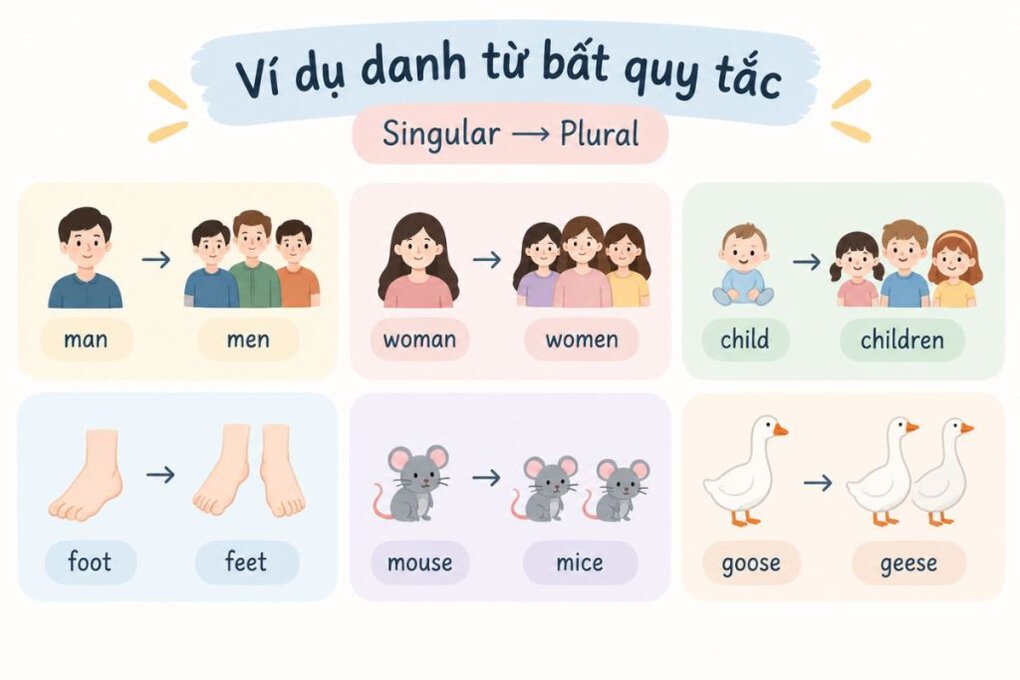
Irregular plural nouns are nouns whose plural forms do not follow the usual rules of adding -s or -es to a singular noun. Instead, their forms may change in different ways, so learners often need to memorize them individually.
Here are some common examples:
- Man → men: adult male people.
- Woman → women: adult female people.
- Child → children: young people.
- Tooth → teeth: the hard structures in the mouth.
- Mouse → mice: small rodents.
These examples show that plural forms can involve vowel changes or completely different word endings. Therefore, simply adding -s to every singular noun can lead to grammatical errors.
It is useful to distinguish irregular plural nouns from other nouns with special plural forms. For example, knife → knives involves a spelling change, while sheep → sheep remains unchanged in the plural.
Irregular Plural Nouns vs. Regular Plural Nouns
Regular plural nouns generally follow predictable spelling rules. Most are formed by adding -s or -es to the singular form.
| Singular Noun | Plural Noun | Meaning |
| Book | Books | Books |
| Car | Cars | Cars |
| Class | Classes | Classes |
| Watch | Watches | Watches |
| Box | Boxes | Boxes |
In contrast, irregular plural nouns follow different patterns.
| Singular Noun | Plural Noun | Pattern |
| Man | Men | Vowel change |
| Child | Children | Different word form |
| Mouse | Mice | Vowel change |
| Sheep | Sheep | No change |
Understanding this distinction helps learners recognize when to apply regular plural rules and when to use a special form.
How to Form Irregular Plural Nouns
There is no single rule that applies to all irregular plural nouns. However, grouping them according to their patterns can make them easier to learn and remember.
Nouns That Change Their Internal Vowels
Some nouns form their plurals by changing the vowel inside the word. This pattern appears in several common English nouns.
| Singular | Plural | Meaning |
| Man | Men | Adult male |
| Woman | Women | Adult female |
| Foot | Feet | Foot |
| Tooth | Teeth | Tooth |
| Goose | Geese | Goose |
| Mouse | Mice | Mouse |
| Louse | Lice | Louse |
Examples:
- One mouse is hiding behind the box.
- Two mice are hiding behind the box.
In the first sentence, mouse refers to one animal and takes the singular verb is. In the second sentence, mice refers to more than one animal and takes the plural verb are.
A helpful learning strategy is to memorize these nouns in pairs. Practicing both forms in complete sentences can also improve recall and help you use them naturally in conversation.
Nouns That Change Completely in the Plural
Some irregular plural nouns have forms that differ considerably from their singular counterparts. Their plural forms cannot be predicted simply by adding a suffix.
| Singular | Plural | Meaning |
| Child | Children | Child |
| Person | People | Person |
| Ox | Oxen | Ox |
Examples:
- The child is reading a book.
- The children are reading books.
The plural of person is usually people in everyday English. The form persons is also used in certain formal, administrative, and legal contexts.
Because these nouns do not follow a consistent spelling pattern, learners should pay special attention to them when studying irregular plural nouns.
Nouns That Stay the Same in the Plural
Some nouns have identical singular and plural forms. Their number is determined by the context, quantity expressions, and verb agreement.
| Singular | Plural | Meaning |
| Sheep | Sheep | Sheep |
| Deer | Deer | Deer |
| Fish | Fish | Fish |
| Species | Species | Species |
| Series | Series | Series |
| Aircraft | Aircraft | Aircraft |
| Spacecraft | Spacecraft | Spacecraft |
| Offspring | Offspring | Offspring |
| Salmon | Salmon | Salmon |
| Trout | Trout | Trout |
| Moose | Moose | Moose |
| Bison | Bison | Bison |
Examples:
- There is one sheep in the field.
- There are five sheep in the field.
Although sheep does not change its spelling, the verb changes according to whether the sentence refers to one animal or several.
The word fish is generally used for both singular and plural when talking about fish in general. The form fishes can also be used when emphasizing different species of fish.
Similarly, species and series remain unchanged in both the singular and plural.
Nouns With Special Spelling Changes
Some nouns ending in -f or -fe form their plurals by changing the ending to -ves.
| Singular | Plural | Meaning |
| Knife | Knives | Knife |
| Wife | Wives | Wife |
| Life | Lives | Life |
| Leaf | Leaves | Leaf |
| Wolf | Wolves | Wolf |
| Half | Halves | Half |
| Calf | Calves | Calf |
| Loaf | Loaves | Loaf |
| Shelf | Shelves | Shelf |
| Thief | Thieves | Thief |
| Self | Selves | Self |
| Sheaf | Sheaves | Sheaf |
However, not every noun ending in -f or -fe changes to -ves.
For example:
- Roof → roofs
- Belief → beliefs
- Cliff → cliffs
These examples demonstrate why learners should study common exceptions instead of applying one spelling rule to every noun with the same ending.
Although these forms are often studied alongside irregular plural nouns, they are more specifically examples of special plural spelling patterns.
Irregular Plural Nouns List: Common Examples
The following tables provide a practical irregular plural nouns list for learners who want to review common forms in everyday English and academic contexts.
Common Irregular Plural Nouns
| Singular | Plural | Meaning |
| Man | Men | Adult male |
| Woman | Women | Adult female |
| Child | Children | Child |
| Person | People | Person |
| Foot | Feet | Foot |
| Tooth | Teeth | Tooth |
| Goose | Geese | Goose |
| Mouse | Mice | Mouse |
| Louse | Lice | Louse |
| Ox | Oxen | Ox |
These words are useful starting points because they frequently appear in basic English lessons, reading passages, and everyday conversations.
When learning each word, practice using it with numbers and verbs. For example, compare one child is with two children are to understand both the plural form and its grammatical role.
Latin and Greek Plural Nouns
English contains many nouns borrowed from Latin and Greek. Some retain traditional plural forms, particularly in academic, scientific, and technical writing.
| Singular | Plural | Meaning |
| Analysis | Analyses | Analysis |
| Basis | Bases | Basis |
| Crisis | Crises | Crisis |
| Diagnosis | Diagnoses | Diagnosis |
| Hypothesis | Hypotheses | Hypothesis |
| Thesis | Theses | Thesis |
| Synthesis | Syntheses | Synthesis |
| Parenthesis | Parentheses | Parenthesis |
| Criterion | Criteria | Criterion |
| Phenomenon | Phenomena | Phenomenon |
| Bacterium | Bacteria | Bacterium |
| Datum | Data | Datum |
| Stimulus | Stimuli | Stimulus |
| Nucleus | Nuclei | Nucleus |
Example:
The researchers analyzed several phenomena.
This sentence uses phenomena, the plural form of phenomenon.
Pay particular attention to pairs such as criterion – criteria and phenomenon – phenomena. In standard usage, criterion and phenomenon are singular, while criteria and phenomena are plural.
The word data has flexible usage in modern English. It can function as a plural noun in scientific writing, while it is often treated as an uncountable noun in general English.
Nouns With Two Accepted Plural Forms
Some English nouns have two accepted plural forms. The preferred form may depend on meaning, context, professional usage, or regional preference.
| Singular | Plural Forms | Meaning |
| Index | Indexes / Indices | Index |
| Appendix | Appendixes / Appendices | Appendix |
| Formula | Formulas / Formulae | Formula |
| Cactus | Cactuses / Cacti | Cactus |
| Fungus | Fungi / Funguses | Fungus |
| Antenna | Antennas / Antennae | Antenna |
| Medium | Media / Mediums | Medium |
| Curriculum | Curricula / Curriculums | Curriculum |
| Memorandum | Memoranda / Memorandums | Memorandum |
| Syllabus | Syllabuses / Syllabi | Syllabus |
| Focus | Focuses / Foci | Focus |
| Radius | Radii / Radiuses | Radius |
For example, indices is commonly found in mathematics, economics, and finance, while indexes is also widely used in general English.
Likewise, formulae appears in some scientific and technical contexts, while formulas is common in contemporary English.
The best choice depends on the intended meaning and the conventions of the field in which the word is used.
How to Use Irregular Plural Nouns in Sentences
Although irregular plural nouns have special forms, they still follow the general grammatical principles of singular and plural nouns. Choosing the correct determiner and verb is essential for constructing accurate sentences.
Using Irregular Nouns in the Singular
Singular countable nouns can be used with a, an, or one. They generally take singular verbs when they function as the subject of a sentence.
Examples:
- A child is playing in the garden.
- One woman is standing near the door.
- A mouse is under the table.
In these sentences, child, woman, and mouse are singular nouns, so they take the appropriate singular verb forms.
Remember that the correct article depends on pronunciation. For example, we say a woman and a mouse.
Using Irregular Nouns in the Plural
Plural nouns can be used with numbers and expressions such as many, several, and a few. They generally take plural verbs.
Examples:
- Two children are playing in the garden.
- Several men are waiting outside.
- Many women work in this building.
- Three mice were hiding behind the cupboard.
Pay attention to subject–verb agreement.
Incorrect: The children is playing outside.
Correct: The children are playing outside.
Even though children does not end in -s, it is grammatically plural and therefore takes are rather than is.
Irregular Plural Nouns and Uncountable Nouns
Not every noun referring to multiple things can be made plural by adding -s or changing its form. Some nouns are generally uncountable and do not have ordinary plural forms.
Examples include:
- Information
- Advice
- Furniture
- Equipment
In standard everyday English, avoid forms such as informations and advices when using these words in their usual uncountable senses.
Instead, use expressions such as:
- A piece of information
- Two pieces of advice
- Three pieces of furniture
Understanding the difference between countable and uncountable nouns helps learners avoid common grammar mistakes and use plural forms appropriately.
Common Mistakes With Irregular Plural Nouns
Adding -s to Every Noun
One common mistake is applying regular plural rules to nouns that have special forms.
Examples:
- Incorrect: childs → Correct: children
- Incorrect: mans → Correct: men
- Incorrect: tooths → Correct: teeth
- Incorrect in ordinary references to the animal: mouses → Correct: mice
Note that mouses can appear in specialized contexts when referring to computer mice, but mice is the usual plural form for the animal.
The best way to avoid this mistake is to learn irregular nouns as complete singular–plural pairs.
Confusing Singular and Plural Forms
Learners sometimes use a singular noun after a number greater than one.
Examples:
- Incorrect: I have two tooth. → Correct: I have two teeth.
- Incorrect: There are three child in the room. → Correct: There are three children in the room.
- Incorrect: She bought two knife. → Correct: She bought two knives.
Whenever a number appears before a noun, check whether the noun requires a plural form.
Using the Wrong Verb With a Plural Subject
Irregular plural nouns still require correct subject–verb agreement.
Examples:
- Incorrect: The women is talking. → Correct: The women are talking.
- Incorrect: The children was playing. → Correct: The children were playing.
- Incorrect: The men has arrived. → Correct: The men have arrived.
Practicing complete phrases can help reinforce these patterns, such as the child is, the children are, the person has, and the people have.
Irregular Plural Nouns Exercises
Complete the following sentences using the correct plural form of the noun in parentheses.
Exercise: Choose the Correct Plural Form
- There are three ______ in the garden. (child)
- I brush my ______ twice a day. (tooth)
- Two ______ are eating grass in the field. (sheep)
- The scientist studied several ______. (phenomenon)
- We saw five ______ near the river. (deer)
- She bought two ______ at the market. (knife)
- The ______ are waiting for the bus. (woman)
- There are several ______ on the table. (box)
Answers
- Children
- Teeth
- Sheep
- Phenomena
- Deer
- Knives
- Women
- Boxes
Try completing the exercise before checking the answers. If you make mistakes, review the relevant noun patterns and write your own sentences using both singular and plural forms.
Regular practice with common irregular plural nouns can help you recognize these forms more quickly in reading and use them more confidently in writing and conversation.

Frequently Asked Questions About Irregular Plural Nouns
What Are Irregular Plural Nouns?
Irregular plural nouns are nouns that form their plural in ways that do not follow the usual -s or -es rules. Examples include child – children, man – men, and tooth – teeth. Learners should memorize these forms and practice using them in complete sentences to improve grammatical accuracy.
Do All English Nouns Have Irregular Plural Forms?
No. Most English nouns form their plurals regularly by adding -s or -es, as in book – books and class – classes. Only certain nouns have irregular forms, change their spelling in special ways, or remain unchanged in the plural. Learning the different patterns helps learners select the correct form.
What Is the Plural of Fish?
The plural of fish is usually fish when referring to fish in general. However, fishes can be used when emphasizing different species of fish. The appropriate form depends on the context and the intended meaning.
What Is the Plural of Person?
The usual plural of person is people in everyday English. The form persons is also used in certain formal, administrative, and legal contexts. In general conversation and most everyday writing, people is the preferred choice.
What Is the Plural of Knife?
The plural of knife is knives. This noun changes its ending from -fe to -ves. However, this spelling pattern does not apply to every noun ending in -f or -fe, so learners should memorize common examples and exceptions.
Keywords:
- irregular plural nouns
- irregular plural nouns list
- plural nouns in English
- common irregular plural nouns
- English plural noun rules
