

In IELTS Academic Writing Task 1, IELTS Writing Task 1 Vocabulary plays an important role in describing data, identifying trends, and presenting information accurately. If you repeatedly use basic words such as increase, decrease, and show, your writing may become repetitive and lack variety.
To improve your Lexical Resource score, you need to develop a range of vocabulary, understand the differences between similar expressions, and apply them appropriately. Each question type, including Line Graphs, Bar Charts, Pie Charts, Tables, Maps, and Processes, requires specific words and phrases.
This guide covers essential IELTS Writing Task 1 Vocabulary by function and question type, with definitions, examples, and practical tips. By learning these expressions and practising them regularly, you can build a stronger vocabulary foundation and work towards IELTS Writing band 6.0 or higher.
IELTS Writing Task 1 Vocabulary for Describing Upward Trends
Upward trends frequently appear in line graphs, bar charts, and tables. Instead of repeatedly using increase, you can choose different verbs depending on the speed and magnitude of the change.
| Vocabulary | Meaning | Usage |
| Increase | To become greater | Suitable for most contexts |
| Rise | To go up | Commonly used to describe figures |
| Grow | To become larger | Often used with population, revenue, and demand |
| Climb | To increase gradually | Emphasises an upward movement |
| Jump | To increase quickly | Describes a noticeable rise over a short period |
| Surge | To increase sharply | Emphasises a substantial increase |
| Soar | To rise dramatically | Describes a sharp increase to a high level |
Example:
The number of international students rose steadily from 2,000 in 2015 to 3,500 in 2020.
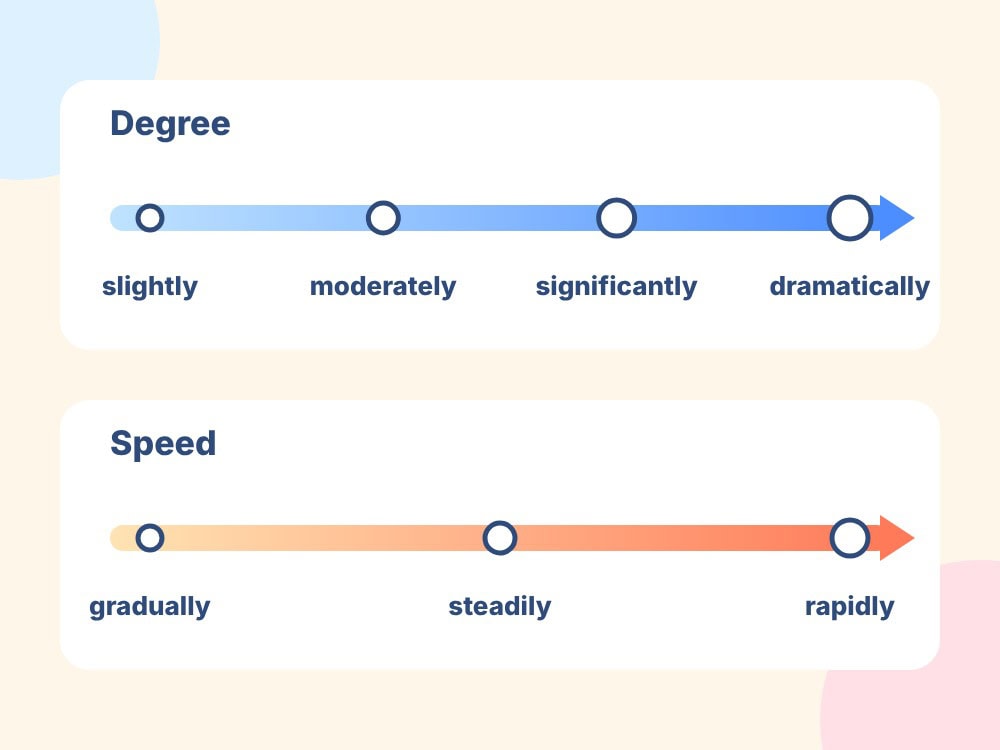
You can make your descriptions more precise by combining these verbs with adverbs of degree:
- Slightly: by a small amount.
- Gradually: slowly over time.
- Steadily: at a consistent rate.
- Rapidly: at a fast rate.
- Significantly: by a considerable amount.
- Dramatically: to a very noticeable extent.
These adverbs help communicate how quickly or substantially a figure changes. However, you should always select words that accurately reflect the data rather than exaggerating a trend.

IELTS Writing Task 1 Vocabulary for Describing Downward Trends
Describing a decline is just as important as identifying an increase. The choice of verb should reflect the magnitude and speed of the decrease shown in the chart.
| Vocabulary | Meaning | Usage |
| Decrease | To become smaller | Neutral and widely applicable |
| Decline | To decrease gradually or over time | Suitable for academic descriptions |
| Fall | To move to a lower level | Common in data descriptions |
| Drop | To decrease | Often used for noticeable changes |
| Dip | To decrease slightly or temporarily | Often suggests a short-term decline |
| Plunge | To decrease sharply | Describes a steep fall |
| Plummet | To fall dramatically | Emphasises a very substantial decline |
Example:
The unemployment rate declined gradually from 8% in 2010 to 5% in 2015.
You can also combine these verbs with adverbs to describe the trend more precisely:
- Fall slightly: to decrease by a small amount.
- Decrease gradually: to become lower over time.
- Drop considerably: to decrease by a significant amount.
- Decline steadily: to fall at a consistent rate.
- Plummet sharply: to fall very rapidly and substantially.
Important: Avoid using plunge or plummet when the data shows only a minor decrease. Academic vocabulary should be both varied and accurate.
IELTS Writing Task 1 Vocabulary for Stability and Fluctuations
Not every chart shows a consistent upward or downward trend. Some figures remain almost unchanged, while others fluctuate throughout the period.
Vocabulary for Describing Stability
| Vocabulary | Meaning |
| Remain stable | To stay at a relatively constant level |
| Remain unchanged | To show no change |
| Stay constant | To remain the same |
| Level off | To become stable after a period of change |
| Plateau | To reach a stable level after increasing or changing |
Example:
The percentage of households using landline phones remained relatively stable throughout the period.
These expressions are particularly useful when describing figures that show little variation over time.
Vocabulary for Describing Fluctuations
- Fluctuate: to rise and fall irregularly.
- Vary: to change or differ.
- Experience fluctuations: to undergo a series of changes.
- Fluctuate considerably: to show substantial variations.
- Fluctuate within a narrow range: to change within a limited range.
Example:
The price of oil fluctuated considerably between 2010 and 2015.
When using these expressions, consider the overall pattern before describing individual changes. This helps make your report more organised and easier to follow.
IELTS Writing Task 1 Vocabulary for Peaks, Lows, and Changes
When analysing a chart, you may need to identify the highest or lowest point, describe a significant change, or compare figures across different periods.
Useful expressions include:
| Vocabulary | Meaning |
| Reach a peak | To reach the highest point |
| Peak at | To reach a maximum value of |
| Reach the highest point | To attain the greatest level |
| Hit a low of | To reach a low value of |
| Reach the lowest point | To attain the minimum level |
| Stand at | To be at a particular figure |
| Double | To become twice as large |
| Triple | To become three times as large |
| Halve | To decrease to half the original amount |
Examples:
The figure peaked at 75% in 2018 before declining slightly.
The number of visitors doubled from 10,000 to 20,000 over the period.
Pay attention to the difference between peak at and reach a peak of. Both expressions describe a maximum value, but the figure you report must match the data accurately.
IELTS Writing Task 1 Vocabulary for Different Chart Types
In addition to general trend vocabulary, each IELTS Academic Writing Task 1 question type requires expressions suited to its specific purpose. Learning vocabulary by chart type can help you select the right language more efficiently during the exam.
IELTS Writing Task 1 Vocabulary for Line Graphs and Bar Charts
Line graphs generally illustrate changes over time, whereas bar charts commonly compare figures across categories, groups, or periods.
Useful expressions include:
- Show an upward trend: to indicate an increase.
- Show a downward trend: to indicate a decrease.
- Follow a similar pattern: to display a comparable trend.
- Overtake: to become greater than another figure.
- Remain higher than: to continue at a higher level.
- Witness a significant increase: to experience a substantial rise.
- Record the highest figure: to have the greatest recorded value.
Example:
The figure for online sales overtook that of in-store purchases in 2020.
When describing line graphs, focus on changes over time. For bar charts, prioritise comparisons between categories and highlight the most significant differences rather than listing every figure.
IELTS Writing Task 1 Vocabulary for Pie Charts
Pie charts illustrate proportions or the composition of a whole. Therefore, vocabulary related to percentages, shares, and proportions is particularly important.
| Vocabulary | Meaning |
| Account for | To represent a proportion of the total |
| Make up | To constitute part of a whole |
| Represent | To correspond to a particular share |
| Constitute | To form or make up part of a whole |
| The largest proportion | The greatest share |
| The smallest share | The lowest proportion |
| A minority of | A smaller part of a group |
| A majority of | More than half or the greater part |
| Respectively | In the order already mentioned |
Example:
Housing accounted for the largest proportion of household expenditure, at 40%.
When describing pie charts, focus on the largest and smallest categories, as well as any notable differences between proportions. If two charts are provided, compare how the composition changes over time or between groups.
IELTS Writing Task 1 Vocabulary for Tables
Tables may present data for several categories, locations, or periods. To describe them effectively, you need expressions for comparison, contrast, and numerical differences.
Useful expressions include:
- Compared with: used to compare two figures or groups.
- In comparison with: when examining differences between items.
- Whereas: used to contrast two facts.
- In contrast: used to introduce a contrasting point.
- Exceed: to be greater than a particular amount.
- Be lower than: to have a smaller value.
- Rank first: to occupy the highest position.
- The corresponding figure: the equivalent figure for another group.
- Respectively: in the order previously stated.
Example:
The corresponding figures for France and Germany were 35% and 42%, respectively.
When writing about tables, you do not need to describe every cell. Identify the most noticeable similarities, differences, and changes, then organise them into clear paragraphs.
IELTS Writing Task 1 Map Vocabulary
Map questions require you to describe changes in buildings, infrastructure, land use, and geographical features. Vocabulary related to construction, demolition, and transformation is particularly useful.
| Vocabulary | Meaning |
| Be constructed | To be built |
| Be demolished | To be torn down |
| Be replaced by | To be substituted with something else |
| Be converted into | To be changed into another form or use |
| Be expanded | To be made larger |
| Be relocated | To be moved to another location |
| Be transformed into | To be significantly changed into something else |
| Be situated to the north of | To be located north of a place |
| Be adjacent to | To be next to |
| Be surrounded by | To have something around all sides |
Example:
The old factory was demolished and replaced by a residential complex.
Passive structures are particularly useful in map descriptions because the focus is usually on what happened to a building or area rather than on who carried out the action.
You should also learn directional vocabulary, such as north, south, east, west, and northeast, along with location phrases such as in the centre of, to the left of, and at the intersection of.
IELTS Writing Task 1 Process Vocabulary
Process questions require you to describe a sequence of stages, such as a manufacturing procedure or a natural cycle. Your writing should follow the correct order and use appropriate verbs to explain each stage.
Sequencing expressions:
- Initially: at the beginning.
- First of all: before the other stages.
- Subsequently: after that.
- Following this: after the previous step.
- In the next stage: at the following point in the process.
- Meanwhile: during the same period.
- Finally: at the last stage.
Process verbs:
- Be processed: to undergo a treatment or procedure.
- Be transported: to be moved from one place to another.
- Be packaged: to be placed in packaging.
- Be assembled: to be put together.
- Be converted into: to be changed into another form.
- Undergo: to experience a process or change.
Example:
Initially, the raw materials are collected. Subsequently, they are transported to a factory for processing.
When describing processes, pay attention to verb tense and voice. Manufacturing processes commonly use the present simple, with passive constructions when the materials or products are more important than the people performing the actions.
How to Use IELTS Writing Task 1 Vocabulary to Improve Lexical Resource
Knowing a large number of words does not automatically guarantee a high IELTS Writing score. You need to combine vocabulary knowledge with accurate data interpretation, clear sentence construction, and effective proofreading.
Learn Vocabulary in Phrases Rather Than in Isolation
Instead of memorising only the word increase, learn expressions such as increase significantly, a gradual increase, and an increase in sales. This helps you understand common word combinations and use them more naturally in your writing.
You can create a vocabulary notebook organised by function, such as trends, comparisons, proportions, locations, and processes. Include a definition and an example sentence for each expression.
Understand Meaning and Context
Synonyms are not always interchangeable. For example, soar typically describes a dramatic increase, while rise slightly is appropriate for a minor change.
Choosing a word that accurately reflects the data is more important than trying to use sophisticated vocabulary. Avoid using unfamiliar expressions unless you understand their meaning, grammatical structure, and typical context.
Practise Writing with Real Data
After learning a vocabulary group, choose a chart and write three to five sentences describing its main features. Try expressing the same trend in different ways, then check whether each sentence accurately represents the figures.
For example, you could describe an upward trend using increase, rise, or climb, provided the chosen word reflects the nature of the change.
Review Vocabulary and Correct Your Mistakes
Create topic-based vocabulary lists and review them regularly. When practising IELTS Writing Task 1, check your word choice, spelling, word forms, prepositions, and collocations before submitting your work.
To work towards band 6.0 or higher, your goal should not be to use as many difficult words as possible. Instead, focus on accuracy, appropriate word choice, and variety. Combined with clear organisation and sound grammar, a strong vocabulary foundation can help you produce more effective IELTS Academic Writing Task 1 responses.
Frequently Asked Questions About IELTS Writing Task 1 Vocabulary
Should I Learn IELTS Writing Task 1 Vocabulary by Chart Type?
Yes. Organising vocabulary into Line Graphs, Bar Charts, Pie Charts, Tables, Maps, and Processes helps you choose expressions that suit each question type and avoid inappropriate word choices.
Do I Need Difficult Vocabulary to Achieve Band 6.0+?
No. You should prioritise accurate, natural, and context-appropriate vocabulary. Using rare words incorrectly can weaken your writing rather than improve your score.
How Can I Avoid Repetition in IELTS Writing Task 1?
Learn synonyms by function and practise using them in complete sentences. For example, increase, rise, and climb can describe upward trends, but you should consider their nuances and the magnitude of the change before choosing one.
Keywords:
- IELTS Academic Writing Task 1 Vocabulary
- IELTS Writing Task 1 Pie Chart Vocabulary
- IELTS Writing Task 1 Table Vocabulary
- IELTS Writing Task 1 Map Vocabulary
- IELTS Writing Task 1 Line Graph Vocabulary
