
Are you struggling with your writing skills and unsure what examiners look for in your responses? Understanding the IELTS Writing assessment criteria is a crucial first step towards developing the right learning strategy.
If you simply focus on writing without understanding the rules, you may easily fall into the traps of going off-topic or using an inappropriate language style.
This article will break down the scoring criteria in detail to help you optimise your writing performance.
Overview of the Current IELTS Writing Band Score System
Before exploring the details, you need to understand the basics of the IELTS Writing band score system. This section is assessed on a scale from 0 to 9.0 for both Task 1 and Task 2.
Examiners assess each task separately based on specific requirements. The final Writing band score is calculated using a weighted formula.
Task 2 accounts for 66.6% of the overall Writing score, while Task 1 accounts for the remaining 33.3%. Therefore, you need to allocate your time appropriately to both writing tasks.

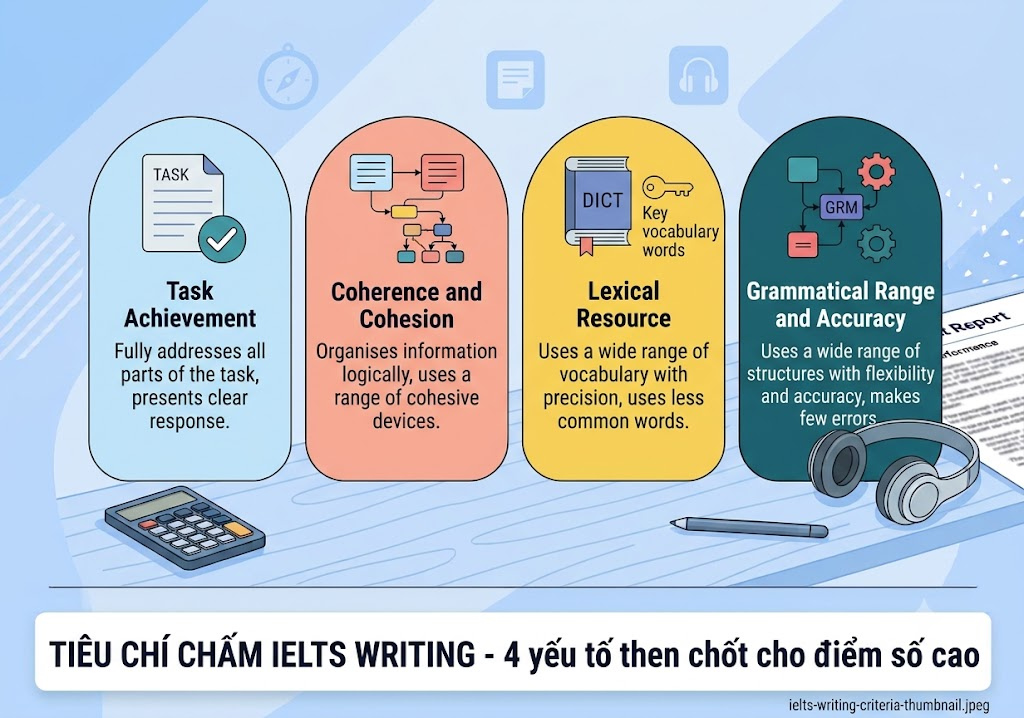
The 4 Core IELTS Writing Assessment Criteria You Need to Know
The IELTS test providers apply four IELTS Writing assessment criteria with equal weighting, with each criterion accounting for 25% of the score.
[Image 1: Diagram illustrating the weighting of the four IELTS Writing assessment criteria]
Understanding each criterion will help you identify which areas you need to focus on to improve your score.
Task Achievement / Task Response (Addressing the Task Requirements)
For Task 1, this criterion assesses your ability to select and report key data. You need to provide a clear overview and avoid including personal opinions.
For Task 2, you must fully address every part of the question. Your arguments should be developed logically and supported by convincing evidence.
Coherence and Cohesion (Organisation and Logical Flow)
This criterion focuses on how you organise information and structure your paragraphs. Your writing should flow naturally and be easy to follow.
You should use linking words flexibly, avoiding repetition or excessive use that makes your sentences sound unnatural.
Lexical Resource (Vocabulary)
Examiners assess the range and accuracy of the vocabulary you use. Using collocations naturally and appropriately can help you achieve a higher score.
However, controlling spelling and word-form errors is equally important to avoid losing valuable points.
Grammatical Range and Accuracy (Variety and Accuracy of Grammar)
You need to combine simple, complex and compound sentences effectively in your writing.
At the same time, minimising errors involving tenses and subject–verb agreement is essential for achieving a high band score.
Detailed IELTS Writing Task 1 Assessment Criteria
Task 1 requires a high level of academic accuracy when reporting the information provided in the question.
Each type of visual, such as a line graph, bar chart or map, requires a different approach.
Read more: Strategies for Analysing Chart Data Quickly in IELTS
How to Achieve a High Task Achievement Score in Task 1
You must include an overview paragraph highlighting the general trends or the most prominent features.
Without this section, your writing will generally struggle to achieve a score above Band 5.0 for the first criterion.
Managing Data and Comparing Information
You do not need to list every figure shown in the question. Instead, group similar data and make comparisons.
Selecting three to five key, representative figures is an effective way to keep your writing coherent.
Detailed IELTS Writing Task 2 Assessment Criteria
Task 2 requires in-depth argumentation skills and the ability to express your perspective clearly.
[Image 2: Key factors for optimising your IELTS Writing Task 2 score]
As this task contributes the majority of your Writing score, it requires careful preparation and considerable effort.
Building a Consistent Argument for Your Essay
To meet the IELTS Writing Task 2 assessment criteria effectively, you need to maintain a consistent position from the introduction to the conclusion.
Each body paragraph should focus on just one central idea to avoid confusing the reader.
Developing Ideas and Providing Supporting Examples
A strong argument always needs detailed explanations and practical examples.
Your examples do not need to be particularly broad or complex. They simply need to be relevant and clarify the point you have just made.

Common Mistakes to Avoid Losing Marks
Many candidates fail to achieve high scores despite having a strong vocabulary because they make basic mistakes related to the IELTS Writing assessment criteria.
The first mistake is failing to meet the minimum word count: fewer than 150 words for Task 1 and fewer than 250 words for Task 2. This may result in a lower score under Task Achievement or Task Response.
The next mistake is copying the question verbatim into the introduction without paraphrasing it. Examiners do not count words copied directly from the question towards the total word count of your response.
Finally, overusing academic linking words at the beginning of sentences in an unnatural way can also make your writing sound less fluent and natural.
A thorough understanding of the IELTS Writing assessment criteria is the key to shortening your journey towards your target band score. Instead of memorising model essays, focus on developing logical thinking, expanding your topic-specific vocabulary and maintaining accurate grammatical structures. Start practising today to see clear improvements in your writing.
Frequently Asked Questions
Which task do examiners mark first in the Writing test?
In practice, examiners may mark either task first because Task 1 and Task 2 are assessed independently using separate scoring criteria. The score for one task does not affect the other. However, since Task 2 accounts for 66.6% of the overall Writing score, candidates are generally advised to prioritise Task 2 during the exam to maximise their performance.
Will I lose marks if I write more than the required word count?
There is no maximum word limit specified for the test, so you will not be penalised directly for writing more than the minimum requirement. However, writing excessively can make time management difficult and prevent you from completing your response. A longer essay also increases the likelihood of spelling and grammatical errors and may weaken the logical flow of your arguments.
Which of the four criteria is the most important?
No single criterion is the most important because all four carry equal weighting, each contributing 25% of the score for each writing task. Examiners assess your ability to address the task, organise your ideas coherently, use vocabulary effectively and demonstrate grammatical accuracy. Candidates should develop all four areas rather than focusing on just one to optimise their target band score.
Keywords:
- IELTS Writing assessment criteria
- IELTS Writing Task 1 assessment criteria
- IELTS Writing Task 2 assessment criteria
- IELTS Writing assessment criteria
- IELTS Writing band score system
- 4 IELTS Writing assessment criteria
