

IELTS preparation involves more than completing practice tests. It requires a combination of English language development, test-taking strategies, and consistent practice across Listening, Reading, Writing, and Speaking.
To achieve your target band score, you need a study plan that reflects your current English level, available study time, and reasons for taking the test. Rather than immediately completing full-length practice tests, start by identifying your weaknesses, strengthening essential language skills, and building effective study habits.
Once you have a solid foundation, regular practice tests can help you become familiar with the exam format, manage your time, and identify areas for improvement.
This guide explains how to prepare for IELTS, develop each of the four skills, choose suitable study materials, and create a practical study plan for beginners and intermediate learners.
Choose the Right IELTS Preparation Strategy
Understand the Difference Between IELTS Academic and General Training
Before beginning your IELTS preparation, determine whether you need IELTS Academic or IELTS General Training. Both tests include Listening, Reading, Writing, and Speaking, but their Reading and Writing sections differ.
IELTS Academic is commonly taken by people applying to universities, postgraduate programs, or certain professional organizations. IELTS General Training is often used for migration, employment, or educational purposes where this test format is accepted.
Choosing the correct test helps you select relevant study materials and focus on the appropriate question types. If you need IELTS for an application, check the requirements of the institution, employer, or receiving organization before booking your test.
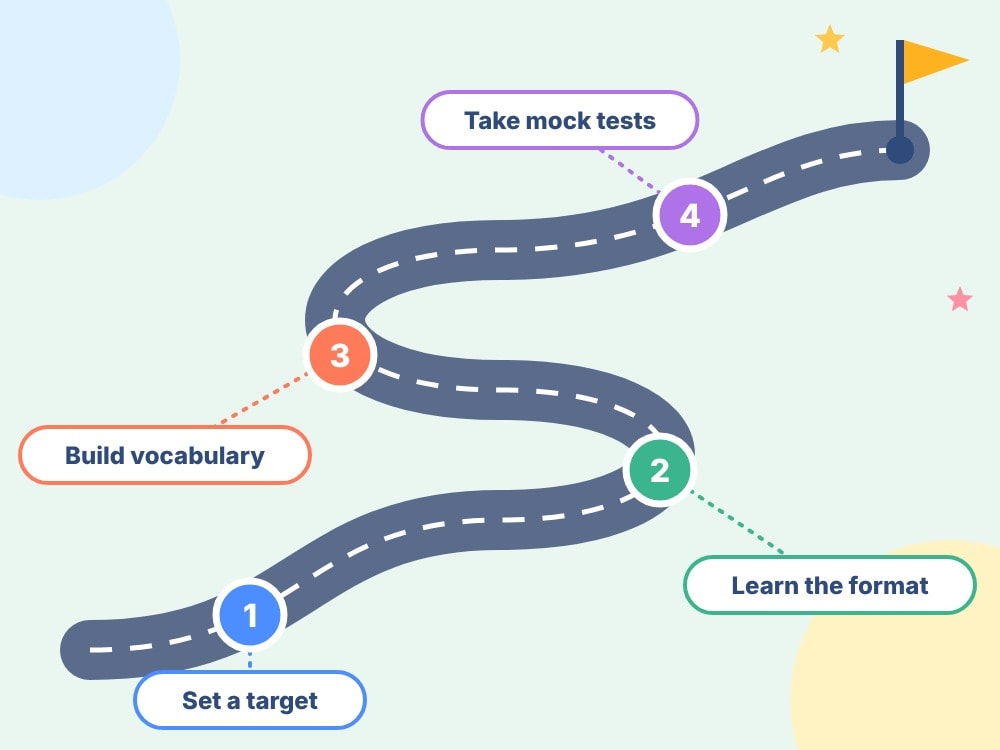
Assess Your Current Level and Set a Target Band Score
An effective IELTS study plan begins with an assessment of your current English proficiency. You can take a placement test or complete a full IELTS practice test to evaluate your Listening, Reading, Writing, and Speaking skills.
Next, establish a realistic target band score and a tentative preparation timeline. For example, someone aiming for an overall band score of 6.5 will need a different study strategy from someone targeting 7.5, especially if their starting levels differ considerably.
Review your performance in each skill rather than focusing exclusively on your overall score. If Listening and Reading are relatively strong but Writing needs improvement, allocate more time to writing practice and essay development.
Build an IELTS Study Plan Based on Your Level
Stage One: Strengthen Your English Foundations
If you are a beginner or have limited English proficiency, focus on fundamental language skills before moving on to intensive IELTS test preparation.
Prioritize the following areas:
- Grammar: Learn essential tenses, sentence structures, clauses, and conjunctions.
- Vocabulary: Study topic-based words, parts of speech, common collocations, and contextual usage.
- Pronunciation: Practice word stress, connected speech, and sound recognition.
- Listening and Reading: Begin with short materials suited to your current level.
- Speaking and Writing: Practice expressing ideas through complete, clear, and grammatically accurate sentences.
Avoid memorizing too many new words in a single study session. Instead, learn a manageable number of words, review them regularly, and use them in your own sentences. This approach can improve long-term retention and help you apply vocabulary more effectively in the IELTS test.
Stage Two: Develop IELTS Test-Taking Skills
Once your English foundation is reasonably strong, begin practicing individual IELTS question types. Working on specific tasks allows you to understand the instructions, recognize common question patterns, and develop appropriate problem-solving strategies.
For Listening and Reading, practice identifying key information, recognizing paraphrases, and managing your time. For Writing and Speaking, focus on developing ideas, using accurate language, and organizing your responses logically.
After each study session, record your recurring mistakes. If you consistently struggle with a particular question type, investigate the underlying problem instead of simply completing more exercises.
Stage Three: Practice Full-Length Tests
When you are familiar with the main question types, start completing practice tests under conditions similar to the actual examination.
Full-length IELTS mock tests help you evaluate your time management, concentration, and ability to handle challenging questions.
After each test, analyze both correct and incorrect answers. A correct answer based on a guess does not necessarily mean you understand the question. Similarly, identifying the reason for a wrong answer can help you improve your study strategy.
Gradually progress from individual exercises to complete practice tests. Avoid completing too many tests in a short period if you do not have enough time to review your answers and reinforce the relevant knowledge.
How to Improve the Four IELTS Skills
IELTS Listening: Improve Comprehension and Accuracy
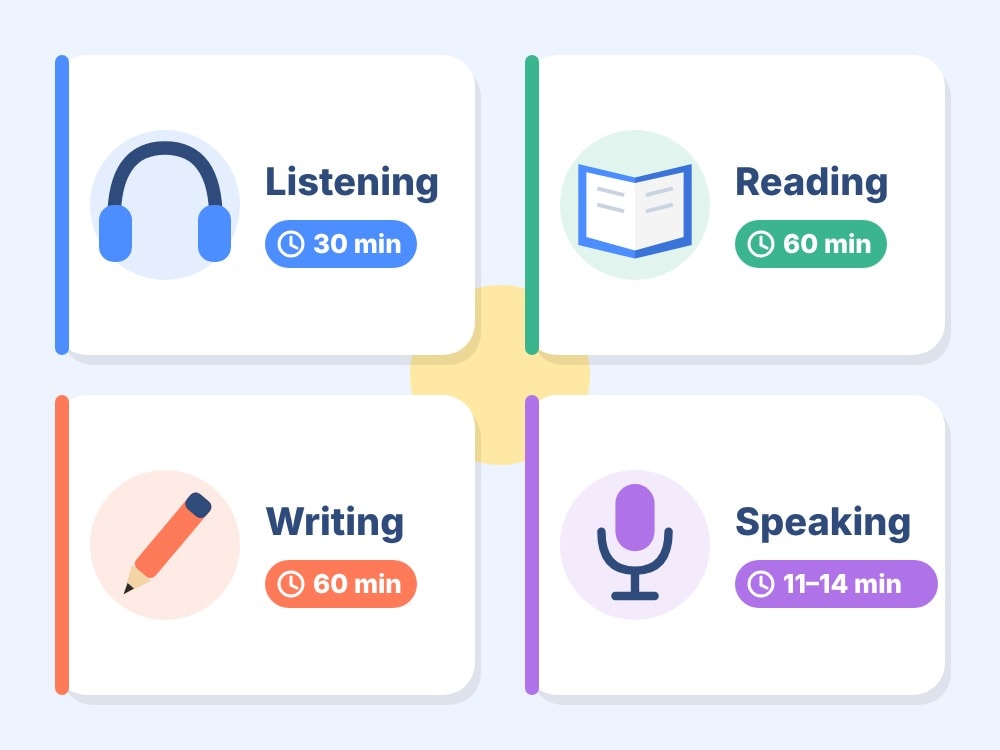
IELTS Listening consists of four parts and 40 questions. Each recording is played once, so test takers must listen carefully, follow the questions, and identify the required information accurately.
Before the recording begins, read the questions and predict the type of information you need to identify, such as names, numbers, locations, or specific characteristics.
While listening, pay attention to paraphrases. The recording may communicate the same meaning using different words from those in the questions.
After completing a practice exercise, check your answers and replay the sections you found difficult. Reading the transcript can help you identify unfamiliar vocabulary, connected speech, and the reasons you missed important information.
An effective Listening session should do more than improve your number of correct answers. It should also help you determine whether your difficulties come from vocabulary gaps, pronunciation recognition, or a lack of concentration.
IELTS Reading: Improve Reading Speed and Accuracy
IELTS Reading tests your ability to understand written information and answer different question types within a limited time.
To improve your performance, learn when to read quickly for general understanding and when to search for specific details.
Skimming helps you identify the main topic, key ideas, and overall structure of a passage. Scanning helps you locate names, figures, technical terms, and details related to a particular question. Use these techniques flexibly rather than applying the same approach to every task.
Common IELTS Reading question types include Multiple Choice, Matching Headings, True/False/Not Given, and Sentence Completion.
Each question type requires a different approach. In particular, you need to understand the difference between information that contradicts the passage and information that is not mentioned.
During IELTS Reading practice, record useful synonyms, paraphrases, and expressions from the passages. These can also help expand your vocabulary for Writing and Speaking.
IELTS Writing: Develop Ideas and Clear Arguments
Writing requires regular practice because you must produce your own responses rather than select answers from a list.
In IELTS Academic Writing Task 1, you describe visual information such as charts, tables, graphs, or processes. In IELTS General Training, Task 1 requires you to write a letter. Task 2 in both test formats requires an essay responding to a given topic.
IELTS Writing is assessed using four criteria: Task Achievement or Task Response, Coherence and Cohesion, Lexical Resource, and Grammatical Range and Accuracy.
Before writing, identify the task requirements, select your main ideas, and organize them logically. Each body paragraph should focus on a central point supported by relevant explanations or examples.
After completing your essay, check whether you have answered the question directly, connected your ideas effectively, and avoided significant grammatical errors.
Do not use complicated vocabulary simply to make your writing sound more advanced. Accurate word choice and appropriate usage are more important than unnecessary complexity.
IELTS Speaking: Speak More Naturally and Confidently
IELTS Speaking consists of three parts and evaluates your ability to communicate, develop ideas, and use English effectively.
In Part 1, answer the question directly before adding relevant details. In Part 2, practice making brief notes and organizing your response into a coherent account with a clear beginning, main points, and ending. Part 3 requires you to explain opinions, analyze causes, or compare different aspects of a topic.
You can practice by recording your answers and listening to them afterward. This helps you identify hesitation, pronunciation problems, and inappropriate word choices.
Practicing with a partner or teacher can also help you become more comfortable with spontaneous questions and follow-up discussions.
Instead of memorizing complete model answers, build topic-based vocabulary and learn how to develop ideas flexibly. This will help you respond more naturally when the actual questions differ from those you have practiced.
How to Choose IELTS Preparation Materials
Your study materials should match your current level, target band score, and stage of preparation. Using too many resources simultaneously can waste time and make it difficult to follow a consistent learning approach.
Consider organizing your resources into three categories.
Foundation materials: These help you develop grammar, vocabulary, pronunciation, and basic listening and reading comprehension.
Skill-specific practice materials: These contain exercises organized by question type, allowing you to understand task requirements and practice relevant strategies.
IELTS mock tests: These help you assess your progress, become familiar with the test format, and evaluate your time management.
Prioritize reliable resources with answer keys, clear explanations, and accurate information. For Writing and Speaking, seek feedback from a qualified teacher or knowledgeable evaluator who can explain how your responses align with the assessment criteria.
You can also maintain a notebook or digital progress tracker to record new vocabulary, recurring mistakes, and practice results. This simple habit helps you monitor your learning without constantly switching between resources.
How to Prepare for IELTS at Home With a Busy Schedule
Self-study can be a practical option for students and working professionals when study time is organized effectively. You do not need to spend several uninterrupted hours on a single skill every day. Consistency and review are more important than following an unnecessarily demanding schedule.
You can use the following daily study plan as a starting point.
| Study activity | Suggested time |
| Listening practice | 25–30 minutes |
| Reading practice | 30 minutes |
| Writing or Speaking | 30–45 minutes |
| Vocabulary and grammar | 15–20 minutes |
| Error review | 10–15 minutes |
This is a flexible example rather than a mandatory schedule. If you only have around one hour per day, alternate between skills across different sessions. For instance, focus on Listening and vocabulary on one day, then practice Reading and Writing the next day.
At the end of each week, review the material you have studied and complete a short assessment. After a suitable period, take a full-length mock test to evaluate your progress.
If you are studying independently, make an effort to obtain feedback on your Writing and Speaking. These skills can be difficult to assess accurately by comparing your work with sample answers alone.
Common IELTS Preparation Mistakes to Avoid
Certain study habits can make your preparation less effective, even when you spend considerable time studying.
Focusing only on practice tests: Completing more tests does not guarantee improvement if you do not analyze your mistakes.
Learning vocabulary without context: Memorizing definitions without understanding collocations and usage can lead to errors in Writing and Speaking.
Ignoring weaker skills: Practicing only the sections you already perform well in can make it difficult to improve your overall performance.
Memorizing model answers: This approach can limit your ability to develop ideas independently and may make your responses sound unnatural.
Failing to track progress: Without recording your results, you may struggle to identify whether your current study methods are working.
To avoid these problems, set weekly goals, track recurring errors, and adjust your study schedule according to your results. When necessary, reduce the number of practice tests and spend more time strengthening the underlying skills you need to improve.
Start Your IELTS Preparation With a Clear Plan
Improving your IELTS performance requires a combination of English language development, four-skill practice, and regular progress assessment. Begin by evaluating your current level, setting a target band score, and choosing suitable study materials instead of following a study schedule designed for someone else.
Whether you study independently or attend an IELTS preparation course, consistent practice, careful error analysis, and timely feedback can help you use your study time more effectively.
Once you have developed a strong foundation and understand the main test-taking strategies, gradually increase the intensity of your practice tests to prepare for the actual examination.
Frequently Asked Questions About IELTS Preparation
Where should I start with IELTS preparation?
Start by choosing the appropriate test format, assessing your current English level, and setting a target band score. If your foundation is weak, focus on grammar, vocabulary, and pronunciation before moving on to intensive IELTS practice.
Can I prepare for IELTS at home?
Yes. You need a clear study plan, suitable materials, and a way to monitor your progress. For Writing and Speaking, feedback from a qualified teacher or knowledgeable evaluator can help you identify errors and improve your responses.
How long does it take to prepare for IELTS?
The preparation time depends on your starting level, target band score, daily study time, and rate of progress. Assess your current abilities before setting a realistic preparation timeline.
Is intensive IELTS preparation suitable for beginners?
Intensive preparation may be appropriate for learners who already have a reasonable English foundation and need to focus on test-taking strategies within a limited period. Beginners and learners with very limited English proficiency should generally strengthen their foundations before increasing the intensity of their practice.
How can I measure my IELTS preparation progress?
Record your mock test results, recurring mistakes in each skill, and feedback on your Writing and Speaking. Comparing these results over time helps you identify strengths, weaknesses, and areas that require further practice.
Related Keywords
- IELTS Listening
- IELTS Reading
- IELTS Writing
- IELTS Speaking
- IELTS band score
