

IELTS Band 8.5 is an exceptionally high score on the IELTS nine-band scale. It indicates that a test taker can use English effectively across a wide range of academic, professional, and everyday situations. Achieving this score requires more than memorizing vocabulary or mastering grammar rules. Candidates must demonstrate strong listening comprehension, advanced reading skills, well-developed writing abilities, and fluent spoken communication.
So, what knowledge do you need to achieve IELTS Band 8.5? How well must you perform in each skill, and what is the most effective way to prepare for this goal? Understanding these requirements can help you develop a focused study plan, identify weaknesses, and make better use of your preparation time.
What Does IELTS Band 8.5 Mean?
IELTS uses a nine-band scale to report English proficiency, with scores ranging from Band 1 to Band 9. Candidates receive an overall band score as well as individual scores for Listening, Reading, Writing, and Speaking.
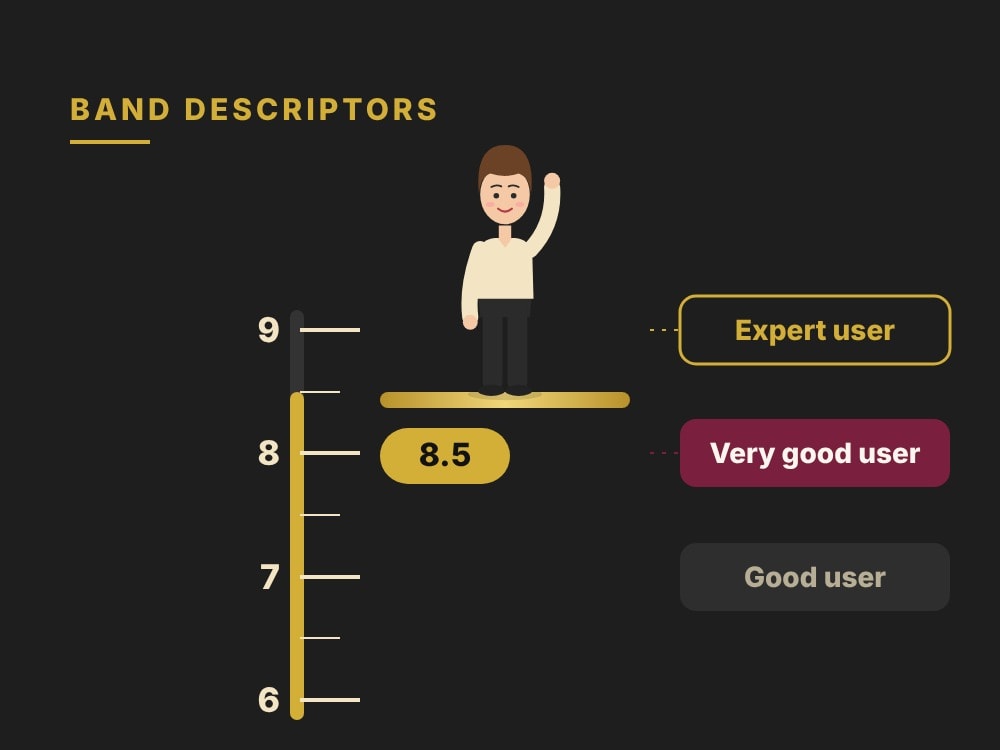
According to the official IELTS band descriptors, Band 8 represents a Very Good User, while Band 9 represents an Expert User. IELTS Band 8.5 therefore falls near the top of the scoring scale and reflects a very high level of English proficiency.
Candidates at this level can generally understand complex information, recognize subtle differences in meaning, and communicate ideas accurately in a variety of contexts. However, a high score does not mean that a candidate never makes mistakes. What matters is the ability to use English effectively, maintain consistency, and avoid errors that interfere with communication.
Is IELTS Band 8.5 Difficult to Achieve?
The difficulty of achieving IELTS Band 8.5 depends on your current proficiency, study habits, and preparation time.
Candidates already scoring around Band 7.0 may need to focus on improving accuracy, developing more sophisticated arguments, and correcting recurring mistakes. Those at Band 5.0 or Band 6.0 generally need to strengthen their language foundations before moving on to advanced exam practice.
The difference between Band 8.0 and Band 8.5 is not simply the amount of knowledge a candidate possesses. At this level, learners must apply their knowledge appropriately, process information efficiently, and maintain a consistently high standard across the test.
How Are IELTS Band 8.5 Scores Calculated?
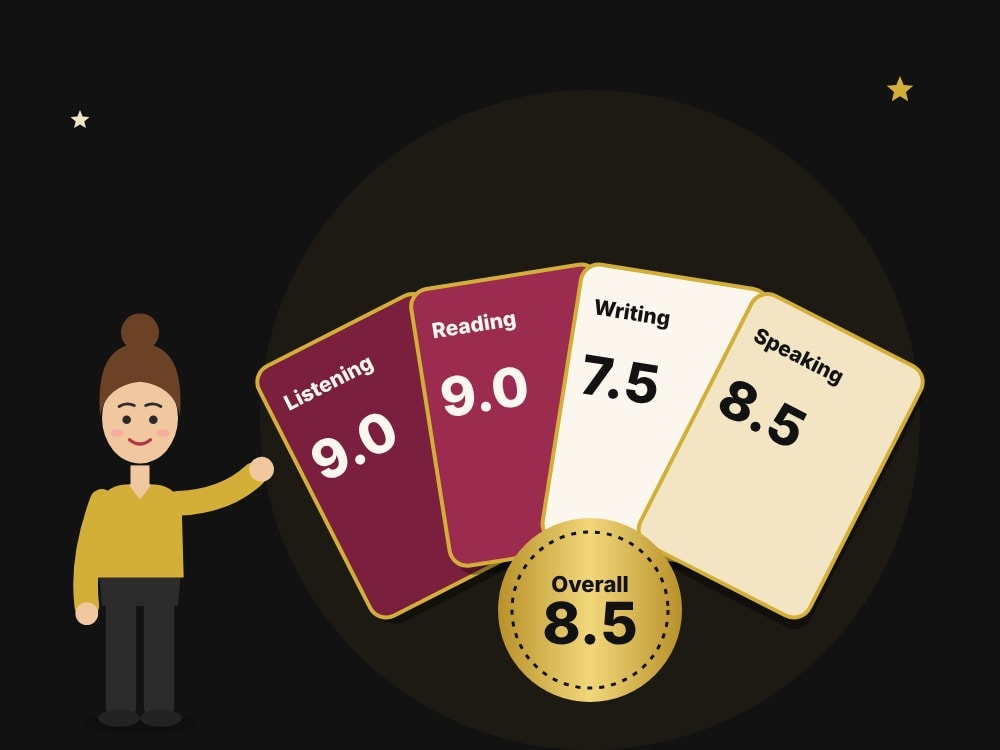
The IELTS overall band score is calculated from the average of the four individual skill scores. The result is then rounded according to IELTS scoring rules. Therefore, candidates do not necessarily need to achieve Band 8.5 in every skill to obtain an overall score of 8.5.
For example, a hypothetical score profile might look like this:
- Listening: 9.0
- Reading: 9.0
- Writing: 8.0
- Speaking: 8.0
The average of these scores is 8.5, giving the candidate an overall band score of 8.5.
However, some universities, employers, and professional organizations require minimum scores in individual skills. An overall score of 8.5 may not be sufficient if one section falls below a specific requirement.
How to Set a Realistic IELTS Band 8.5 Target
Before creating a study plan, take a full practice test covering all four skills. This will help you identify your strengths, weaknesses, and the areas that require the most attention.
For instance, if your Listening and Reading scores are already around 8.5 but your Writing score is only 6.5, spending most of your study time on listening and reading exercises may not be the most productive approach.
Instead, prioritize essay development, paragraph organization, grammatical accuracy, and vocabulary use. Targeted practice can help you address the weaknesses that are preventing you from reaching your desired overall score.
What Knowledge Do You Need for IELTS Band 8.5?
Achieving IELTS Band 8.5 requires a combination of strong language knowledge and practical communication skills. The following areas deserve particular attention during preparation.
Advanced Vocabulary and Natural Collocations for IELTS Band 8.5
A broad vocabulary helps candidates understand complex texts and express ideas precisely. However, learning as many difficult words as possible is not the main objective. You also need to understand meaning, connotation, context, and common word combinations.
For example, rather than memorizing the word significant in isolation, learn expressions such as a significant impact, a significant increase, and play a significant role. Studying vocabulary in context makes it easier to use expressions naturally in both Writing and Speaking.
Important areas to study include:
- Academic vocabulary related to education, technology, health, the environment, and society.
- Collocations and common word combinations.
- Paraphrasing techniques that preserve the original meaning.
- Synonyms and differences in meaning or tone.
- Vocabulary appropriate for academic writing and everyday communication.
You should also maintain a vocabulary notebook based on mistakes made during practice tests. This approach allows you to focus on words and expressions that are directly relevant to your learning needs.
Grammar Accuracy and Complex Sentence Structures
Grammar is essential for communicating ideas clearly, especially when discussing complex topics. Candidates aiming for IELTS Band 8.5 should be able to use a variety of grammatical structures without making their sentences unnecessarily complicated.
Useful areas to review include conditional sentences, relative clauses, passive constructions, concessive clauses, adverbial clauses, and the effective combination of simple and complex sentences.
At the same time, do not overlook basic grammatical errors involving articles, prepositions, subject–verb agreement, and verb forms. Repeated mistakes can affect the accuracy of your responses, even when your ideas are strong.
An effective method is to record incorrect sentences, identify the reason for each mistake, and rewrite them correctly. You can then use the corrected structures in a paragraph or Speaking response to reinforce what you have learned.
Critical Thinking and Argument Development
IELTS assesses not only language proficiency but also your ability to process information and communicate ideas logically. Critical thinking is particularly important in Writing Task 2 and Speaking Part 3.
When responding to a question, identify your main position, explain your reasoning, develop your argument, and provide a relevant example when appropriate. Your ideas should connect logically rather than repeat the same point in different words.
To develop this skill, read English-language articles that discuss social, educational, or environmental issues. Summarize the author’s main arguments and explain whether you agree or disagree with them.
This activity can strengthen your Reading comprehension while helping you develop more convincing arguments in Writing and Speaking.
IELTS Band 8.5 Requirements for All Four Skills
Listening: Understanding Details and Recognizing Paraphrases
The IELTS Listening test contains 40 questions. To achieve a high score, candidates need to follow information throughout a recording, recognize paraphrased expressions, and identify important details accurately.
One common difficulty is recognizing a keyword but failing to understand an equivalent expression used in the recording. Distractors, self-corrections, and closely related pieces of information can also lead to incorrect answers.
Practice listening to different English accents, including British, Australian, New Zealand, and North American varieties. After completing a practice test, review your answers, replay the sections you found difficult, and consult the transcript to identify the source of each mistake.
Rather than simply increasing the number of practice tests, focus on understanding why an answer is correct and why the alternatives are incorrect. This habit helps you develop more reliable listening strategies.
Reading: Reading Quickly and Understanding Complex Arguments
The IELTS Academic Reading test contains 40 questions and lasts 60 minutes. The passages may include academic information, detailed arguments, and different expressions of the same idea.
To work toward IELTS Band 8.5, develop a combination of reading strategies. Use skimming to understand the main idea, scanning to locate specific information, and careful reading to examine relationships between arguments.
Question types such as True/False/Not Given, Matching Headings, and Matching Information require you to distinguish between explicitly stated facts and information that must be inferred. Searching only for identical keywords in the question and passage can lead to mistakes.
Practice reading under timed conditions and record your incorrect answers by question type. When reviewing a test, locate the relevant evidence in the passage and explain how it supports your answer.
Writing: Developing Logical Arguments and Using Accurate Language
Writing can take considerable time to improve because candidates must meet several assessment criteria simultaneously. These include task achievement or task response, coherence and cohesion, lexical resource, and grammatical range and accuracy.
For Academic Writing Task 1, you need to select relevant data, describe trends, and compare significant features. For Task 2, your essay must address the question fully, develop a clear position, and maintain logical connections between paragraphs.
To improve your writing, focus on the following areas:
- Address every part of the question.
- Support each main argument with clear explanations.
- Use precise vocabulary and avoid unnecessary repetition.
- Combine simple and complex sentences naturally.
- Check grammar, spelling, and punctuation before finishing.
Avoid forcing rare words or complicated structures into every sentence. A clear essay with convincing arguments and accurate language is more effective than a complicated essay that sounds unnatural.
Regular feedback is also valuable. A qualified teacher can help you identify recurring problems, assess your writing against IELTS criteria, and suggest specific improvements.
Speaking: Fluency, Pronunciation, and Flexible Communication
The IELTS Speaking test is assessed using four criteria: Fluency and Coherence, Lexical Resource, Grammatical Range and Accuracy, and Pronunciation.
Candidates aiming for IELTS Band 8.5 need to communicate ideas smoothly, develop responses logically, choose appropriate vocabulary, and use grammar accurately. Clear pronunciation, effective word stress, and natural intonation also contribute to successful communication.
Practice answering familiar questions before moving on to more abstract topics. Instead of giving very short responses, explain your opinions and expand on your ideas with relevant details.
Recording your answers is a useful self-study technique. Listen for unnecessary hesitation, repeated words, unclear pronunciation, and grammatical errors. If possible, ask a teacher to evaluate your performance and identify weaknesses that may be difficult to notice independently.
Rather than memorizing complete sample answers, learn how to organize ideas and use flexible expressions. This makes it easier to respond naturally to unfamiliar questions.
How to Create an IELTS Band 8.5 Study Plan
An effective IELTS Band 8.5 study plan should reflect your current level, available study time, and weakest skills. There is no single preparation period that works for every candidate.
Stage One: Assess Your Current English Level
Begin with a full practice test and analyze the results. Identify recurring problems in vocabulary, grammar, listening comprehension, and question interpretation.
If your foundations are still weak, focus on expanding your vocabulary, reviewing essential grammar, and increasing your exposure to English through articles, podcasts, and other suitable learning materials.
Set measurable goals for each skill so that you can track your progress over time.
Stage Two: Improve Individual Skills
Once your foundations are stable, create a focused plan for each IELTS skill.
For Listening and Reading, combine timed practice with detailed answer analysis. For Writing and Speaking, practice regularly and seek specific feedback on language accuracy, organization, and communication.
Allocate more time to the skills that need improvement rather than dividing your study time equally. However, continue practicing all four skills to maintain a balanced level of performance.
Stage Three: Practice Full Tests and Analyze Mistakes
As you approach your target score, complete practice tests under conditions similar to the actual exam. Follow the time limits and practice the procedures required for each section.
After each test, categorize your mistakes and track changes from week to week. For Writing and Speaking, feedback from a qualified teacher or experienced evaluator can help you assess criteria that are difficult to judge independently.
Do not increase the number of practice tests at the expense of reviewing your results. Completing many tests without correcting mistakes can cause the same weaknesses to persist.
What Are the Benefits of IELTS Band 8.5?
IELTS Band 8.5 demonstrates a very high level of English proficiency at the time of testing. Depending on the requirements of the receiving organization, it may support university applications, study-abroad plans, and job applications for positions that require strong English skills.
However, the practical value of the certificate depends on your goals. A university may require an overall score alongside minimum scores in individual skills, while an employer may place greater emphasis on professional communication, email writing, or workplace English.
You should also check the certificate acceptance period specified by the institution. IELTS recommends that organizations generally consider test results valid for two years, although individual policies may differ.
Before taking the test with a target of 8.5, identify how you intend to use your result and confirm the relevant requirements.
Is IELTS Band 8.5 Equivalent to CEFR C2?
IELTS and the Common European Framework of Reference for Languages (CEFR) are different systems for describing language proficiency. CEFR uses levels ranging from A1 to C2, whereas IELTS reports results on a nine-band scale.
IELTS Band 8.5 is within the highest range of IELTS scores and may be referenced against CEFR C2 in certain comparison frameworks. However, the two systems should not be treated as directly interchangeable in every situation.
If you need your score for university admission or employment, consult the official conversion guidance and requirements provided by the receiving organization. This helps you avoid confusion between an IELTS band score and a specific proficiency standard.
Key Steps to Achieving IELTS Band 8.5
Achieving IELTS Band 8.5 requires strong language foundations and the ability to use English accurately in complex situations. Academic vocabulary, advanced grammar, logical reasoning, and effective error analysis all contribute to better performance.
Start by assessing your current level, identifying the skills that limit your overall score, and creating a realistic study plan. As you approach your target, correcting recurring mistakes and maintaining consistent performance become increasingly important.
Focus on purposeful practice rather than simply increasing the amount of material you complete. With a structured approach, regular feedback, and careful progress tracking, you can work toward your target score more effectively.
Frequently Asked Questions About IELTS Band 8.5
Is IELTS Band 8.5 difficult to achieve?
Yes. IELTS Band 8.5 is a very high score that requires advanced English proficiency, a broad vocabulary, and strong accuracy across all four skills. The difficulty depends on your starting level and preparation strategy.
Do I need advanced grammar for IELTS Band 8.5?
Yes. You should be able to use a range of grammatical structures flexibly while minimizing errors involving verb forms, articles, prepositions, and sentence construction. Grammar must also be supported by appropriate vocabulary and natural expression.
Can I achieve IELTS Band 8.5 through self-study?
Yes, self-study can be effective, especially if you already have a strong foundation, suitable resources, and a structured study plan. However, teacher feedback can help you identify weaknesses in Writing and Speaking that are difficult to recognize on your own.
Is it difficult to improve from IELTS Band 8.0 to Band 8.5?
It can be challenging because you are already performing at a high level. Focus on recurring errors, grammatical and lexical precision, and consistency rather than simply completing more practice tests.
Should I memorize Speaking answers to achieve IELTS Band 8.5?
No. Relying on memorized answers can make your responses sound unnatural and limit your ability to adapt to unfamiliar questions. Practice developing ideas, expanding your vocabulary, and using flexible language instead.
How long is IELTS Band 8.5 valid?
IELTS results are generally considered by organizations for two years, but the exact acceptance period depends on the receiving institution. Check the relevant policy before submitting your certificate.
Keywords:
- IELTS Band 8.5
- How to achieve IELTS Band 8.5
- IELTS Band 8.5 study plan
- Vocabulary for IELTS Band 8.5
- IELTS Band 8.5 equivalent to C2
