

IELTS Band 6.0 is a common goal for English learners who want to improve their academic opportunities, prepare for overseas study, or strengthen their professional profiles. This score indicates that a candidate can use English reasonably effectively in many situations, although difficulties may arise when discussing complex topics or expressing ideas with greater precision.
Achieving IELTS Band 6.0 requires more than memorizing vocabulary or practicing sample questions. Learners need to understand the assessment criteria, develop all four language skills, and follow a study plan that matches their current proficiency.
Another common question is how IELTS Band 6.0 compares with TOEIC scores. Understanding the differences between these examinations can help learners choose the right test for their educational or career goals.
This guide explains the meaning of IELTS Band 6.0, its potential benefits, score comparisons, and practical strategies for preparing for the examination.
What Does IELTS Band 6.0 Mean?
According to the IELTS scoring system, Band 6.0 falls within the Competent User category. Candidates at this level can generally understand the main ideas of written texts and conversations and communicate their opinions in English.
However, their performance may vary across individual skills. Someone who performs well in Listening and Reading may still need additional practice to speak fluently or organize a well-developed academic essay.
IELTS Band 6.0 Listening and Reading Requirements
Listening and Reading assess a candidate’s ability to understand spoken and written English. To approach Band 6.0, test takers should be able to identify main ideas, locate relevant details, and handle common question types.
For IELTS Academic, the following approximate raw scores can be used as a reference:
Listening: Approximately 23–25 correct answers out of 40 may correspond to Band 6.0.
Reading: Approximately 23–26 correct answers out of 40 may correspond to Band 6.0.
These figures are estimates rather than guaranteed conversion rules. The number of correct answers required can vary slightly between test versions. IELTS General Training Reading also uses different conversion thresholds from Academic Reading.
To improve performance, learners should record their results after each practice test and identify recurring mistakes. For example, if they frequently struggle with True/False/Not Given questions, they should practice distinguishing between information that is explicitly stated, contradicted, or absent from the passage.
IELTS Band 6.0 Writing Criteria
Writing assesses task achievement or task response, coherence and cohesion, lexical resource, and grammatical range and accuracy.
In IELTS Academic Writing Task 1, candidates describe charts, tables, diagrams, or processes. A clear response should identify the main features, provide an overview, and make relevant comparisons where appropriate.
In Task 2, candidates are expected to address the question, express a position when required, and develop their arguments with explanations and examples.
To work toward Band 6.0, learners should focus on answering the question directly, organizing ideas into logical paragraphs, and using appropriate vocabulary and grammar. Complicated sentence structures are not necessary if they make the response unclear or introduce frequent errors.
A practical approach is to write regularly, review each essay against the official assessment criteria, and maintain a list of recurring mistakes.
IELTS Band 6.0 Speaking Criteria
Speaking is assessed through fluency and coherence, lexical resource, grammatical range and accuracy, and pronunciation.
Candidates working toward Band 6.0 should be able to maintain a conversation, extend their answers, and communicate ideas clearly enough for the listener to follow. Some hesitation and grammatical errors may still occur.
One useful exercise is to record answers to familiar topics, including work, education, family, hobbies, and the local environment. Listening to the recordings helps learners identify unclear pronunciation, unnatural expressions, and unnecessary pauses.
Rather than memorizing complete answers, candidates should practice explaining their ideas naturally and supporting their responses with relevant reasons or examples.

Benefits of Achieving IELTS Band 6.0
The value of IELTS Band 6.0 depends on the requirements of individual universities, educational institutions, and employers. Nevertheless, this score may support several academic and professional goals.
IELTS Band 6.0 for University Admissions
Some universities in Vietnam accept IELTS results as part of combined admission pathways, institution-specific selection schemes, or foreign-language requirements.
The accepted score and additional conditions vary by institution, degree program, and admission year. Applicants should therefore review the official admission announcement before deciding whether their results meet the requirements.
IELTS-related exemptions from English examinations may also depend on the applicable regulations for a particular examination year. Candidates should verify the accepted certificates, minimum scores, validity conditions, and submission procedures through official sources.
IELTS Band 6.0 for Studying Abroad
IELTS Band 6.0 may meet the English-language entry requirements of certain foundation, diploma, or undergraduate programs. However, admission requirements differ considerably between institutions and courses.
Some programs require a higher overall score or specify minimum scores for individual skills. Meeting the English-language requirement also does not guarantee admission, as universities may consider academic qualifications and other application materials.
Before booking a test, learners should check the language requirements of their intended university and program. This helps them determine whether Band 6.0 is sufficient or whether a higher target is necessary.
IELTS Band 6.0 for Career Opportunities
English proficiency can be valuable in fields such as customer service, education, tourism, international trade, and companies that work with overseas partners.
An IELTS result may help demonstrate a candidate’s English-language ability, particularly when a position involves reading documents or communicating with international colleagues.
However, IELTS Band 6.0 alone does not guarantee employment or promotion. Relevant experience, professional knowledge, communication skills, and the specific requirements of a role remain important considerations.
IELTS Band 6.0 Equivalent to TOEIC: Score Comparison
Many learners want to know the IELTS Band 6.0 equivalent to TOEIC score so that they can compare different English examinations.
IELTS and TOEIC were designed for different assessment purposes, meaning that their scores cannot be converted through one universally applicable formula. It is also important to distinguish between TOEIC Listening & Reading and TOEIC tests that assess Speaking and Writing.
The following table provides illustrative comparisons commonly used to understand the approximate relationship between English proficiency scores.
| English Test or Framework | Approximate Reference |
| IELTS | Band 6.0 |
| TOEIC Listening & Reading | Around 600–750 in some comparison tables |
| TOEFL iBT | Around 60–78 in some comparison tables |
| CEFR | Often associated with B2 in certain reference tables |
These figures are indicative only and should not be treated as official, universal score conversions. The relationship between examinations depends on the comparison framework, test version, and skills assessed.
Why IELTS Band 6.0 Is Not Directly Equivalent to a TOEIC Score
Traditional TOEIC Listening & Reading primarily measures the ability to understand spoken and written English, often in workplace and business contexts.
IELTS assesses four skills: Listening, Reading, Writing, and Speaking. Candidates must demonstrate their ability to produce spoken and written language in addition to understanding information.
Consequently, a candidate with a TOEIC Listening & Reading score of 700 may have relatively strong receptive skills but still need additional practice in speaking and writing. The TOEIC result alone cannot establish that the candidate would achieve IELTS Band 6.0.
The appropriate examination depends on your goal. TOEIC may be suitable when an employer specifically requests it, while IELTS may be more relevant for university admissions, overseas study, or situations requiring evidence of four-skill English proficiency.
IELTS Band 6.0 Study Plan for Beginners
The time required to reach IELTS Band 6.0 depends on your starting level, study habits, learning pace, and weekly study hours. A learner with a solid foundation in English will generally need a different plan from someone who is starting almost from scratch.
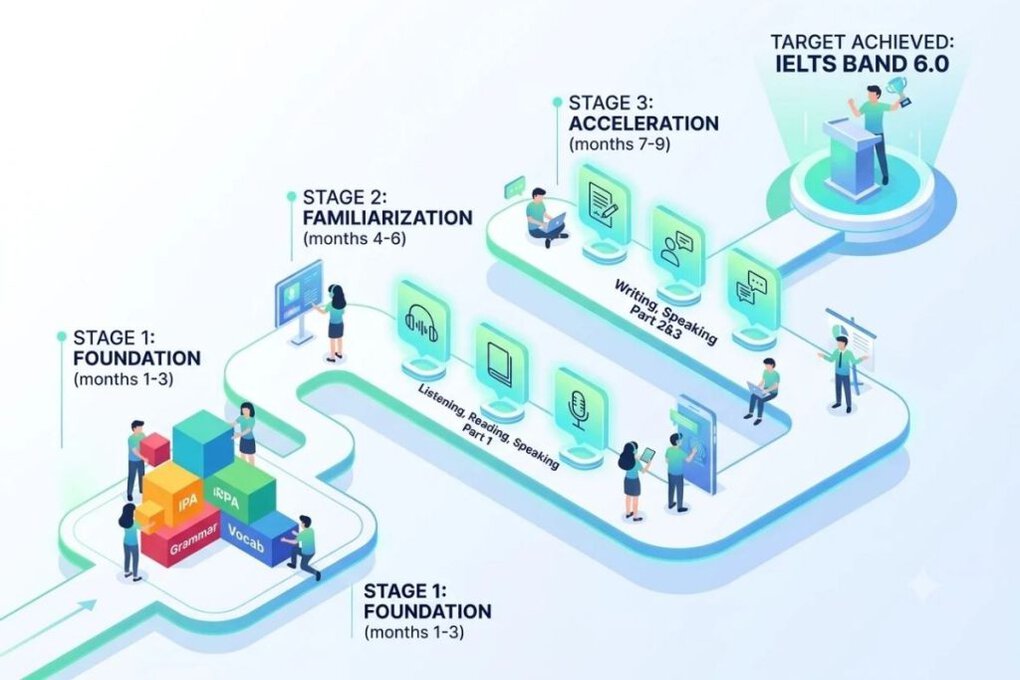
Dividing preparation into three stages can make progress easier to monitor and help you identify what to study next.
| Study Stage | Approximate Target | Main Learning Priorities |
| Foundation building | Beginner to around Band 3.5 | Pronunciation, essential vocabulary, basic grammar, and sentence construction |
| IELTS familiarization | Around Band 3.5–5.0 | Question types, reading strategies, listening practice, essay structure, and basic speaking |
| Skill development | Around Band 5.0–6.0 | Timed practice tests, error analysis, vocabulary development, and targeted skill improvement |
These stages are flexible guidelines rather than fixed deadlines. Your progress should determine when you move to the next stage.
Stage One: Build a Strong English Foundation
At the beginning, focus on knowledge that supports all four IELTS skills. Learn basic pronunciation, word stress, common verb tenses, sentence structures, and frequently used vocabulary.
Vocabulary learning is more effective when new words are studied in context. Instead of memorizing translations alone, review pronunciation, example sentences, common word combinations, and grammatical patterns.
For Listening, start with short conversations and beginner-friendly audio materials. Listen several times, check the transcript, and identify words or expressions that you missed.
The objective of this stage is to develop enough basic knowledge to approach IELTS materials without becoming overwhelmed by unfamiliar language.
Stage Two: Become Familiar With IELTS Question Types
Once you have established a foundation, begin learning the format of each IELTS section and practicing common question types.
For Listening, work on identifying keywords, predicting the information required, and checking spelling. For Reading, practice locating relevant information rather than translating every sentence.
For Writing, learn how to organize paragraphs, construct topic sentences, and develop arguments logically. For Speaking, begin with short answers and gradually add explanations, reasons, and examples.
Reviewing mistakes should be part of every study session. Completing practice questions without understanding why answers are incorrect can limit improvement, even when the amount of practice increases.
Stage Three: Practice Tests and Targeted Improvement
When you understand the main question types, introduce timed practice tests to improve accuracy and time management.
After each test, record your score for every skill and identify the question types that cause the most difficulty. For Writing and Speaking, use the IELTS assessment criteria to review your performance or seek feedback from a qualified teacher.
Do not focus exclusively on skills that improve quickly while neglecting weaker areas. If your Listening and Reading scores are strong but your Writing performance remains below your target, you should dedicate more practice time to writing.
Adjust the plan based on actual results rather than following a fixed timetable regardless of progress.
Practical Tips for Reaching IELTS Band 6.0
A realistic study plan works best when combined with consistent practice and regular review.
Study consistently. Divide your available time into manageable sessions and combine new material with revision. If your schedule is busy, assign different skills to different days.
Practice all four skills. Listening and Reading develop receptive language abilities, while Writing and Speaking require you to produce English independently. A balanced routine helps prevent gaps in your preparation.
Keep an error log. Record recurring vocabulary, grammar, pronunciation, and question-type mistakes. Review this list regularly and check whether the same problems continue to appear.
Use practice tests strategically. You do not need to complete full tests every day. Focus on one area that needs improvement, practice it systematically, and use similar questions to evaluate your progress.
Choose materials appropriate to your level. Beginners should strengthen their foundations before moving to more demanding IELTS practice tests. Reliable learning resources and official IELTS materials can help you understand the test format and assessment standards.
Practice under realistic conditions. As your skills improve, complete timed exercises and full practice tests. This helps you become familiar with the pressure of the examination and identify time-management problems.
IELTS Band 6.0 is a goal that can be approached through structured learning, measurable progress, and consistent practice. By understanding the requirements of each skill and adapting your study plan to your results, you can prepare more effectively for the examination and make an informed decision about when to take it.
Frequently Asked Questions About IELTS Band 6.0
What CEFR Level Is IELTS Band 6.0?
IELTS Band 6.0 is often associated with B2 in certain comparison frameworks. However, mapping an IELTS score to another proficiency framework depends on the reference system being used. Official requirements should take precedence when a school, employer, or organization specifies an accepted qualification.
Is IELTS Band 6.0 a High or Low Score?
Band 6.0 indicates that a candidate can use English reasonably effectively in many situations. There may still be limitations in vocabulary, grammatical accuracy, or the ability to discuss complex subjects. Whether the score is sufficient depends on the candidate’s academic or professional objective.
How Long Does It Take to Reach IELTS Band 6.0?
The preparation period varies according to your current English level, study schedule, and learning needs. Learners with an existing foundation may progress differently from beginners. Taking a diagnostic test is a useful first step toward estimating the time required.
Can IELTS Band 6.0 Be Used for University Admissions?
Some universities accept this score for particular admission pathways or language requirements. Acceptance depends on the institution, degree program, admission year, and any additional conditions. Always check the official admissions information before applying.
Can You Achieve IELTS Band 6.0 if You Hesitate During Speaking?
Yes. Occasional hesitation does not automatically prevent a candidate from achieving Band 6.0. Examiners assess overall fluency and coherence, vocabulary, grammar, and pronunciation. The important point is to communicate ideas clearly and maintain a reasonably coherent conversation.
Keywords:
- IELTS Band 6.0 equivalent to TOEIC
- IELTS Band 6.0 CEFR level
- IELTS Band 6.0 English proficiency level
- IELTS Band 6.0 certificate
- IELTS Band 6.0 study plan
