
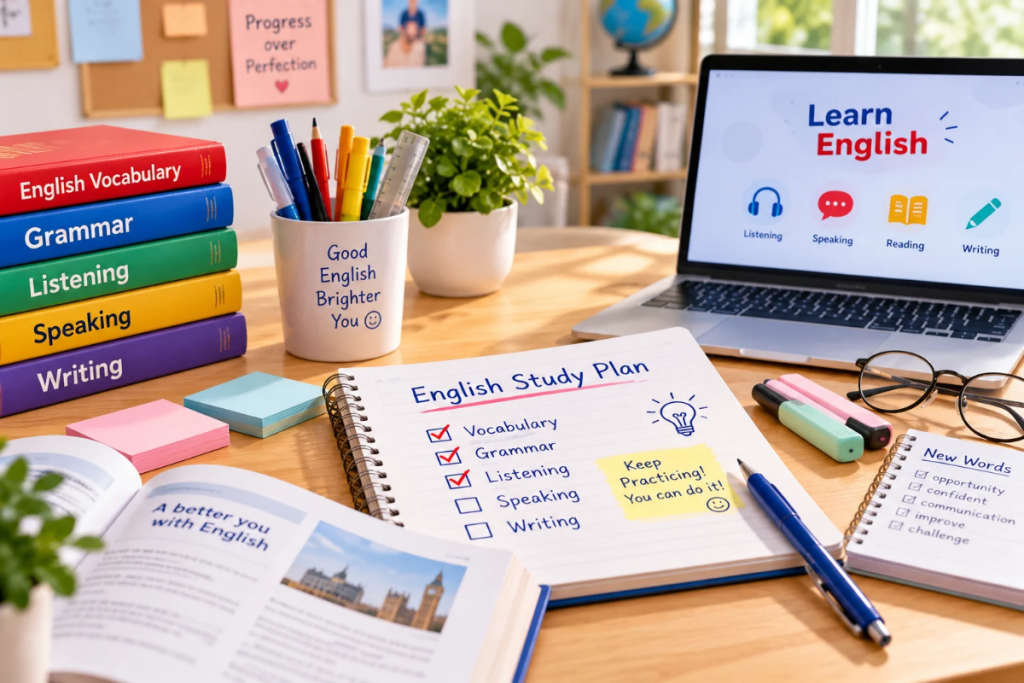
When children enter Grade 3, they begin learning more English sentence patterns and basic grammar structures instead of studying vocabulary alone. Understanding Grade 3 English Grammar helps them become more confident in listening, speaking, reading, and writing simple sentences.
At this stage, children learn how to greet others, introduce themselves, ask questions, describe familiar objects, and talk about everyday activities. With clear explanations, familiar examples, and regular practice, they can gradually understand how English sentences work.
This guide covers essential grammar topics for Grade 3 students, including the verb to be, personal pronouns, possessive adjectives, common question forms, regular verbs, singular and plural nouns, and prepositions of place. It also includes practical exercises that parents and children can use for revision at home.
What Does Grade 3 English Grammar Include?
Grade 3 English Grammar focuses on basic sentence patterns used in familiar situations. Children learn to ask and answer simple questions, describe people and things, and communicate information about their daily lives.
Common topics include:
- Greetings and self-introductions
- Asking and answering questions about names and ages
- Talking about school and classroom objects
- Asking about colors and quantities
- Asking and answering questions about locations
- Describing people and objects
- Using the verb to be
- Using personal pronouns and possessive adjectives
- Forming Yes/No questions and Wh-questions
- Using common verbs in simple sentences
- Understanding singular and plural nouns
- Using prepositions of place
These basic structures help children build a foundation for more advanced English lessons in later grades. The exact order and content may vary depending on the textbook and school curriculum.

Essential Grade 3 English Grammar Rules
Learning grammar one topic at a time can help children understand how each structure works. The following sections explain common rules with simple examples.
The Verb To Be: Am, Is, Are
The verb to be is used to introduce people, describe things, and provide basic information. In the present tense, it takes the forms am, is, or are, depending on the subject.
| Subject | Verb to Be | Example |
| I | am | I am eight years old. |
| He / She / It | is | She is my friend. |
| You / We / They | are | They are students. |
Affirmative sentence structure:
Subject + am/is/are + …
Examples:
- I am a student.
- He is my brother.
- We are happy.
To make a negative sentence, add not after the verb to be.
Examples:
- I am not tired.
- She is not at school.
- They are not teachers.
Children should identify the subject first and then choose the correct form of to be.
Personal Pronouns
Personal pronouns replace the names of people, animals, or things. They help avoid repeating the same noun several times in a sentence.
| Personal Pronoun | Meaning | Example |
| I | Tôi, mình | I am Nam. |
| You | Bạn, các bạn | You are my friend. |
| He | Anh ấy, cậu ấy | He is nine. |
| She | Cô ấy, bạn nữ ấy | She is Lan. |
| It | Nó | It is a cat. |
| We | Chúng tôi, chúng ta | We are classmates. |
| They | Họ, chúng | They are my friends. |
Examples:
- Nam is my brother. He is nine years old.
- Lan and I are classmates. We study together.
Children should learn to choose the pronoun that matches the person or thing being discussed. He is commonly used for a male person, she for a female person, and it for an object or an animal when its sex is not being specified.
Possessive Adjectives
Possessive adjectives show ownership. They usually appear before a noun to indicate whose object or possession is being discussed.
| Personal Pronoun | Possessive Adjective | Example |
| I | my | This is my book. |
| You | your | Is this your pen? |
| He | his | His bag is blue. |
| She | her | Her name is Lan. |
| It | its | The dog moves its tail. |
| We | our | Our school is big. |
| They | their | Their classroom is clean. |
Basic structure:
Possessive adjective + noun
Examples:
- This is my pencil.
- Her school bag is pink.
- Their teacher is nice.
A common mistake is confusing personal pronouns with possessive adjectives. Children can practice by learning pairs such as I – my, he – his, she – her, and they – their.
Questions with What
What is used to ask about names, objects, colors, and other specific information. The question structure depends on what the speaker wants to know.
Asking about a name:
- What is your name?
- My name is Nam.
Asking about an object:
- What is this?
- It is a pencil.
Asking about a color:
- What color is it?
- It is red.
Encourage children to answer with complete sentences when appropriate. This helps them practice both grammar and everyday communication.
Questions with How Old
How old is used to ask about a person’s age. The answer commonly includes the verb to be, a number, and the phrase years old.
Question structure:
How old + am/is/are + subject?
Answer structure:
Subject + am/is/are + age + years old.
Examples:
- How old are you?
I am eight years old. - How old is your brother?
He is ten years old. - How old is she?
She is nine years old.
Children should pay attention to the subject when choosing am, is, or are in both questions and answers.
Questions with Where
Where means “ở đâu” and is used to ask about the location of a person, animal, or object.
Basic structure:
Where + am/is/are + subject?
Examples:
- Where is the cat?
It is under the table. - Where is my book?
It is on the desk. - Where are the books?
They are in the bag.
To answer these questions, children need to combine the verb to be with prepositions of place, such as in, on, under, and next to.
Yes/No Questions with To Be
Yes/No questions are questions that can be answered with Yes or No. When using the verb to be, place am, is, or are before the subject.
Question structure:
Am/Is/Are + subject + …?
Examples:
- Is this your pencil?
Yes, it is. - Is she your sister?
No, she isn’t. - Are they your friends?
Yes, they are. - Are you a student?
Yes, I am.
For short answers, children should use the correct pronoun and verb. For example, the question “Are you a student?” is answered with “Yes, I am” or “No, I’m not.”
Common Verbs in Simple Sentences
Verbs describe actions, such as reading, writing, playing, singing, dancing, running, and swimming. Common examples include read, write, play, sing, dance, run, and swim.
In affirmative sentences in the simple present tense, verbs generally remain in their base form with I, you, we, and they. With he, she, and it, verbs usually take -s or -es.
| Subject | Structure | Example |
| I / You / We / They | Subject + base verb | I play football. |
| He / She / It | Subject + verb-s/es | She reads books. |
Examples:
- I read a book every day.
- We play games after school.
- He likes cats.
- She sings a song.
At this level, children should begin with short sentences and familiar vocabulary. When completing exercises, they need to check the subject before choosing the verb form.
Singular and Plural Nouns
Singular nouns refer to one person, animal, or thing. Plural nouns refer to two or more. Many English nouns form the plural by adding -s or -es.
| Singular Noun | Plural Noun | Meaning |
| book | books | Quyển sách |
| pen | pens | Cây bút |
| cat | cats | Con mèo |
| dog | dogs | Con chó |
| box | boxes | Cái hộp |
| bus | buses | Xe buýt |
Examples:
- I have one book.
- She has two cats.
- There are three boxes.
Children can use numbers such as one, two, and three to recognize when a plural noun is needed. They should also practice reading both singular and plural forms aloud.
Prepositions of Place
Prepositions of place describe where a person, animal, or object is located. Common prepositions include in, on, under, and next to.
| Preposition | Vietnamese Meaning | Example |
| in | Trong | The pen is in the bag. |
| on | Trên | The book is on the table. |
| under | Dưới | The ball is under the chair. |
| next to | Bên cạnh | The cat is next to the box. |
Parents can use real objects at home to help children understand these expressions. For example, place a book on a table and ask, “Where is the book?” Then move it to another location and encourage the child to answer again.
Grade 3 English Grammar by Unit
In English textbooks, grammar structures are usually introduced alongside vocabulary and specific communication situations. Reviewing grammar by unit helps children connect each structure with the words and conversations they have learned.
A simple revision routine includes:
- Review the sentence patterns: Read the questions and answers from the lesson.
- Revise related vocabulary: Use familiar words to practice the target structure.
- Create new sentences: Write or say two or three sentences using the pattern.
- Practice conversations: Take turns asking and answering questions with a parent or classmate.
- Complete short exercises: Check whether the structure is understood correctly.
For children studying Global Success, Smart Start, or Family and Friends, parents should refer to the relevant textbook to follow the correct lesson order and content.
How to Learn Grade 3 English Grammar Effectively
Children do not need to memorize every grammar rule in one sitting. Short, engaging activities that combine speaking, reading, and practice can make learning easier to manage.
Study One Grammar Topic at a Time
Focus on one main topic per session, such as the verb to be or questions with What. Once children understand the structure and can use it in simple examples, they can move on to another topic.
Combine Grammar with Vocabulary
Vocabulary provides the words needed to express an idea, while grammar helps organize those words into meaningful sentences.
Examples:
- This is my book.
- The cat is under the table.
- She likes apples.
Using familiar words from home and school helps children understand how grammar works in context.
Read Sentences Aloud and Practice Speaking
Ask children to read a model sentence aloud and then replace one or two words to create a new sentence.
For example, after practicing “This is my pencil,” they can say “This is my book” or “This is my ruler.”
This activity reinforces sentence structure while giving children an opportunity to practice pronunciation.
Review Previous Lessons Regularly
Before introducing a new topic, spend a few minutes reviewing an earlier lesson. Short, regular revision sessions help children recall grammar rules and use them more confidently.
Use Exercises and Learning Materials
After studying each topic, children can complete multiple-choice questions, fill-in-the-blank exercises, or sentence-ordering activities.
Parents looking for offline practice can prepare a Grade 3 English Grammar PDF that matches the child’s current lessons. Choose resources with clear explanations, suitable examples, and answer keys so children can check their work after finishing.
Grade 3 English Grammar Exercises with Answers
After reviewing the rules, students can complete the following exercises to check their understanding.

Exercise 1: Choose the Correct Answer
Question 1: I ___ seven years old.
- am
B. is
C. are
Question 2: She ___ my friend.
- am
B. is
C. are
Question 3: They ___ students.
- am
B. is
C. are
Question 4: ___ is your name?
- Where
B. What
C. How old
Question 5: The cat is ___ the table. (The cat is below the table.)
- under
B. are
C. my
Exercise 2: Fill in the Blanks
Complete each sentence with my, his, her, or their.
Question 1: This is ___ book. (The speaker is talking about their own book.)
Question 2: Nam is a boy. ___ bag is blue.
Question 3: Lan is my friend. ___ name is Lan.
Question 4: They are students. ___ classroom is big.
Exercise 3: Put the Words in the Correct Order
Rearrange the words to make complete sentences.
Question 1: am / I / eight / years old
Question 2: is / my / She / friend
Question 3: the / under / is / table / cat / The
Question 4: your / What / name / is
Answer Key
Exercise 1:
- A — am
- B — is
- C — are
- B — What
- A — under
Exercise 2:
- my
- His
- Her
- Their
Exercise 3:
- I am eight years old.
- She is my friend.
- The cat is under the table.
- What is your name?
Build a Strong Foundation in Grade 3 English Grammar
Learning grammar takes time, practice, and regular revision. Children can begin with familiar topics such as personal pronouns, the verb to be, common question forms, and prepositions of place before gradually exploring other structures in their school curriculum.
Rather than expecting children to memorize every rule quickly, encourage them to create their own sentences, answer questions, and use English in familiar situations. Combining grammar with vocabulary, listening, and speaking practice can help children understand lessons more clearly and become more confident English learners.
Frequently Asked Questions About Grade 3 English Grammar
What grammar topics should Grade 3 students learn?
Students should become familiar with the verb to be, personal pronouns, possessive adjectives, questions with What, How old, and Where, Yes/No questions, common verbs, plural nouns, and prepositions of place. The exact content depends on the textbook and curriculum.
Do children need to memorize every grammar rule?
Not necessarily. Understanding how a structure works and practicing it in different sentences are more important than memorizing formulas without context. Regular practice helps children gradually remember how to use each structure.
Should children learn grammar or vocabulary first?
Both should be learned together. Vocabulary provides the words children need, while grammar helps them arrange those words into meaningful sentences. Parents can introduce a simple sentence pattern alongside related vocabulary.
Where can parents find a Grade 3 English Grammar PDF?
Parents can look for learning materials from reputable educational providers, publishers, or trusted learning platforms. Choose resources that match the child’s current textbook and include explanations, examples, and answer keys.
How can children remember grammar for longer?
Break lessons into smaller topics, review previous material regularly, and give children opportunities to use sentence patterns in everyday situations. Question-and-answer games, flashcards, and short exercises can also make revision more engaging.
Keywords:
- Grade 3 English Grammar for Term 1
- Grade 3 English Grammar for Term 2
- Grade 3 English Grammar Global Success
- Grade 3 English Grammar Smart Start
- Grade 3 English Grammar Exercises PDF
- Grade 3 English Grammar Family and Friends
