

Learning vocabulary is an essential step toward improving your English communication, reading comprehension, and writing skills. However, many learners struggle to remember new words even after writing them down and reviewing them several times. This often happens because they rely on passive learning methods or do not review vocabulary regularly.
English vocabulary flashcards offer a practical way to address this challenge. By dividing information into small, manageable cards, learners can test their knowledge, review difficult words, and build stronger vocabulary habits. Instead of simply reading a list of definitions, you actively try to recall each word’s meaning, pronunciation, or usage before checking the answer.
Today, digital flashcards make this process even more convenient. Many online platforms allow users to create vocabulary sets, add audio and images, organize words by topic, and track their learning progress. You can study on a computer or mobile device without setting aside a long period for each session.
In this guide, you will discover how English vocabulary flashcards work, explore four useful websites, and learn practical strategies for remembering new words and using them confidently in everyday communication.
What are English vocabulary flashcards?
English vocabulary flashcards are learning cards designed to help learners remember words, phrases, and expressions. Each card usually has two sides. The front contains a word, phrase, or question, while the back provides its meaning, pronunciation, example sentence, or other useful information.
For example, a flashcard for the word improve might include the following details:
- Front: Improve
- Meaning: To make something better
- Pronunciation: /ɪmˈpruːv/
- Example: I want to improve my English speaking skills.
- Related phrases: Improve your skills, improve performance.
This format helps you learn more than a word’s basic definition. You can also understand how it sounds and how to use it naturally in a sentence.
There are two common types of vocabulary flashcards. Traditional paper cards are suitable for learners who enjoy handwriting and creating their own study materials. Digital flashcards, on the other hand, allow you to store multiple vocabulary sets, search for information quickly, and use automated review features.
Regardless of which format you choose, the main goal is to strengthen your memory and make new vocabulary easier to use in real-life situations.

Why are English vocabulary flashcards effective?
They encourage active recall
One major advantage of flashcards is that they encourage you to retrieve information from memory before looking at the answer. This technique is known as active recall.
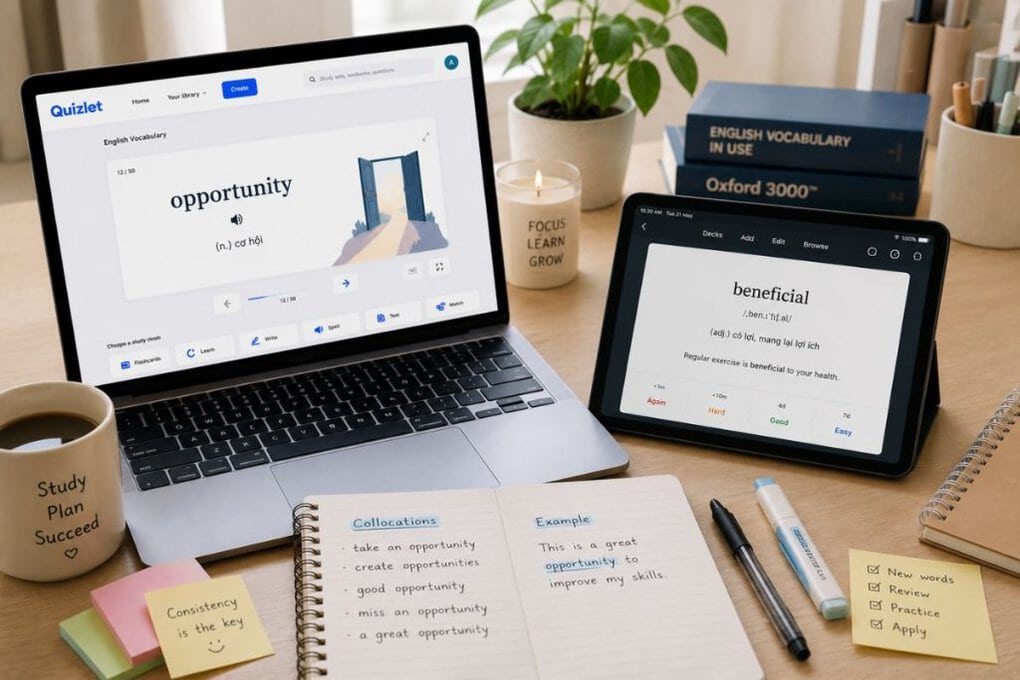
For example, when you see the word opportunity, try to remember its meaning before turning the card over. If you cannot recall the definition, check the answer, read the example, and test yourself again.
This process helps you identify which words you already know and which ones require more practice. It can also reduce the gap between recognizing a word on a page and remembering its meaning during a conversation.
They support long-term vocabulary retention
Reviewing a word several times in one sitting does not necessarily mean you will remember it for long. A more effective approach is to revisit vocabulary at suitable intervals.
This technique is called spaced repetition. Some flashcard websites use algorithms to schedule reviews based on how well you remember each word.
For instance, words you frequently forget may appear again sooner, while familiar words may require less frequent review. This approach helps you allocate study time more efficiently and maintain your vocabulary over time.
They make learning by topic easier
Rather than memorizing unrelated words, you can organize English vocabulary flashcards into specific categories, such as:
- Everyday English expressions
- Business and workplace vocabulary
- Travel and shopping vocabulary
- IELTS and TOEIC vocabulary
- Academic English and reading vocabulary
Learning related words together can help you connect ideas and understand how vocabulary is used in context.
For example, when studying workplace English, you might learn meeting, deadline, workload, and submit a report in the same set. This makes it easier to build complete sentences instead of remembering isolated definitions.
They fit into a busy schedule
Digital flashcards allow you to study during short breaks, at lunchtime, while commuting, or before starting work.
You do not need to complete a lengthy lesson to make progress. By reviewing vocabulary consistently, you can gradually expand your knowledge without significantly changing your daily routine.
Best websites for English vocabulary flashcards
Each platform offers different features for creating cards, organizing vocabulary, and reviewing information. The best choice depends on your learning goals, preferred study style, and available time.
Quizlet: An easy way to get started
Website: https://quizlet.com/
Quizlet is an online learning platform that allows users to create flashcards and practice with existing study sets. You can search for vocabulary by topic, build personalized collections, or explore materials shared by other learners.
Key benefits:
- An intuitive interface for beginners.
- Access to vocabulary sets covering different subjects.
- Tools for creating personalized flashcards.
- Multiple ways to practice and review information.
Quizlet is suitable for students, beginners, and learners who want a straightforward way to organize vocabulary. If you are preparing for an English test or studying a textbook, you can create a separate set for each lesson or chapter.
However, you should check the definitions, pronunciation, and examples in community-created sets before relying on them. A large collection of words is not necessarily the best choice for your current level or learning objectives.
Anki: A useful tool for long-term learning
Website: https://apps.ankiweb.net/
Anki is well known for its spaced repetition system, which helps learners organize vocabulary reviews according to their memory performance. You can create personalized flashcards, add images or audio, and organize your learning materials around specific goals.
Key benefits:
- Structured vocabulary review.
- Flexible flashcard customization.
- Support for long-term learning plans.
- Useful tools for managing large vocabulary collections.
Anki may be particularly useful for IELTS and TOEIC candidates or learners who want to build a substantial vocabulary over time. You can create separate cards for synonyms, common expressions, and words encountered during practice tests.
One potential drawback is that its interface and settings may take some time to learn. Beginners can start with a simple vocabulary deck before exploring more advanced features.
Memrise: Learn vocabulary through context
Website: https://www.memrise.com/
Memrise focuses on interactive language learning and may combine vocabulary practice with visual materials and real-world language content, depending on the course.
Key benefits:
- An interactive learning experience.
- Opportunities to encounter vocabulary in context.
- Visual learning materials for different study preferences.
- A more varied alternative to memorizing word lists.
If you find it difficult to remember words from translations alone, try studying them alongside example sentences or short dialogues.
For example, instead of memorizing only the definition of recommend, learn the sentence I recommend this book to beginners.
This approach helps you understand how a word works in context and makes it easier to imagine when you might use it.
Keep in mind that available features and free access may vary depending on the platform’s current offerings, location, and subscription plan.
Knowt: Turn study notes into review materials
Website: https://knowt.com/
Knowt is a learning platform that provides tools for creating flashcards and other study materials. Depending on the features available, learners may be able to use their notes or learning resources to build flashcards and practice questions.
Key benefits:
- Tools for organizing study materials.
- Flashcards for reviewing lesson content.
- Useful options for learners who work with notes and textbooks.
- A convenient way to organize vocabulary in one place.
Knowt may be worth considering if you study from specific materials and want to turn them into short review cards.
For example, after reading an article about the environment, you could collect words such as pollution, renewable energy, and conservation. You can then add definitions and example sentences to create a personalized vocabulary set.
When using automated tools to generate study materials, review the information carefully before adding it to your main vocabulary collection.
Which flashcard website should you choose?
The best platform depends on how you prefer to study:
- Quizlet: A practical starting point for learners who want ready-made study sets.
- Anki: Suitable for structured, long-term vocabulary review.
- Memrise: Worth considering if you prefer interactive learning and contextual examples.
- Knowt: Useful for organizing notes and turning study materials into review resources.
You do not need to use all four platforms at once. Choose one that fits your needs, establish a consistent routine, and adjust your approach as your learning goals develop.
How to create effective English vocabulary flashcards
Choose words that match your goals
Before creating flashcards, identify why you are learning English. If your main goal is communication, prioritize common words, everyday expressions, and phrases used in familiar situations.
If you are preparing for IELTS or TOEIC, you can select vocabulary from reading passages, listening exercises, and topics relevant to your exam preparation.
Avoid adding every unfamiliar word to your flashcard collection. Focus on vocabulary that appears frequently, relates to your interests, or supports your specific learning objectives.
Keep each flashcard focused
A flashcard containing too much information can make it difficult to identify the main point. Instead, focus each card on one key word or expression.
For example:
Front: Make a decision
Back:
- Meaning: To choose after considering different options.
- Example: I need to make a decision today.
- Common structure: Make a decision about something.
For words with several meanings, consider creating separate cards for different contexts. This can make your reviews clearer and reduce confusion between different uses.
Add pronunciation and example sentences
If your flashcards contain only English words and translations, you may remember the spelling without knowing how to pronounce or use the vocabulary correctly.
A useful flashcard may include:
- The English word or phrase.
- A concise definition.
- Phonetic transcription or audio.
- A natural example sentence.
- Common collocations.
- An image, when appropriate.
Not every card needs all these elements. Keep simple words brief, but add examples when a word is difficult to understand or easy to confuse with another expression.
Test yourself before checking the answer
When reviewing flashcards, avoid turning them over immediately. Give yourself a few seconds to recall the meaning, pronunciation, or an example of how the word is used.
After checking the answer, evaluate your performance honestly. If you answer incorrectly or hesitate significantly, place the word in a group that needs further review.
The goal is not to finish your flashcard deck as quickly as possible. It is to identify what you genuinely remember and what still needs practice.
Use new vocabulary in real situations
After reviewing a group of flashcards, practice using the words by writing sentences, speaking for a short time, or answering simple questions in English.
For example, after learning confident, improve, and opportunity, you could write:
I want to improve my English because it gives me more opportunities at work. I also want to become more confident when speaking.
This activity connects individual words and helps you move beyond memorizing definitions toward using vocabulary in meaningful communication.
A 20-minute daily English vocabulary flashcard routine
If you have a busy schedule, try the following study routine. Adjust the number of new words according to your level and how much time you need to review previous material.
First five minutes: Review old vocabulary
Open your flashcard website and review the cards that are due. Try to recall each answer before revealing it, and pay attention to words you still find difficult.
Next ten minutes: Learn new words
Start with approximately five to ten new words or phrases that match your level. Read the definitions, listen to pronunciation, and study example sentences. If the vocabulary is challenging, reduce the number of new cards and focus on understanding them properly.
Final five minutes: Practice using the words
Choose several words from your new set and use them in sentences or a short spoken response. If you are studying workplace vocabulary, describe a meeting, your daily schedule, or a work task in English.
The most important habit is to keep reviewing previous vocabulary instead of focusing exclusively on new words. As your collection grows, let your flashcard platform help organize reviews and identify words that need extra attention.
Common mistakes to avoid when using English vocabulary flashcards
Although flashcards are easy to use, certain habits can reduce their effectiveness.
Learning too many words at once: Creating hundreds of cards without enough time to review them can make your collection difficult to manage. Start with a manageable number and increase it gradually as your routine becomes more consistent.
Memorizing translations only: Knowing a word’s meaning does not necessarily mean you can use it correctly. Add example sentences, common word combinations, and pronunciation when needed.
Skipping previous vocabulary: Continuously learning new words without reviewing older ones can make it harder to retain what you have already studied. Reserve part of each session for reviewing existing cards.
Copying flashcard sets without checking them: Shared study materials may not match your level or goals. Check the definitions and examples before using them regularly.
Relying on flashcards alone: Flashcards support vocabulary learning, but they cannot fully replace listening, speaking, reading, and writing practice. Combine them with reading passages, dialogues, and real communication activities.
Overall, flashcards work best as part of a broader English learning plan. Choose relevant vocabulary, review it consistently, and actively use what you learn.
Frequently asked questions about English vocabulary flashcards
Should I create my own flashcards or use ready-made sets?
Beginners can start with ready-made sets to save time and become familiar with the method. As they gain experience, creating personalized cards can help them focus on difficult words, frequently encountered expressions, and vocabulary related to their goals. Combining both approaches allows you to use existing resources while developing a collection tailored to your needs.
Why do I forget words even after using flashcards?
You may be learning too many words at once, reviewing them inconsistently, or memorizing translations without understanding how to use them. Reduce the number of new words, review older cards more regularly, and include examples. Trying to recall an answer before revealing it can also help you evaluate your memory more accurately.
Which website is suitable for IELTS vocabulary?
Quizlet is useful for exploring vocabulary sets organized by topic, while Anki may be a good choice for learners who want a structured long-term review system. Whichever platform you choose, prioritize vocabulary from IELTS materials appropriate to your level and study how words are used in sentences rather than memorizing isolated definitions.
Can flashcards improve my speaking skills?
Flashcards can support speaking development, especially when you learn phrases, collocations, and example sentences. After reviewing a card, try using the word in an answer or short conversation. For broader speaking improvement, continue practicing pronunciation, listening comprehension, and spoken communication.
Should I learn Oxford 3000 with flashcards?
Yes. You can use flashcards to study Oxford 3000 vocabulary in manageable groups. Add examples, pronunciation, and common collocations to understand how each word is used. Prioritize words that match your current level and practice applying them in real contexts.
Are paper or digital flashcards better?
Paper flashcards are suitable for learners who enjoy handwriting and creating their own cards. Digital flashcards are convenient for storing multiple vocabulary sets, accessing audio, and using automated review features. Neither option is best for everyone, so choose the format you can maintain consistently.
How many words should I learn with flashcards each day?
You can start with approximately five to ten new words per day and adjust the number based on their difficulty and the time required to review older vocabulary. The priority is to understand how each word is used and remember it over time rather than completing a large number of cards in a single session.
English vocabulary flashcards are a useful tool for expanding your vocabulary when combined with an appropriate review strategy and practical language activities. You can start with Quizlet, Anki, Memrise, or Knowt, choose a vocabulary set that matches your goals, and spend around 15–20 minutes each day learning and reviewing.
Remember that progress depends not only on how many words you study but also on how well you recognize and use them in real situations. A manageable plan that you follow consistently can help you develop stronger English vocabulary skills over time.
Keywords:
- English vocabulary flashcards
- Learn English vocabulary with flashcards
- English vocabulary flashcard websites
- English flashcards by topic
- English vocabulary flashcard apps
- Oxford 3000 flashcards
- How to memorize English vocabulary
