

In today’s global business environment, communicating with international customers is a valuable skill for sales representatives, retail assistants, and online sellers. You do not need to speak perfect English or use complicated grammar to assist customers effectively. Knowing how to greet shoppers, introduce products, answer questions, and explain payment options can already make a significant difference.
Learning English for sales through real-life situations helps you remember useful expressions and apply them more confidently at work. Whether you sell clothing, work in a restaurant, manage an online store, or assist customers in a retail shop, familiar phrases can make everyday conversations easier.
This guide covers essential sales vocabulary, common customer service expressions, practical dialogues, and learning strategies to help you communicate with international customers more naturally.
Essential English for Sales Vocabulary
Learning vocabulary by topic makes it easier to remember new words and understand how they are used in professional situations. Instead of memorizing isolated words, try learning them in groups related to your daily responsibilities.
English for Sales: Product Vocabulary
These words are useful when describing products, explaining features, and recommending suitable options to customers.
| English vocabulary | Vietnamese meaning |
| Product | Sản phẩm |
| Item | Mặt hàng |
| Brand | Thương hiệu |
| Model | Mẫu sản phẩm |
| Feature | Tính năng, đặc điểm |
| Material | Chất liệu |
| Quality | Chất lượng |
| Durable | Bền |
| Lightweight | Nhẹ |
| Best-selling product | Sản phẩm bán chạy |
Example: This product is lightweight and durable.
Meaning: This product is light and lasts a long time.
English for Sales: Prices and Promotions
Sales staff often need to explain prices, discounts, special offers, and promotional conditions. Understanding these terms helps you answer customer questions clearly.
| English vocabulary | Vietnamese meaning |
| Price | Giá bán |
| Cost | Chi phí |
| Discount | Mức giảm giá |
| Promotion | Chương trình khuyến mãi |
| Special offer | Ưu đãi đặc biệt |
| Coupon | Mã giảm giá |
| Affordable | Có giá phải chăng |
| Expensive | Đắt |
| On sale | Đang được giảm giá |
| Value for money | Xứng đáng với số tiền bỏ ra |
Example: This item is currently on sale.
Meaning: This product is available at a reduced price.
English for Sales: Payment and Customer Service
These expressions are especially useful when customers are paying for their purchases, requesting assistance, or asking about returns.
| English vocabulary | Vietnamese meaning |
| Payment | Việc thanh toán |
| Cash | Tiền mặt |
| Credit card | Thẻ tín dụng |
| Debit card | Thẻ ghi nợ |
| Receipt | Biên lai |
| Invoice | Hóa đơn |
| Refund | Hoàn tiền |
| Exchange | Đổi hàng |
| Warranty | Bảo hành |
| Complaint | Khiếu nại |
| Feedback | Phản hồi |
| Customer support | Hỗ trợ khách hàng |
Example: Would you like to pay by cash or card?
Meaning: Would you prefer to pay with cash or a card?
English for Sales in Clothing Stores
If you work in fashion retail, focus on vocabulary related to clothing types, sizes, materials, and fitting rooms.
| English vocabulary | Vietnamese meaning |
| T-shirt | Áo thun |
| Shirt | Áo sơ mi |
| Jacket | Áo khoác |
| Sweater | Áo len |
| Dress | Váy đầm |
| Skirt | Chân váy |
| Jeans | Quần jean |
| Size | Kích cỡ |
| Fitting room | Phòng thử đồ |
| Try on | Mặc thử |
| Fit | Vừa vặn |
| Loose / Tight | Rộng / Chật |
| Cotton / Linen | Vải cotton / vải lanh |
Example: Would you like to try this shirt on?
Meaning: Would you like to wear this shirt to see how it fits?
English for Sales in Restaurants and Cafes
Restaurant employees and cafe staff need vocabulary for describing menu items, taking orders, and answering questions about food and drinks.
| English vocabulary | Vietnamese meaning |
| Menu | Thực đơn |
| Dish | Món ăn |
| Appetizer | Món khai vị |
| Main course | Món chính |
| Dessert | Món tráng miệng |
| Beverage | Đồ uống |
| Seafood | Hải sản |
| Special dish | Món đặc biệt |
| Takeaway | Mang đi |
| Dine in | Ăn tại chỗ |
| Reservation | Đặt bàn |
| Bill | Hóa đơn thanh toán |
Example: Our seafood pasta is one of our most popular dishes.
Meaning: Our seafood pasta is a dish that many customers enjoy ordering.
English for Sales Online
Online sellers also need expressions related to orders, shipping, delivery, and after-sales support.
| English vocabulary | Vietnamese meaning |
| Order | Đơn hàng |
| Purchase | Việc mua hàng |
| Shopping cart | Giỏ hàng |
| Checkout | Thanh toán đơn hàng |
| Order confirmation | Xác nhận đơn hàng |
| Tracking number | Mã vận đơn |
| Shipping | Vận chuyển |
| Free shipping | Miễn phí vận chuyển |
| Express delivery | Giao hàng nhanh |
| Estimated delivery | Thời gian giao hàng dự kiến |
| Return policy | Chính sách đổi trả |
| Out of stock | Hết hàng |
| In stock | Còn hàng |
Example: Your order will be delivered within three business days.
Meaning: Your order is expected to arrive within three working days.

Common English for Sales Phrases for Customer Communication
Knowing individual words is useful, but complete expressions help you communicate more naturally. The following phrases are organized according to the typical sales process, from greeting customers to providing after-sales support.
English for Sales: Greeting Customers
A friendly greeting helps create a positive first impression when customers enter a store or start a conversation online.
- Welcome to our store! — Welcome to our shop.
- Hello! How can I help you today? — What can I do for you today?
- Please feel free to look around. — You are welcome to browse freely.
- Let me know if you need any assistance. — Tell me if you need help.
- Thank you for visiting us. — Thank you for stopping by.
Communication tip: Not every customer wants immediate assistance. If someone prefers to browse independently, greet them politely and give them space. This approach makes the interaction more comfortable.
English for Sales: Asking About Customer Needs
Asking relevant questions helps you understand what customers are looking for before recommending products.
- What are you looking for today?
- Is there anything specific you need?
- Which color do you prefer?
- What size are you looking for?
- What is your budget?
- Are you buying this for yourself or as a gift?
These questions help you identify customer preferences, budget limits, and purchasing needs.
For example, if a customer is shopping for a gift, you can suggest products based on the recipient’s preferences rather than simply recommending your most expensive item.
English for Sales: Introducing Products
When customers show interest in a product, explain its key features and benefits in clear, simple language.
- This is one of our best-selling products.
- This product comes in different colors.
- It is made from high-quality materials.
- I think this model would suit you better.
- This option offers great value for money.
- Many customers recommend this product.
Try to connect product features with the customer’s needs. For clothing, discuss fit and material. For electronic devices, explain useful features. For food products, describe ingredients, flavor, or preparation methods.
English for Sales: Explaining Prices and Promotions
Customers often ask about prices before making a purchasing decision. Use straightforward expressions to explain current offers.
- How much is this item?
- This item is currently on sale.
- We are offering a 20% discount today.
- Buy one, get one free.
- This promotion ends this weekend.
- Free shipping is available for this order.
Only mention discounts, deadlines, and promotional conditions that are actually available. Clear and accurate information helps build customer trust.
English for Sales: Closing a Deal
Once customers have found a suitable product, you can help them complete their purchase with polite, low-pressure questions.
- Would you like to go with this one?
- Shall I prepare it for you?
- Would you like to place the order now?
- How would you like to pay?
- Would you like a receipt?
- Would you like a gift bag?
Rather than pressuring customers to buy immediately, offer assistance and allow them time to decide. A helpful approach can create a more positive shopping experience.
English for Sales: Thanking Customers
A polite farewell helps maintain a good relationship with customers after a transaction.
- Thank you for your purchase.
- We appreciate your support.
- Please contact us if you need any assistance.
- We hope to see you again soon.
- Have a wonderful day!
These expressions are suitable for both in-store interactions and online customer service conversations.
English for Sales: Handling Difficult Customer Situations
Not every customer will make a purchase immediately. Some may question the price, request a discount, or ask to return a product. Learning how to respond professionally helps you manage these situations more confidently.
When a Customer Says the Product Is Too Expensive
Customer: It’s too expensive.
Salesperson: I understand. This product offers excellent quality and durability.
Salesperson: We also have another option at a lower price.
Meaning:
- Customer: The product costs too much.
- Salesperson: I understand. This product is good quality and built to last.
- Salesperson: We also have another option that costs less.
This response acknowledges the customer’s concern and offers an alternative without dismissing their budget.
When a Customer Needs More Time to Decide
Customer: I’ll think about it.
Salesperson: Of course. Please take your time.
Salesperson: Let me know if you have any questions.
Meaning:
- Customer: I need more time to consider it.
- Salesperson: Certainly. Take your time.
- Salesperson: Feel free to ask if you have any questions.
Giving customers time to decide helps create a comfortable shopping experience and avoids unnecessary pressure.
When a Customer Asks for a Discount
Customer: Can you give me a discount?
Salesperson: Let me check which promotions are available for you.
Meaning:
- Customer: Is it possible to reduce the price?
- Salesperson: I’ll check whether there are any available promotions for you.
This is a useful response when you need to confirm current discounts before making a commitment.
When a Product Is Out of Stock
Customer: Do you have this in another size?
Salesperson: Unfortunately, it’s currently out of stock.
Salesperson: I can let you know when it’s available again.
Meaning:
- Customer: Is this available in another size?
- Salesperson: Unfortunately, we don’t have it in stock right now.
- Salesperson: I can notify you when it becomes available again.
If possible, offer an alternative size, color, or similar product that meets the customer’s needs.
When a Customer Wants to Exchange an Item
Customer: I’d like to exchange this item.
Salesperson: Certainly. May I see your receipt, please?
Salesperson: I’ll check our exchange policy and help you with the next steps.
Meaning:
- Customer: I would like to exchange this product.
- Salesperson: Certainly. Could I see your receipt?
- Salesperson: I’ll check our exchange policy and explain what to do next.
Always follow the store’s actual exchange and return policy when assisting customers.
Practical English for Sales Dialogues
Practicing complete conversations helps you understand how phrases work together in realistic situations. Read each dialogue aloud and try switching roles to improve your speaking confidence.
English for Sales in a Clothing Store
Salesperson: Hello! Welcome to our store.
Customer: Hi! I’m looking for a white shirt.
Salesperson: Sure. What size do you wear?
Customer: Medium.
Salesperson: We have this model in medium. Would you like to try it on?
Customer: Yes, please.
Salesperson: The fitting room is over there.
This dialogue demonstrates how to greet a customer, ask about size, recommend an item, and offer assistance with trying it on.
English for Sales in a Restaurant
Customer: Could you recommend a popular dish?
Staff: Our grilled chicken is one of our most popular dishes.
Customer: That sounds good. Does it come with rice?
Staff: Yes, it does. Would you like something to drink?
Customer: A glass of orange juice, please.
The conversation shows how restaurant employees can recommend food, answer questions about menu items, and suggest drinks politely.
English for Online Sales
Customer: Hi! Is this item still available?
Seller: Yes, it’s currently in stock.
Customer: How long does delivery take?
Seller: Delivery usually takes two to three business days.
Customer: Great! I’d like to place an order.
Seller: Certainly. I’ll help you with the order confirmation.
This example covers common questions about product availability, delivery times, and order placement in an online store.
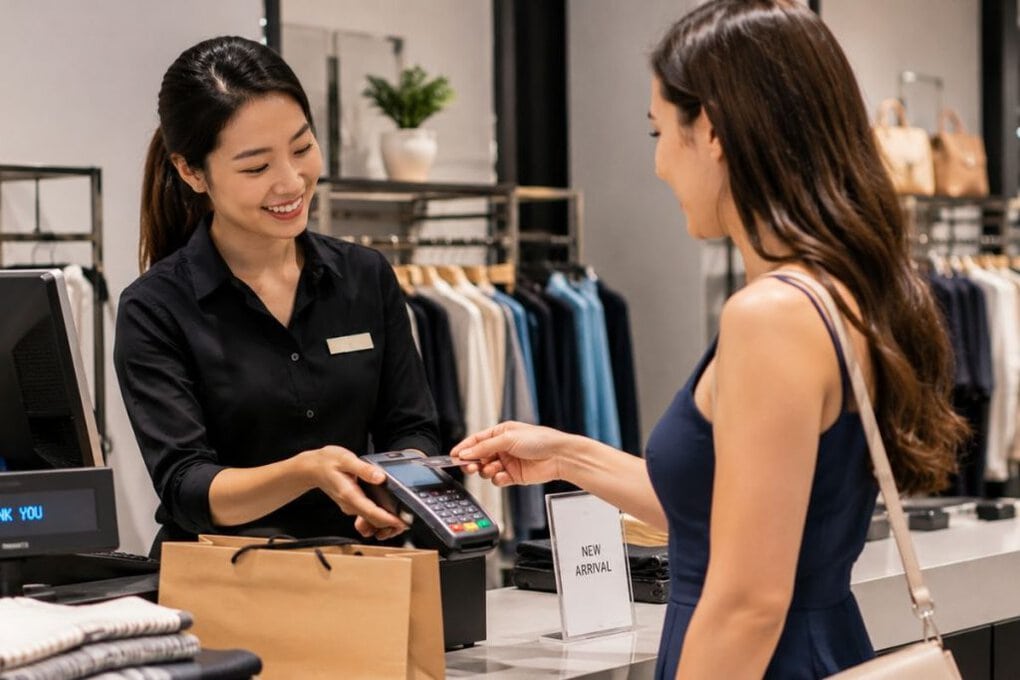
How to Learn English for Sales More Effectively
Improving your sales communication skills requires consistent practice and a learning plan that matches your daily responsibilities.
Learn English for Sales by Following the Sales Process
Divide your study sessions into practical topics, such as greeting customers, identifying needs, introducing products, discussing prices, completing payments, and providing after-sales support.
Practice one topic at a time. Once you are comfortable with the basic expressions, combine them into a complete conversation.
Memorize Phrases Instead of Individual Words
Rather than learning only the word order, practice related expressions such as place an order, confirm an order, and track an order.
Learning words in meaningful groups helps you form sentences more quickly and understand how vocabulary is used in different contexts.
Practice Pronunciation and Speaking Fluency
Read each phrase aloud, listen to pronunciation examples, and repeat them until they feel natural. You can also role-play as both the salesperson and the customer to improve your response speed.
If possible, practice with a colleague or language partner who can ask unexpected questions. This helps prepare you for conversations that do not follow a fixed script.
Focus on Your Industry
Choose vocabulary that matches your actual work. Clothing store employees should prioritize sizes, colors, materials, and fitting rooms. Online sellers should focus on orders, shipping, payments, and return policies. Restaurant staff should practice describing dishes, taking orders, and answering menu questions.
The key is consistency. Start with short, frequently used expressions and gradually move on to longer explanations. With regular practice, you can become more comfortable communicating with international customers.
Frequently Asked Questions About English for Sales
Is English for sales difficult to learn?
English for sales is manageable when you start with familiar situations. Basic greetings, product descriptions, price explanations, and payment questions often use straightforward sentence structures. Regular practice can help you remember these expressions and respond more confidently.
Should I learn vocabulary or phrases first?
Start by learning complete phrases that you can use immediately at work. Then expand your vocabulary according to your industry. Combining phrases with relevant vocabulary helps you adapt your language to different customers and products.
Can I communicate with international customers without perfect grammar?
Yes. You can begin with simple expressions such as How can I help you? and Would you like to try it on? However, learning basic grammar remains useful for communicating clearly and avoiding misunderstandings.
How can I speak English for sales more naturally?
Practice dialogues, listen to how fluent speakers use everyday expressions, and repeat phrases aloud. Focus on understanding the meaning of each sentence instead of memorizing words mechanically. Adapting your tone to the situation also makes conversations more natural.
Is English for online sales different from in-store sales?
Yes. In-store sales usually involve greeting customers, recommending products, and providing face-to-face assistance. Online sales focus more on order confirmation, shipping, payments, delivery updates, and return policies. Both require clear communication and polite customer service.
English for sales becomes easier when you learn vocabulary that matches your work and practice it in realistic situations. Begin with common expressions, build your industry-specific vocabulary, and gradually practice complete conversations. With consistent effort, you can improve your confidence and provide better service to international customers.
Keywords:
- English for online sales
- sales vocabulary in English
- English for clothing sales
- English for restaurant staff
- English sales phrases
