
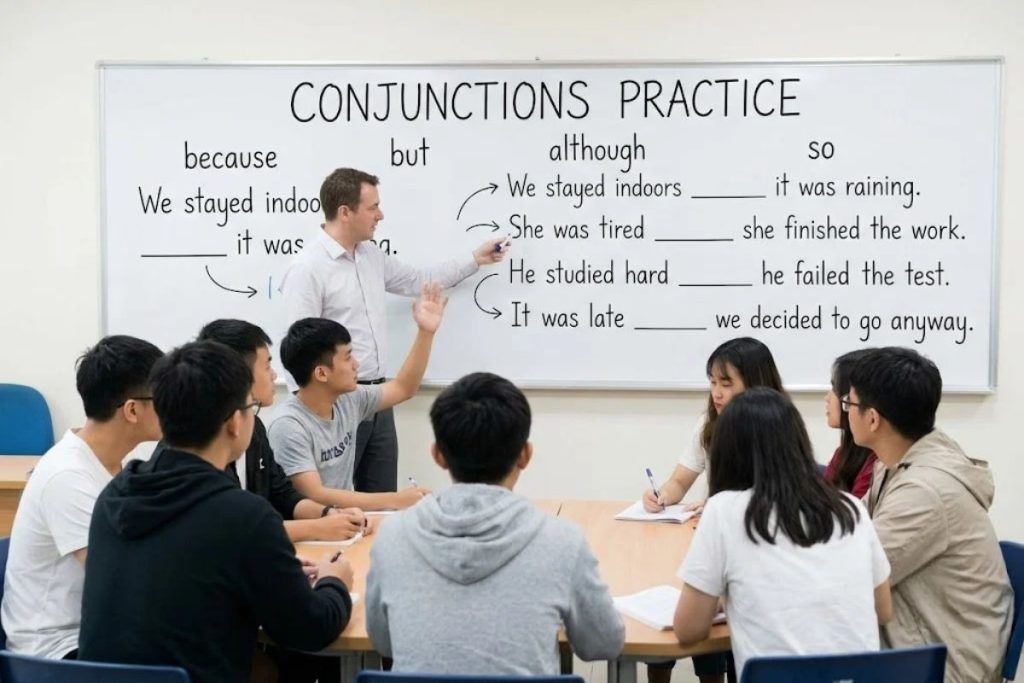
Conjunctions are essential parts of English grammar because they connect words, phrases, and clauses to create clear, logical sentences. Learning how to use them correctly helps you improve your writing, speaking, and reading comprehension. However, choosing the right conjunction can be challenging, especially when several words have similar meanings.
These conjunctions exercises will help you understand the main types of conjunctions, learn their grammatical rules, and practice using them in different contexts. Each exercise includes answers and explanations so you can check your understanding and identify common mistakes.
What Are Conjunctions in English?
A conjunction is a word that connects words, phrases, or clauses. It shows the relationship between different parts of a sentence, such as addition, contrast, choice, reason, result, or condition.
Consider these examples:
- I like tea and coffee.
- She was tired, but she continued working.
- We stayed home because it was raining.
- You can take the bus or walk to school.
In these sentences, the conjunctions connect ideas and show how they relate to one another.
There are three main types of conjunctions in English:
- Coordinating conjunctions: Connect words, phrases, or independent clauses of equal grammatical importance.
- Subordinating conjunctions: Connect a dependent clause to an independent clause.
- Correlative conjunctions: Work in pairs to connect related words, phrases, or clauses.
Understanding these categories will make it easier to choose the correct conjunction when completing grammar exercises.

Types of Conjunctions and How to Use Them
Coordinating conjunctions
Coordinating conjunctions connect elements that have equal grammatical importance. The seven common coordinating conjunctions are often remembered using the acronym FANBOYS.
| Conjunction | Function | Example |
| For | Gives a reason | I went to bed early, for I was exhausted. |
| And | Adds information | She bought apples and oranges. |
| Nor | Adds a negative idea | He doesn’t smoke, nor does he drink. |
| But | Shows contrast | The test was difficult, but I passed. |
| Or | Presents a choice | Would you like tea or coffee? |
| Yet | Shows unexpected contrast | It was cold, yet they went swimming. |
| So | Shows a result | I was hungry, so I made a sandwich. |
When a coordinating conjunction connects two independent clauses, a comma usually comes before the conjunction.
For example:
- Correct: I wanted to go outside, but it was raining.
- Incorrect: I wanted to go outside but, it was raining.
However, a comma is generally unnecessary when a conjunction connects only two words or short phrases.
For example: She likes reading and writing.
Subordinating conjunctions
Subordinating conjunctions introduce dependent clauses and show their relationship to the main clause. They can express time, reason, condition, contrast, purpose, and other relationships.
| Function | Common conjunctions | Example |
| Time | When, while, before, after, until, as soon as | Call me when you arrive. |
| Reason | Because, since, as | We stayed inside because it was raining. |
| Condition | If, unless, provided that | You can go out if you finish your homework. |
| Contrast | Although, though, even though, whereas | Although she was tired, she kept working. |
| Purpose | So that, in order that | He spoke slowly so that everyone could understand. |
| Result | So…that, such…that | The movie was so exciting that I watched it twice. |
The position of the dependent clause affects comma placement.
When the dependent clause comes first, a comma usually separates it from the main clause.
- Because I was sick, I stayed home.
- I stayed home because I was sick.
Both sentences are grammatically correct.
Correlative conjunctions
Correlative conjunctions are pairs of words that connect grammatically similar elements.
| Pair | Function | Example |
| Both…and | Includes two things | Both Anna and Lisa speak English. |
| Either…or | Presents two alternatives | You can either call me or send a message. |
| Neither…nor | Excludes two things | Neither Tom nor Jack was available. |
| Not only…but also | Emphasizes two related ideas | She is not only intelligent but also hardworking. |
| Whether…or | Presents alternatives or possibilities | I don’t know whether he will come or stay home. |
A key rule is parallel structure: the elements connected by a correlative pair should have the same grammatical form.
- Correct: She enjoys both reading and writing.
- Incorrect: She enjoys both reading and to write.
Using parallel structures makes sentences more natural and easier to understand.
How to Choose the Correct Conjunction
To answer conjunctions exercises accurately, identify the relationship between the ideas before selecting a word.
Use “and” to add information
Use and when two ideas are connected or when you want to add information.
Example: He speaks English, and he is learning Korean.
Use “but” or “yet” to show contrast
Use but to introduce an opposing idea. Yet can express a similar contrast, often with a stronger sense of surprise.
Examples:
- She is young, but she is very responsible.
- The task was difficult, yet he completed it successfully.
Use “because” to give a reason
Use because to explain why something happens.
Example: They canceled the picnic because it was raining.
Use “so” to show a result
Use so to introduce the result of a situation.
Example: The road was closed, so we took another route.
Remember that because introduces a reason, while so introduces a result.
- Correct: Because I was tired, I went to bed early.
- Correct: I was tired, so I went to bed early.
- Incorrect: Because I was tired, so I went to bed early.
In standard sentence structures, avoid using because and so together to connect the same two clauses.
Use “although” to introduce a contrast
Use although, though, or even though when one fact contrasts with another.
Example: Although it was raining, they continued playing football.
Avoid using although and but together to connect the same clauses.
- Correct: Although he was busy, he helped me.
- Correct: He was busy, but he helped me.
- Incorrect: Although he was busy, but he helped me.
Use “if” and “unless” for conditions
Use if to introduce a condition and unless to mean “if not.”
Examples:
- If you study regularly, you will improve.
- Unless you hurry, you will miss the bus.
Be careful not to add another negative when it changes the intended meaning.
Common Mistakes When Using Conjunctions
Before starting the exercises, review these frequent errors.
| Incorrect sentence | Correct sentence | Explanation |
| Because it was late, so we left. | Because it was late, we left. | Avoid using because and so together for the same relationship. |
| Although she was tired, but she worked. | Although she was tired, she worked. | Do not combine although and but in this structure. |
| Either he studies and he works. | He either studies or works. | The standard pair is either…or. |
| Both reading as writing are useful. | Both reading and writing are useful. | Use both…and. |
| Unless you don’t study, you will fail. | Unless you study, you may fail. | Unless already expresses a negative condition. |
The best way to avoid these mistakes is to practice identifying the meaning and grammatical structure of each sentence.
Conjunctions Exercises With Answers
Complete the following exercises before checking the answer key. They cover basic conjunctions, sentence combining, error correction, and multiple-choice questions.
Exercise 1: Fill in the blanks
Choose the most suitable conjunction for each sentence.
- I wanted to buy the dress, ______ it was too expensive.
- She stayed at home ______ she was feeling unwell.
- You can have tea ______ coffee with breakfast.
- He studied hard, ______ he passed the examination.
- ______ it was raining, we decided to go for a walk.
- I will call you ______ I arrive at the airport.
- You won’t improve ______ you practice regularly.
- She is ______ intelligent ______ hardworking.
- He doesn’t like coffee, ______ does he drink tea.
- We left early ______ we could catch the first train.
Answer key and explanations
- but — Shows contrast between wanting the dress and its high price.
- because — Introduces the reason she stayed home.
- or — Presents two choices.
- so — Introduces the result of studying hard.
- Although — Shows contrast between the rain and the decision to walk.
- when — Indicates the time of the call.
- unless — Means that improvement will not happen if you do not practice.
- both / and — Connects two positive qualities using a correlative pair.
- nor — Adds another negative idea. The auxiliary verb does comes before the subject in this structure.
- so that — Explains the purpose of leaving early.
Exercise 2: Choose the correct conjunction
Select the best answer for each question.
Question 1: I was hungry, ______ I made myself a sandwich.
- A. because
- B. so
- C. although
- D. unless
Question 2: ______ you finish your homework, you can watch television.
- A. If
- B. But
- C. Nor
- D. Yet
Question 3: She is not only talented ______ also very hardworking.
- A. and
- B. or
- C. but
- D. so
Question 4: We waited at the station ______ the train arrived.
- A. until
- B. because
- C. although
- D. unless
Question 5: ______ he had little experience, he performed the task well.
- A. Because
- B. Although
- C. So
- D. And
Question 6: You must leave now, ______ you will be late for class.
- A. or
- B. because
- C. although
- D. while
Question 7: Both my brother ______ my sister enjoy cooking.
- A. or
- B. nor
- C. and
- D. but
Question 8: I don’t know ______ she will accept the offer or reject it.
- A. whether
- B. because
- C. so
- D. although
Answers and explanations
- B. so — The sandwich is the result of being hungry.
- A. If — Introduces a condition.
- C. but — Completes the pair not only…but also.
- A. until — Indicates that the waiting continued up to the train’s arrival.
- B. Although — Introduces a contrast.
- A. or — Shows a warning about an alternative outcome.
- C. and — Completes the pair both…and.
- A. whether — Introduces two possibilities using whether…or.
Exercise 3: Combine the sentences using conjunctions
Join each pair of sentences using the conjunction in parentheses. Make any necessary changes to punctuation.
- It was cold. We went swimming. (although)
- He was tired. He finished his homework. (but)
- You can take a taxi. You can take the bus. (either…or)
- She practiced every day. She wanted to improve her English. (because)
- Finish your work. You can leave the office. (after)
- He is kind. He is generous. (both…and)
- I didn’t bring an umbrella. I got wet. (so)
- You should save money. You may need it in the future. (because)
Suggested answers
- Although it was cold, we went swimming.
- He was tired, but he finished his homework.
- You can either take a taxi or take the bus.
- She practiced every day because she wanted to improve her English.
- You can leave the office after you finish your work.
- He is both kind and generous.
- I didn’t bring an umbrella, so I got wet.
- You should save money because you may need it in the future.
Other answers may also be correct if they preserve the intended meaning and use the conjunction appropriately.
Exercise 4: Correct the mistakes
Each sentence contains an error involving conjunctions. Rewrite it correctly.
- Because she was sick, so she didn’t attend class.
- Although he was tired, but he continued working.
- Either you can call me and send me an email.
- Both Anna as well as Peter are good students.
- Unless you don’t hurry, you will miss the train.
- She is not only beautiful and intelligent.
- I will wait here because you return.
- He stayed at home, because it was raining, so.
Answers and explanations
- Because she was sick, she didn’t attend class. — Remove so because because already introduces the reason.
- Although he was tired, he continued working. — Remove but.
- You can either call me or send me an email. — Use either…or.
- Both Anna and Peter are good students. — Use both…and.
- Unless you hurry, you will miss the train. — Remove don’t because unless means “if not.”
- She is not only beautiful but also intelligent. — Complete the pair not only…but also.
- I will wait here until you return. — Until expresses the time limit for waiting.
- He stayed at home because it was raining. — Remove the unnecessary so at the end.
Exercise 5: Complete the sentences with your own ideas
Choose a suitable conjunction and finish each sentence. Several answers may be possible.
- I enjoy learning English because ______.
- Although the weather was bad, ______.
- I will go shopping if ______.
- She was hungry, so ______.
- Both my friends and I ______.
- You should leave now, or ______.
- I stayed up late while ______.
- Neither my brother nor I ______.
Sample answers
- I enjoy learning English because it helps me communicate with more people.
- Although the weather was bad, we still went hiking.
- I will go shopping if I finish my work early.
- She was hungry, so she ordered some food.
- Both my friends and I enjoy playing badminton.
- You should leave now, or you will miss the bus.
- I stayed up late while I was preparing for my exam.
- Neither my brother nor I like getting up early.
This exercise helps you apply conjunctions in meaningful contexts instead of simply memorizing grammar rules.

Tips for Practicing Conjunctions Effectively
To get better results from conjunctions exercises, follow these strategies:
- Identify the relationship between ideas. Decide whether the sentence expresses addition, contrast, reason, result, choice, time, or condition.
- Learn conjunctions in groups. Study words with similar functions together, such as because and since for reasons or although and though for contrast.
- Pay attention to sentence structure. Check whether the conjunction connects words, phrases, independent clauses, or dependent clauses.
- Review punctuation rules. Remember that introductory dependent clauses are usually followed by a comma, while dependent clauses at the end of a sentence generally do not require one.
- Practice writing original sentences. Use each conjunction in your own examples to understand how it works in context.
- Check your mistakes carefully. Instead of memorizing the correct answer, identify why your original choice was incorrect.
Regular practice will help you recognize conjunction patterns more quickly and use them with greater confidence in both written and spoken English.
Frequently Asked Questions
What are conjunctions exercises?
Conjunctions exercises are grammar activities designed to help learners practice connecting words, phrases, and clauses. Common formats include filling in blanks, choosing the correct answer, combining sentences, and correcting grammatical errors.
What are the three main types of conjunctions?
The three main types are coordinating conjunctions, subordinating conjunctions, and correlative conjunctions. Each type connects grammatical elements in a different way.
What is the difference between “because” and “so”?
Because introduces a reason, while so introduces a result.
- I stayed home because I was sick.
- I was sick, so I stayed home.
Avoid using because and so together to connect the same two clauses in a standard sentence.
Can “although” and “but” be used in the same sentence?
They can appear in the same sentence when they serve different grammatical purposes, but they should not normally be used together to connect the same two contrasting clauses.
For example, write “Although she was tired, she continued working” or “She was tired, but she continued working.”
How can I improve my conjunctions grammar?
Study the function of each conjunction, review example sentences, and complete different types of exercises. After checking your answers, review your mistakes and write new sentences using the conjunctions you found difficult.
Improve Your English Grammar With Conjunctions Exercises
Learning conjunctions helps you connect ideas clearly and create more natural English sentences. By understanding coordinating, subordinating, and correlative conjunctions, you can avoid common grammatical mistakes and improve the flow of your writing. Practice the exercises regularly, check the explanations, and try using these conjunctions in your own conversations and paragraphs.
Keywords:
- conjunctions exercises with answers
- conjunctions grammar rules
- types of conjunctions in English
- coordinating and subordinating conjunctions
- conjunctions multiple choice exercises
