

 Tiếng Việt

IELTS Speaking Part 1 is the opening section of the IELTS Speaking test. It focuses on familiar topics such as work, studies, family, accommodation, hobbies, and daily routines. The examiner asks questions directly to assess how well candidates communicate, express ideas, and use English in everyday situations. Although the topics are generally familiar, many candidates […]
Category Archives: vocabulary for ielts
26
Oct
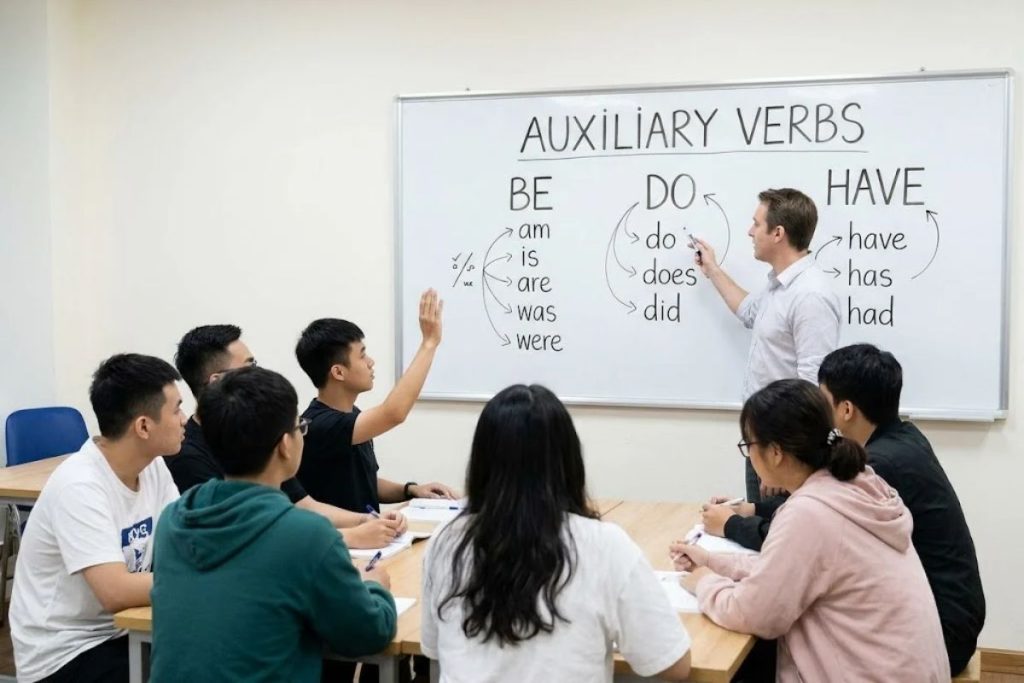
When learning English, many students struggle to form questions, make negative sentences, and use different verb tenses correctly. One common reason is a lack of understanding of auxiliary verbs. Auxiliary verbs, also known as helping verbs, play an essential role in English grammar. They work with main verbs to form tenses, questions, negative statements, passive […]

26
Oct
Learning to communicate confidently in English can open up new opportunities in education, career development, and everyday life. However, finding the right course is not always easy. Some learners need to rebuild their basic knowledge, while others want to improve their pronunciation, speak more naturally, or communicate more effectively at work. Online learning offers a […]

26
Oct
Identifying Information IELTS Reading is a question type that tests your ability to compare statements with information presented in a reading passage. You must decide whether each statement is True, False or Not Given based on the evidence available in the text. Although the task may seem straightforward, many candidates struggle to distinguish between False […]

26
Oct
The simple present tense is one of the fundamental grammar topics that Grade 4 students need to understand when learning English. It helps children talk about their daily routines, describe habits, express likes and dislikes, and share simple facts about the world around them. Learning this tense also prepares students for more advanced grammar topics […]

26
Oct
Diagram Label Completion IELTS Reading is a question type that requires candidates to fill in missing labels on a diagram using information from a reading passage. The diagram may illustrate the structure of a machine, a building, a natural object, or a system described in the text. The main challenge is connecting visual information with […]

26
Oct
Understanding transitive verbs is an essential part of learning English grammar. These verbs help learners express actions clearly, identify objects in sentences, and build grammatically correct structures. Knowing how to use them can also improve writing accuracy and make everyday communication more natural. However, transitive verbs can sometimes be confusing, especially when learners encounter verbs […]

26
Oct
When learning English, many people spend hours searching for books and study materials but still struggle to decide where to begin. Some buy several textbooks at once, while others constantly switch between learning methods without making much progress in listening comprehension or speaking fluency. One possible reason is that their materials do not match their […]

26
Oct
Coordinating conjunctions are an essential part of English grammar. They help connect words, phrases, and independent clauses, making sentences clearer and more logical. By choosing the right conjunction, learners can express addition, contrast, alternatives, reasons, and results more effectively. One helpful way to remember the seven common coordinating conjunctions is the acronym FANBOYS, which stands […]

26
Oct
Building a strong vocabulary is an important first step when learning English from scratch. If you have forgotten basic English or struggle to remember words, starting with familiar topics can make learning easier and more practical. This guide to English vocabulary for beginners introduces essential words for everyday communication, including family, work, daily routines, emotions, […]