

Phrasal verbs are an essential part of English vocabulary. They appear frequently in everyday conversations, reading passages, workplace communication, and English examinations. However, many learners find them challenging because a verb can combine with different particles to create meanings that are not always easy to predict.
To use phrasal verbs confidently, learners need more than a list of definitions. They must understand how these expressions work in context, recognize their grammatical patterns, and practise using them in different situations.
This guide provides 45 phrasal verbs exercises with answers, covering multiple question types, including multiple-choice questions, gap-filling activities, matching exercises, error correction, and sentence rewriting. The questions progress from basic to advanced levels, helping you review familiar expressions and develop a deeper understanding of more complex structures.
For the best results, try to complete each exercise before checking the answer key. This approach will help you identify your strengths, recognize recurring mistakes, and decide which phrasal verbs require further practice.
What Are Phrasal Verbs? Essential Grammar Rules
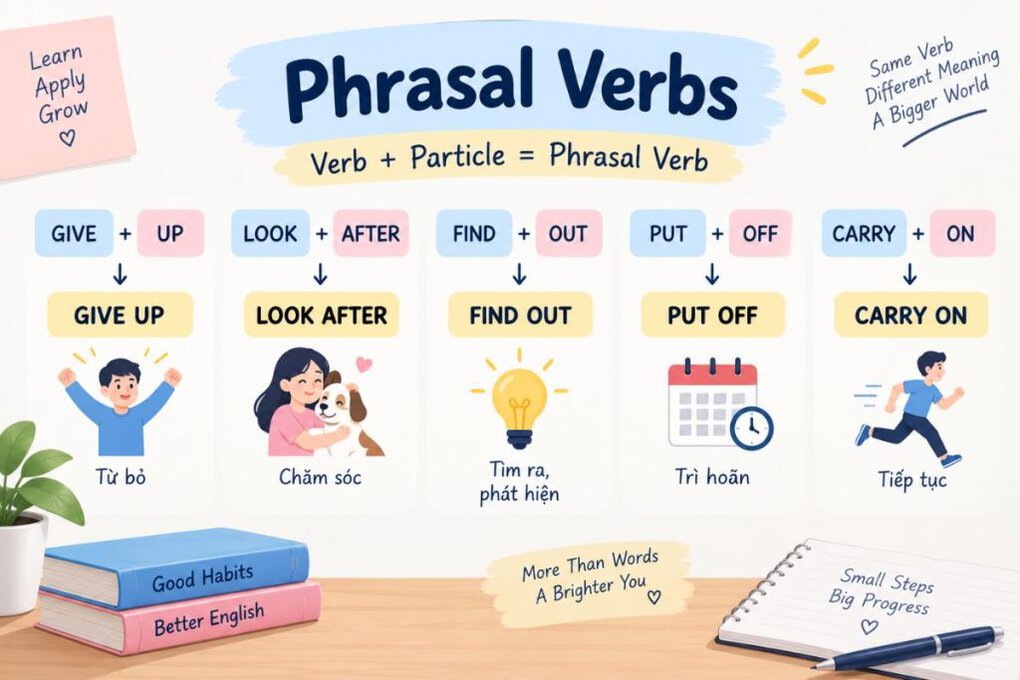
A phrasal verb is a combination of a verb and one or more particles, usually an adverb or a preposition. Together, these elements form an expression with a particular meaning. In many cases, the meaning differs from the literal meaning of the original verb.
Here are some common examples:
- Give up: to stop trying or quit a habit.
- Look after: to take care of someone or something.
- Find out: to discover information.
- Put off: to postpone something.
- Carry on: to continue doing something.
- Come across: to find or encounter something by chance.
- Get over: to recover from a difficulty, illness, or disappointment.
Before starting these phrasal verbs exercises, review three important grammar points.
Meaning depends on context. A phrasal verb may have several meanings. For example, take off can refer to an aircraft leaving the ground or someone removing an item of clothing.
Some phrasal verbs are separable. With certain expressions, the object can appear between the verb and the particle. With others, the components generally stay together.
Pronoun placement matters. When a separable phrasal verb takes a pronoun as its object, the pronoun normally comes between the verb and the particle.
For example:
- Turn off the radio.
- Turn the radio off.
- Turn it off.
All three sentences are grammatically correct. However, when the object is the pronoun it, the standard construction is turn it off, not turn off it.
Basic Phrasal Verbs Exercises
The first section focuses on frequently used phrasal verbs related to daily routines, education, communication, and common activities. Read each sentence carefully and select or supply the expression that best fits the context.
Exercise 1: Choose the Correct Phrasal Verb
Choose the best answer to complete each sentence.
Question 1. Could you ______ the lights before you leave the room?
- turn off
B. look for
C. take after
D. bring up
Question 2. I need to ______ my little brother while my parents are away.
- give up
B. look after
C. find out
D. put off
Question 3. Sarah ______ smoking last year because she wanted to improve her health.
- took off
B. came across
C. gave up
D. turned on
Question 4. We don’t know the exact cause of the problem, but we’re trying to ______.
- find out
B. get up
C. put on
D. go out
Question 5. Please ______ your jacket. It’s quite cold outside.
- take off
B. put on
C. look up
D. give away
Question 6. The plane will ______ at 7:30 p.m., so we should get to the airport early.
- take off
B. turn down
C. carry on
D. break down
Question 7. Tom ______ an old photograph while he was cleaning the attic.
- came across
B. looked after
C. gave up
D. turned off
Question 8. The teacher asked the students to ______ working until the end of the lesson.
- put on
B. carry on
C. take after
D. run into
Exercise 2: Complete the Sentences with Phrasal Verbs
Use each expression in the box once. Change the verb form if necessary.
look for – wake up – put off – turn down – pick up – go out – fill in – set up
Question 9. I usually ______ at 6:30 on weekdays.
Question 10. We had to ______ the meeting because the manager was sick.
Question 11. Could you ______ the volume? I’m trying to concentrate.
Question 12. Please ______ this form before your interview.
Question 13. Anna is ______ a new apartment near her university.
Question 14. I’ll ______ the package from the post office after work.
Question 15. They decided to ______ a small business together.
Question 16. Let’s ______ for dinner tonight.
Exercise 3: Match the Phrasal Verbs with Their Meanings
Match each phrasal verb with the correct definition.
Question 17. break down
Question 18. grow up
Question 19. give away
Question 20. look up
Question 21. put away
- to become an adult
b. to search for information
c. to put something in its proper place
d. to stop working because of a fault
e. to give something to someone without expecting payment
Answers to Basic Phrasal Verbs Exercises
Exercise 1: Multiple-Choice Answers
| Question | Answer | Question | Answer |
| 1 | A | 5 | B |
| 2 | B | 6 | A |
| 3 | C | 7 | A |
| 4 | A | 8 | B |
Exercise 2: Gap-Filling Answers
- Question 9: wake up
- Question 10: put off
- Question 11: turn down
- Question 12: fill in
- Question 13: looking for
- Question 14: pick up
- Question 15: set up
- Question 16: go out
Exercise 3: Matching Answers
- Question 17: d
- Question 18: a
- Question 19: e
- Question 20: b
- Question 21: c
Explanations for Commonly Confused Phrasal Verbs
Question 4 – Find out: This expression means to discover or obtain information that was previously unknown. In the sentence, the speaker is trying to identify the cause of a problem.
Question 7 – Come across: This phrasal verb means to find or encounter something by chance. Tom discovered an old photograph while cleaning the attic, rather than deliberately searching for it.
Question 11 – Turn down: When referring to sound, turn down means to reduce the volume. In contrast, turn up usually means to increase it.
Question 17 – Break down: When used to describe a machine or vehicle, this expression means to stop functioning properly because of a fault.
Advanced Phrasal Verbs Exercises with Answers
The advanced section features longer contexts, expressions with similar meanings, and questions that require careful attention to grammar. Consider the meaning of the entire sentence before selecting an answer.
Exercise 4: Choose the Best Phrasal Verb for Each Context
Question 22. The researchers spent several months trying to ______ why the new treatment was not producing the expected results.
- figure out
B. take over
C. bring about
D. put away
Question 23. Although the negotiations were difficult, both sides agreed to ______ with the discussion rather than ending the meeting.
- carry on
B. break into
C. turn over
D. come off
Question 24. The company has decided to ______ the launch of its new product until more safety tests have been completed.
- bring up
B. put off
C. take in
D. call for
Question 25. When the journalist asked about the controversial decision, the spokesperson tried to ______ the question instead of answering directly.
- get around
B. bring about
C. turn out
D. look into
Question 26. We were surprised to learn that the small startup had ______ a much larger technology company.
- been taken over by
B. looked down on
C. got away with
D. come up against
Question 27. The committee will ______ the complaints before deciding whether further action is necessary.
- look into
B. take after
C. run over
D. give out
Question 28. The event ______ to be much more successful than the organizers had expected.
- came across
B. turned out
C. broke down
D. went without
Question 29. The athlete had to ______ several difficulties during her recovery, but she eventually returned to competition.
- get over
B. bring out
C. take up
D. put through
Exercise 5: Complete the Passage with Phrasal Verbs
Choose expressions from the box to complete the passage. Pay attention to verb tense and sentence structure.
bring about – cut down on – come up with – deal with – go through – rely on
When the city announced a plan to reduce traffic congestion, local businesses had to (30) ______ several changes. Some companies decided to (31) ______ the amount of unnecessary travel by allowing employees to work remotely. Others (32) ______ creative solutions, such as flexible working hours. Although the transition was difficult, these changes eventually (33) ______ significant improvements in traffic conditions. The city also had to (34) ______ concerns from residents who could no longer (35) ______ their usual transportation routes.
Exercise 6: Find and Correct the Mistakes
Each sentence contains one error involving a phrasal verb. Rewrite the sentence correctly.
Question 36. I can’t believe she turned down it after waiting for the opportunity for so long.
Question 37. The manager asked us to look the issue into before contacting the client.
Question 38. He got away with to breaking the rules because nobody noticed.
Question 39. We need to come up a better strategy before the next campaign.
Question 40. She has been looking after a new laptop because her old one is no longer reliable.
Exercise 7: Rewrite the Sentences Using Phrasal Verbs
Rewrite each sentence without changing its meaning. Use the phrasal verb provided in parentheses.
Question 41. The meeting was postponed because several team members were unavailable. (put off)
Question 42. The police are investigating the cause of the accident. (look into)
Question 43. I accidentally found an interesting article while searching for information online. (come across)
Question 44. The new policy resulted in significant changes to the way employees work. (bring about)
Question 45. She managed to recover from the disappointment and started working on a new project. (get over)
Answers to Advanced Phrasal Verbs Exercises
Exercise 4: Multiple-Choice Answers
| Question | Answer | Main meaning |
| 22 | A. figure out | To understand or solve something |
| 23 | A. carry on | To continue |
| 24 | B. put off | To postpone |
| 25 | A. get around | To avoid or find a way around something |
| 26 | A. been taken over by | To be acquired or controlled by another company |
| 27 | A. look into | To investigate |
| 28 | B. turned out | To prove to be or develop in a particular way |
| 29 | A. get over | To recover from or overcome something |
Exercise 5: Gap-Filling Answers
- Question 30: go through
- Question 31: cut down on
- Question 32: came up with
- Question 33: brought about
- Question 34: deal with
- Question 35: rely on
Explanation: Go through describes experiencing a process or a series of changes. Cut down on means to reduce something. Come up with means to think of an idea or solution, while bring about means to cause a change or result. Deal with means to handle a problem, and rely on means to depend on something.
Exercise 6: Corrected Sentences
Question 36: I can’t believe she turned it down after waiting for the opportunity for so long.
Explanation: Turn down is separable. When the object is the pronoun it, the pronoun must come between the verb and the particle.
Question 37: The manager asked us to look into the issue before contacting the client.
Explanation: Look into means to investigate or examine something carefully. The object the issue follows the complete phrasal verb.
Question 38: He got away with breaking the rules because nobody noticed.
Explanation: Get away with is followed by a noun or a gerund. Therefore, breaking is correct, not to breaking.
Question 39: We need to come up with a better strategy before the next campaign.
Explanation: Come up with something means to think of or propose an idea, plan, or solution.
Question 40: She has been looking for a new laptop because her old one is no longer reliable.
Explanation: Look for means to search for something, whereas look after means to take care of someone or something.
Exercise 7: Sentence-Rewriting Answers
Question 41: The meeting was put off because several team members were unavailable.
Question 42: The police are looking into the cause of the accident.
Question 43: I came across an interesting article while searching for information online.
Question 44: The new policy brought about significant changes to the way employees work.
Question 45: She managed to get over the disappointment and started working on a new project.
How to Approach Phrasal Verbs Exercises Effectively
Improving your performance in phrasal verbs exercises requires more than memorizing definitions. A consistent problem-solving process can help you identify the correct expression and avoid common grammatical mistakes.
Read the Entire Sentence Carefully
Start by reading the complete sentence to understand who is performing the action, what is happening, and what the sentence is intended to communicate. Avoid selecting an answer simply because the expression looks familiar.
Use Context to Identify the Correct Meaning
A single phrasal verb may have several meanings depending on the situation.
For example, take off can describe an aircraft leaving the ground or a person removing an item of clothing. Look at the surrounding words to determine which meaning makes sense.
Check the Grammatical Structure
After identifying a suitable meaning, check whether the phrasal verb follows the correct grammatical pattern. Pay particular attention to object placement and the form of the following verb.
For example:
- Turn off the TV.
- Turn the TV off.
- Turn it off.
All three sentences are correct. However, when the object is the pronoun it, the correct pattern is turn it off.
Compare the Options and Eliminate Incorrect Answers
In multiple-choice questions, remove options that do not fit the meaning or grammatical structure. When two expressions have similar definitions, compare how each is normally used in context rather than relying on direct translation.
Review Mistakes with Specific Examples
After finishing an exercise, record the questions you answered incorrectly and identify the reason for each mistake. You can create a study table containing the phrasal verb, its meaning, grammatical pattern, example sentence, and common errors.
Reviewing this table regularly helps reinforce your understanding and makes it easier to recognize familiar expressions in new contexts.
Common Mistakes When Practising Phrasal Verbs
Guessing the Meaning by Translating Each Word
The meaning of a phrasal verb is not always the sum of its individual components. Learn the expression as a meaningful unit and check how it appears in authentic example sentences.
Memorizing Only One Meaning
Some phrasal verbs have several meanings that vary according to context. Studying examples grouped by situation can help you distinguish between these meanings more accurately.
Ignoring Object Placement
Object placement is a common source of grammatical errors. Learn which phrasal verbs are separable and which generally remain together. Remember the special placement rule for pronouns with separable expressions.
Checking Answers Without Understanding the Reasons
Knowing which answer is correct does not automatically mean you understand how to use the expression. After checking your work, explain why the correct option fits and why the alternatives are unsuitable.
Practising Without Real-Life Contexts
Memorizing isolated vocabulary lists may make it difficult to use phrasal verbs naturally. Try writing your own sentences, creating short paragraphs, or incorporating these expressions into everyday conversations.
Frequently Asked Questions About Phrasal Verbs Exercises
What Are the Most Common Phrasal Verbs with Go in Exercises?
Common expressions include go on (continue), go out (leave home or stop shining, depending on context), go over (review or examine), go through (experience or examine carefully), go ahead (proceed), and go back (return). The phrasal verb go off can describe an alarm ringing, an explosive device detonating, or food becoming spoiled. When completing phrasal verbs exercises with go, always use the surrounding context to identify the intended meaning.
How Can I Remember Phrasal Verbs More Effectively?
Study phrasal verbs in topic-based groups, learn them through example sentences, and create your own examples. After each practice session, record unfamiliar expressions and review them at regular intervals. Using the expressions actively in speaking and writing can also help you remember their meanings and grammatical patterns.
Who Should Practise Advanced Phrasal Verbs Exercises with Answers?
Advanced exercises are generally suitable for learners at approximately the B1–B2 level or above, particularly when questions require distinguishing between similar expressions or identifying complex grammatical patterns. However, the appropriate difficulty depends on your vocabulary and reading comprehension. If you are not confident with basic phrasal verbs, begin with simpler exercises before progressing to more challenging questions.
Do I Need to Memorize Every Phrasal Verb Before Practising?
No. You can study and practise phrasal verbs at the same time. Encountering an expression in different contexts helps you understand how it works rather than simply memorizing a translation. Add unfamiliar expressions to your vocabulary notes and revisit questions you answered incorrectly.
Why Do I Choose the Wrong Answer Even When I Know the Meaning?
This often happens because a phrasal verb has multiple meanings, two expressions are easily confused, or the learner does not understand the required grammatical structure. In addition to learning definitions, pay attention to context, object placement, and the words that follow the expression. A reliable dictionary, such as Cambridge Dictionary, can help you check definitions and example sentences.
Keywords:
- phrasal verbs exercises
- phrasal verbs exercises with answers
- phrasal verbs with go exercises
- how to do phrasal verbs exercises
- advanced phrasal verbs exercises with answers
