

The Such…That Structure is an important English grammar pattern used to emphasize the characteristics of a person, object, situation, or experience and explain the result that follows. It is commonly used in both spoken and written English to show how a particular quality or circumstance leads to a specific outcome.
However, English learners sometimes confuse such…that with so…that, so that, and too…to because these structures share some similarities in meaning. Understanding their grammatical patterns and differences can help you write more accurately, communicate more naturally, and perform better in English grammar exercises.
In this guide, you will learn the Such…That Structure, including its formulas, different noun patterns, practical examples, sentence transformations, inversion, and common mistakes to avoid.
What Is the Such…That Structure?
The Such…That Structure is used to emphasize a noun or noun phrase and introduce a result associated with its characteristics. In Vietnamese, it can often be translated as “đến mức,” “đến nỗi,” or a similar expression, depending on the context.
The word such usually comes before a noun or noun phrase, while that introduces the clause describing the resulting situation.
Example:
It was such an interesting presentation that everyone stayed until the end.
In this sentence, such an interesting presentation emphasizes the quality of the presentation. The clause that everyone stayed until the end explains the result.
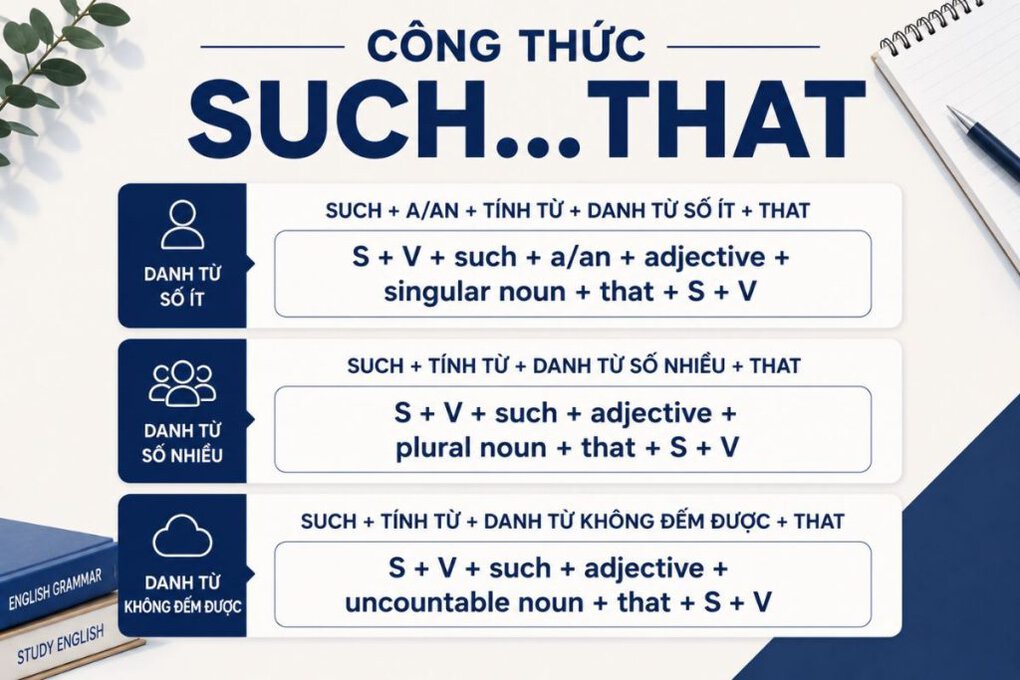
The structure can be used with singular countable nouns, plural countable nouns, and uncountable nouns. The article a or an is necessary in certain singular noun patterns but not with plural or uncountable nouns.
Understanding the noun phrase that follows such is essential for forming grammatically correct sentences.
Such…That Structure: Grammar Rules and Formulas
The formula for the Such…That Structure depends on the type of noun used in the sentence.
Such + A/An + Adjective + Singular Noun + That
When such is followed by a singular countable noun modified by an adjective, use a or an before the adjective.
Formula:
S + V + such + a/an + adjective + singular noun + that + S + V
Examples:
It was such an important decision that we discussed it carefully.
She gave such a clear explanation that everyone understood the problem.
It was such a difficult task that we needed additional help.
In these examples, decision, explanation, and task are singular countable nouns. The article appears before the adjective because it belongs to the noun phrase.
Remember the correct word order: such + a/an + adjective + singular noun.
For example, such an important decision is correct, while such important an decision is incorrect.
The choice between a and an depends on the sound at the beginning of the word immediately following the article.
Such + Adjective + Plural Noun + That
When the noun is plural, do not use a or an.
Formula:
S + V + such + adjective + plural noun + that + S + V
Examples:
They received such positive reviews that they decided to improve the service further.
We faced such difficult challenges that we had to change our original plan.
The students asked such interesting questions that the discussion lasted longer than expected.
The nouns reviews, challenges, and questions are plural countable nouns. Therefore, the noun phrases do not require a singular article.
When completing grammar exercises, identify whether the noun is singular or plural before choosing the appropriate structure.
Such + Adjective + Uncountable Noun + That
When such is followed by an uncountable noun modified by an adjective, an article is not normally required.
Formula:
S + V + such + adjective + uncountable noun + that + S + V
Examples:
There was such strong demand that the company increased production.
We received such useful information that we could make a better decision.
She gave us such helpful advice that we avoided several mistakes.
In these sentences, demand, information, and advice are uncountable nouns in their intended meanings.
Other common uncountable nouns include furniture, equipment, and research. In standard usage, these nouns do not take a or an when used in their ordinary uncountable senses.
Such + Noun Phrase + That
The Such…That Structure does not always require an adjective. The essential element is the noun or noun phrase introduced by such.
Formula:
S + V + such + noun phrase + that + S + V
Examples:
It was such a pleasure that we decided to meet again.
It was such a relief that everyone could finally relax.
In these examples, such a pleasure and such a relief are noun phrases without an adjective between the article and the noun.
This pattern shows why learners should focus on the complete noun phrase rather than assuming that an adjective must always follow such.
How to Use the Such…That Structure
The Such…That Structure is useful when you want to emphasize a characteristic and explain its consequences.
Emphasizing a Quality That Leads to a Result
This is one of the most common uses of the structure. It highlights a quality or characteristic that produces a particular outcome.
Examples:
It was such a stressful week that I decided to take a few days off.
She had such a busy schedule that she rarely had time to relax.
The weather was such a serious concern that the organizers postponed the event.
The noun phrases emphasize the situations, while the clauses introduced by that describe their consequences.
Emphasizing the Intensity of an Experience
The structure can also describe memorable experiences, events, or situations by emphasizing their characteristics.
Examples:
It was such an inspiring experience that I wanted to share it with my colleagues.
They had such a wonderful time that they planned another trip.
It was such an enjoyable event that many guests asked about the next one.
In each example, the noun phrase describes the experience, and the following clause explains what happened as a result.
What Comes After Such?
The word such is generally followed by a noun or noun phrase. Depending on the sentence, that phrase may include an article, an adjective, and a noun.
Examples include:
- Such a difficult task
- Such useful information
- Such positive results
- Such an interesting idea
Do not confuse such with so. When emphasizing an adjective or adverb directly, so is generally the appropriate choice.
Compare these sentences:
The task was so difficult that we needed more time.
It was such a difficult task that we needed more time.
Both sentences express a relationship between a characteristic and a result. However, the first emphasizes the adjective difficult, whereas the second emphasizes the noun phrase a difficult task.
So Much, So Many, So Little, and So Few
When emphasizing quantity with much, many, little, or few, English generally uses so in this result structure rather than placing such directly before these expressions.
Examples:
There was so much information that I needed more time to review it.
There were so many applicants that the company extended the recruitment period.
We had so little time that we could not finish the discussion.
There were so few opportunities that many people decided to move elsewhere.
Remember these combinations because they frequently appear in English grammar exercises and everyday communication.
Such…That vs So…That, So That, and Too…To
These structures may express related ideas, but their grammatical patterns and meanings differ.
Such…That vs So…That
Both structures can express a degree or characteristic that leads to a result. The main difference is the grammatical element being emphasized.
Such…That formula:
Such + noun phrase + that + clause
It was such a difficult task that we needed more time.
So…That formula:
So + adjective/adverb + that + clause
The task was so difficult that we needed more time.
The first sentence emphasizes the noun phrase a difficult task. The second emphasizes the adjective difficult.
| Structure | Formula | Main function |
| Such…that | Such + noun phrase + that + clause | Emphasizes a noun phrase and introduces a result |
| So…that | So + adjective/adverb + that + clause | Emphasizes an adjective or adverb and introduces a result |
| So that | So that + clause | Often expresses purpose |
| Too…to | Too + adjective/adverb + to + verb | Expresses an excessive degree that prevents or makes an action difficult |
Such…That vs So That
Although both structures contain that, they do not serve the same grammatical function.
Such…that expresses a characteristic or degree that leads to a result. In contrast, so that commonly introduces a purpose, explaining why someone performs an action.
Example with such…that:
It was such a difficult exam that many students needed extra time.
Example with so that:
She explained the instructions slowly so that everyone could understand them.
In the first sentence, the second clause describes the result of the exam being difficult. In the second, the clause introduced by so that explains the purpose of speaking slowly.
Such…That vs Too…To
The too…to structure expresses an excessive degree, often suggesting that an action cannot be performed or is difficult to perform under the circumstances.
Formula:
Too + adjective/adverb + to + verb
Example:
The report was too complicated for me to understand quickly.
A sentence with a similar meaning can be written using such…that:
It was such a complicated report that I couldn’t understand it quickly.
Although the sentences communicate similar ideas, the structures are not always interchangeable. Consider the subject, verb, and intended meaning before rewriting a sentence.
How to Transform Sentences Using the Such…That Structure
A common grammar exercise asks learners to rewrite sentences using such…that instead of so…that.
To complete this task, identify the adjective in the original sentence and build an appropriate noun phrase around it.
Step-by-Step Sentence Transformation
Step 1: Identify the adjective in the original sentence.
Original sentence:
The presentation was so impressive that everyone paid attention.
The adjective is impressive.
Step 2: Identify a suitable noun.
The noun in the original sentence is presentation.
Step 3: Create a noun phrase with such.
The appropriate phrase is such an impressive presentation.
Step 4: Rewrite the sentence while keeping the result clause.
Rewritten sentence:
It was such an impressive presentation that everyone paid attention.
When transforming sentences, check the article, noun number, verb tense, and meaning. The rewritten sentence should preserve the essential message of the original.
So + Adjective + A/An + Singular Noun + That
Another pattern you may encounter is:
So + adjective + a/an + singular noun + that + clause
Example:
It was so difficult a negotiation that both sides needed more time.
This sentence can be rewritten as:
It was such a difficult negotiation that both sides needed more time.
The pattern so + adjective + a/an + noun is more formal and less common in everyday conversation. Recognizing it can help you understand written English and complete sentence-transformation exercises.
Inversion in the Such…That Structure
Inversion is a grammatical technique that changes the usual word order to place emphasis on a particular expression. In formal English, such can appear at the beginning of a sentence to emphasize the extent or nature of a situation.
Such Was and Such Were
A common inversion pattern is:
Such + be + noun phrase + that + clause
Examples:
Such was the demand for the product that the company had to increase production.
Such was the pressure that she decided to take a break.
The first sentence can also be written in a more conventional order:
The demand for the product was such that the company had to increase production.
Both versions describe a strong demand that led the company to increase production. The inversion places greater emphasis on the situation.
The choice between was and were depends on the grammatical number of the subject.
- Such was + singular or uncountable noun: Such was the pressure that she decided to take a break.
- Such were + plural noun: Such were the difficulties that the team needed additional support.
This pattern is useful for reading and formal writing. In everyday communication, the conventional sentence structure is often more direct.
Common Mistakes When Using the Such…That Structure
Understanding common errors can help you apply the grammar rules more accurately.
Confusing Such and So
Learners sometimes replace so with such without changing the rest of the sentence.
To avoid this error, identify the element being emphasized. Use such with a noun phrase and so with an adjective or adverb in the relevant result structure.
Forgetting the Article Before a Singular Countable Noun
A singular countable noun usually requires an article in the pattern such + a/an + adjective + noun.
Incorrect: It was such difficult task that we needed help.
Correct: It was such a difficult task that we needed help.
Check the noun phrase before completing the sentence.
Placing A/An in the Wrong Position
The article should appear before the adjective that modifies the singular countable noun.
Incorrect: Such difficult a task
Correct: Such a difficult task
Learning complete noun phrases can help you remember the correct word order.
Using Such with Much, Many, Little, and Few
When emphasizing quantity in this type of result construction, English generally uses so with these words.
Examples:
- So much work that…
- So many people that…
- So little time that…
- So few opportunities that…
Practising these expressions as complete phrases can make the correct structure easier to remember.
Replacing So with Such Without Rewriting the Sentence
The two words follow different grammatical patterns. When transforming a sentence, identify a suitable noun and rebuild the noun phrase instead of simply replacing one word.
Confusing Results with Purposes
Such…that commonly expresses a result, while so that often expresses purpose. Examine the relationship between the clauses before choosing the structure.

Overusing Inversion
Inversion can add emphasis, but it often sounds more formal than the conventional word order. Choose the structure that suits the context instead of using inversion in every sentence.
The Such…That Structure helps you express how a characteristic or situation leads to a particular result. By learning its formulas, understanding the differences between related structures, and practising sentence transformations, you can strengthen your English grammar and improve your accuracy in both writing and speaking.
Start with the basic noun patterns, review the examples, and gradually practise more complex sentences. Regularly checking your mistakes will help you recognize the structure more confidently in different contexts.
Frequently Asked Questions About the Such…That Structure
When should I use the Such…That Structure instead of So…That?
Use such…that when emphasizing a noun or noun phrase, and use so…that when emphasizing an adjective or adverb. For example, such a difficult task emphasizes the noun phrase, while so difficult emphasizes the adjective. The appropriate choice depends on the grammatical structure of the sentence.
Can I use Such…That instead of So That?
These structures should not be used interchangeably without considering meaning. Such…that expresses a characteristic or degree that leads to a result, whereas so that often explains the purpose of an action. Examine the relationship between the clauses to determine which structure is appropriate.
Does Such…That always mean “to such an extent that”?
Not necessarily. The structure emphasizes a noun or noun phrase and introduces a related result. Depending on the context, it may be translated using expressions such as “to such an extent that” or “so…that.” The most natural translation depends on the meaning of the complete sentence.
Can I omit That in the Such…That Structure?
For learners using the standard result construction, it is best to retain that because it introduces the result clause and makes the grammatical relationship clear. Follow the full pattern when practising sentence formation and transformation.
Is the Such…That Structure common in everyday English?
Yes. The structure can be used in everyday communication to emphasize a characteristic and its consequences. However, inversion patterns such as Such was the demand that… are generally more formal than conventional sentence structures.
Does Such always need an adjective after it?
No. Such is followed by a noun or noun phrase, which may or may not contain an adjective. For example, such useful information contains the adjective useful, whereas such a pleasure does not have an adjective between the article and the noun.
Keywords:
- Such That Grammar Rules
- Such…That vs So…That
- How to Use Such…That
- Such…That Sentence Transformation
- Such…That Examples and Exercises
