

Learning how to study for IELTS on your own can be an effective way to improve your English, manage your schedule, and prepare for the test at your own pace. However, successful self-study requires more than downloading practice materials or completing test after test. You need a structured plan based on your current English level, target band score, and available study time.
The IELTS test assesses four language skills: Listening, Reading, Writing, and Speaking. Each skill requires different techniques, so your preparation should cover all four areas rather than focusing only on the sections that are easier to practise independently.
If you are starting from scratch, the best approach is to build a strong English foundation before moving on to IELTS-specific exercises. Once you are comfortable with essential grammar, vocabulary, pronunciation, and listening comprehension, you can gradually develop your test-taking skills.
This guide explains how to create an IELTS self-study plan, practise each skill effectively, choose suitable learning resources, and track your progress at home.
Set Your IELTS Goals Before You Start
Before creating a study schedule, identify why you need IELTS and what score you are aiming for. Your purpose may be university admission, professional development, immigration, or another personal goal. This will help you determine which test format and score requirements are relevant to your situation.
Assess Your Current English Level
Start by evaluating your English proficiency through a placement test or an IELTS practice test. Review your performance in each skill instead of relying solely on your overall score.
For example, you may understand written texts reasonably well but struggle to express ideas in Writing. In this case, you should spend more time practising essay structure, grammar accuracy, and the development of arguments.
An initial assessment also helps you identify gaps in your vocabulary, pronunciation, and comprehension. Understanding these weaknesses early can prevent you from wasting time on materials that are either too easy or too difficult.
Break Your Target Into Smaller Milestones
Rather than trying to improve your band score within an unrealistic timeframe, divide your preparation into manageable stages.
Your first milestone might be mastering essential grammar and vocabulary. The next could involve learning IELTS question types, followed by developing individual skills and completing timed practice tests.
Your progress will depend on your starting level, study consistency, and the quality of your practice. Review your results regularly and adjust your plan whenever necessary.
Build an IELTS Self-Study Plan From the Ground Up
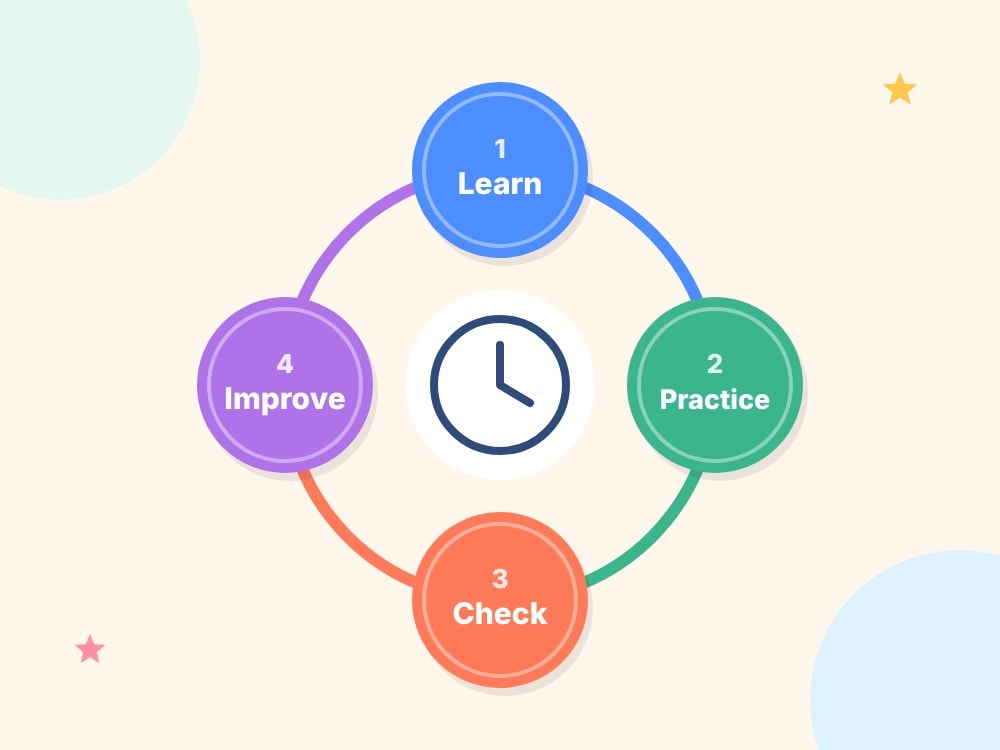
An effective IELTS study roadmap should take you from basic English knowledge to independent test practice. You can organise your preparation into four main stages.
Stage One: Strengthen Your English Foundation
If you are a beginner or have forgotten much of what you learned at school, start with grammar, vocabulary, pronunciation, and basic listening comprehension.
Learn vocabulary by topic, such as education, work, health, technology, and the environment. Instead of memorising isolated words, study common phrases, example sentences, pronunciation, and typical word combinations.
For grammar, focus on essential topics such as verb tenses, passive voice, conditionals, relative clauses, and complex sentences. The goal is not simply to memorise rules but to understand how to use them accurately in context.
Pronunciation practice is equally important. Listen to short recordings, imitate the speaker, and record yourself to compare your pronunciation. Regular practice can help you recognise spoken English more easily and communicate more clearly.
Stage Two: Understand the IELTS Test Format
Once you have established a basic foundation, learn about IELTS Academic and IELTS General Training. Choose the format that matches your intended use of the test.
Familiarise yourself with the structure, timing, instructions, and question types in each section. Listening and Reading each contain 40 questions. Speaking consists of three parts, while Writing includes two tasks.
You should also learn how to approach common question types. Reading, for instance, may require you to identify information, match headings, or distinguish between True, False, and Not Given statements.
Understanding the assessment criteria for Writing and Speaking is also essential. These criteria explain how your performance is evaluated, including coherence, vocabulary, grammatical accuracy, and the development of ideas.
Stage Three: Develop All Four IELTS Skills
After becoming familiar with the test format, practise each skill systematically. Begin with individual exercises and gradually move towards more challenging tasks.
Avoid spending all your time on Listening and Reading simply because their answers are easier to check. Writing and Speaking also require regular practice, and neglecting them can limit your overall progress.
You can dedicate different study sessions to different skills while continuing to review grammar and vocabulary. As your confidence grows, combine these activities to develop more flexible English communication skills.
Stage Four: Practise Under Test Conditions
When you understand the main question types and have developed your core skills, begin completing practice tests within the official time limits.
After each test, review your answers carefully and identify why you made mistakes. A wrong answer may result from unfamiliar vocabulary, misunderstanding the question, weak reading strategies, or poor time management.
Keep a record of recurring errors and revisit the relevant topics. If your results remain unchanged, focus on the underlying weakness rather than simply completing more practice tests.
Effective Methods for Self-Studying IELTS at Home
Studying IELTS at home becomes more productive when you use a different approach for each skill. The following methods can help you build confidence and improve your performance.
How to Improve IELTS Listening
Do not expect to understand every detail the first time you listen. Begin with short recordings and focus on identifying the topic and main ideas before working on specific information.
A practical routine involves three steps. First, listen without reading the transcript. Next, compare your understanding with the transcript and identify unfamiliar words or sounds. Finally, listen again and pay attention to connected speech, word stress, and pronunciation.
You should also practise predicting answers before the recording starts. If a question asks for a location, name, or number, identify the type of information you need to hear.
How to Improve IELTS Reading
IELTS Reading requires comprehension, information retrieval, and effective time management. Instead of translating every sentence, practise identifying main ideas and locating information relevant to each question.
One particularly useful skill is recognising paraphrases. The wording in a question may differ from the wording in the passage, even when both express the same idea.
After completing an exercise, review incorrect answers and questions you answered with uncertainty. Identify the evidence that supports the correct answer, especially in True, False, and Not Given questions. This helps you avoid choosing answers based on assumptions or outside knowledge.
How to Improve IELTS Writing
Writing can be challenging because you must organise ideas, develop arguments, and maintain grammatical accuracy at the same time. To make progress, practise individual components before attempting full responses.
Start by analysing the question and identifying exactly what it requires. Create a brief outline, organise your main points, and then write your response.
For IELTS Academic Writing Task 1, learn how to select and describe key features in charts, tables, diagrams, maps, or processes. For Task 2, focus on answering the question directly and supporting each main argument with explanations and relevant examples.
After writing, review your work in three areas: task response, organisation and coherence, and vocabulary and grammar. If possible, seek feedback from a qualified teacher or experienced IELTS tutor to identify problems you may not notice yourself.
How to Improve IELTS Speaking
To improve Speaking, practise answering common questions naturally rather than memorising complete sample answers.
For Part 1, answer directly and add a brief explanation or example. For Part 2, practise making quick notes before delivering a longer response with a clear structure. For Part 3, develop your ability to explain causes, compare viewpoints, and support opinions with examples.
Recording yourself is a useful self-study technique. Listen to your responses and evaluate your fluency, pronunciation, vocabulary range, and grammatical accuracy.
If you often hesitate while speaking, practise discussing one topic for a short period each day. Focus on expressing your ideas clearly and confidently rather than forcing yourself to use complicated vocabulary.
Create a Realistic IELTS Study Schedule
Your study schedule should fit your work, education, and personal commitments. Beginners can start with approximately 60–120 minutes a day, depending on their availability and current English level.
A sample daily schedule might look like this:
| Study Time | Activity |
| 15 minutes | Review vocabulary and useful phrases |
| 20 minutes | Study grammar or practise pronunciation |
| 30 minutes | Work on one IELTS skill |
| 15–30 minutes | Review answers and record mistakes |
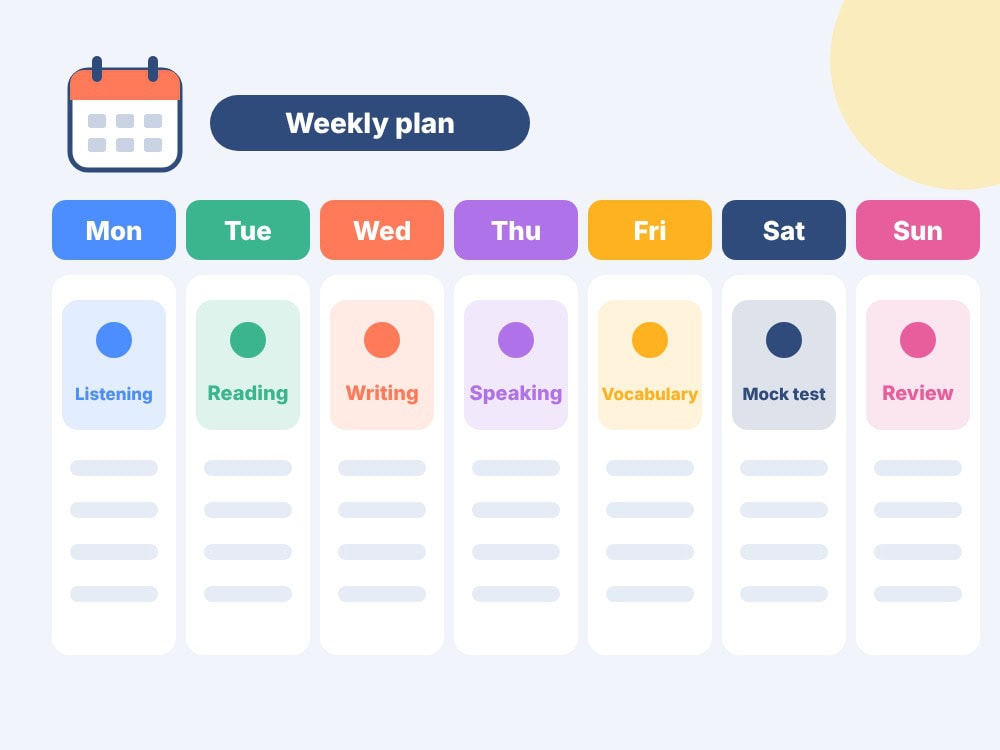
You do not need to practise all four skills in every session. Instead, rotate Listening, Reading, Writing, and Speaking throughout the week, giving extra attention to areas where you need improvement.
At the end of each week, review what you have completed and decide what to prioritise next. If your schedule feels overwhelming, reduce the workload to a manageable level rather than abandoning your routine altogether.
Consistency is more important than occasional intensive study sessions that are difficult to maintain.
Recommended IELTS Self-Study Books and Materials
Choosing suitable IELTS self-study books and online resources can make your preparation more organised. Rather than using too many resources at once, begin with a small collection that addresses your main learning needs.
Consider including the following types of materials in your study plan.
Foundation materials: Grammar references, vocabulary resources, and pronunciation exercises suitable for your current level.
Skill-specific materials: Guides that explain IELTS question types, problem-solving techniques, and approaches to individual tasks.
Practice tests: Materials with answer keys, audio recordings, and transcripts for reviewing Listening and Reading performance.
Assessment resources: Writing and Speaking band descriptors that explain the criteria used to evaluate test performance.
When choosing IELTS self-study materials, check the source, level of difficulty, relevance to your test format, and quality of the answer explanations.
For Writing and Speaking, combine independent practice with expert feedback whenever possible. This can help you identify recurring mistakes and develop more effective strategies.
Common Mistakes to Avoid When Self-Studying IELTS
One common mistake is collecting too many learning resources without following a clear plan. Constantly switching between books, websites, and study methods makes it difficult to measure progress and consolidate knowledge.
Another mistake is focusing only on test scores rather than understanding the reasons behind them. If you repeatedly struggle with a particular question type, identify the missing skill and practise it directly.
You should also avoid relying entirely on model answers in Writing and Speaking. Sample responses can demonstrate useful structures and vocabulary, but memorising them mechanically may result in unnatural language and answers that do not address the actual question.
Finally, do not compare your progress too closely with that of other learners. Everyone starts with a different level of English and has different goals, resources, and study commitments.
A realistic schedule, regular error analysis, and consistent practice will help you make more sustainable progress.
Learning how to study for IELTS on your own becomes easier when you have a clear goal, a structured roadmap, and a reliable way to evaluate your performance. Start with your current English level, strengthen your foundation, develop all four skills, and gradually introduce timed practice tests.
Throughout the process, reviewing mistakes and adjusting your study plan should be part of your regular routine. With a practical approach and consistent effort, you can make meaningful progress towards your target IELTS band score.
Frequently Asked Questions About Self-Studying IELTS
Can I achieve IELTS Band 7.0 through self-study?
Yes. It is possible to work towards Band 7.0 through independent study. Your results will depend on your starting level, preparation time, study methods, and ability to identify and correct mistakes. Feedback from an experienced teacher can be particularly helpful for Writing and Speaking.
Where should beginners start when studying IELTS?
Beginners should start with pronunciation, essential vocabulary, basic grammar, and listening comprehension. Once they have developed a stronger foundation, they can learn the IELTS test format and practise individual question types.
How many hours a day should I study IELTS?
You can begin with approximately one to two hours a day, adjusting the schedule to fit your commitments. Consistency, focused practice, and regular review are more useful than studying for long hours without a clear purpose.
Can I prepare for IELTS without a teacher?
Yes. Many aspects of IELTS preparation, including vocabulary, grammar, Listening, and Reading, can be practised independently. However, Writing and Speaking often benefit from expert feedback because some weaknesses are difficult to identify through self-assessment alone.
Should I start doing IELTS practice tests immediately?
You can complete an initial practice test to assess your current level, but avoid relying on full tests before developing the necessary foundation. Build your core skills first, then increase the frequency of timed practice as you become more confident.
Related Keywords
- IELTS self-study books
- IELTS self-study materials
- IELTS study roadmap
- Self-study IELTS at home
- IELTS self-study methods
