
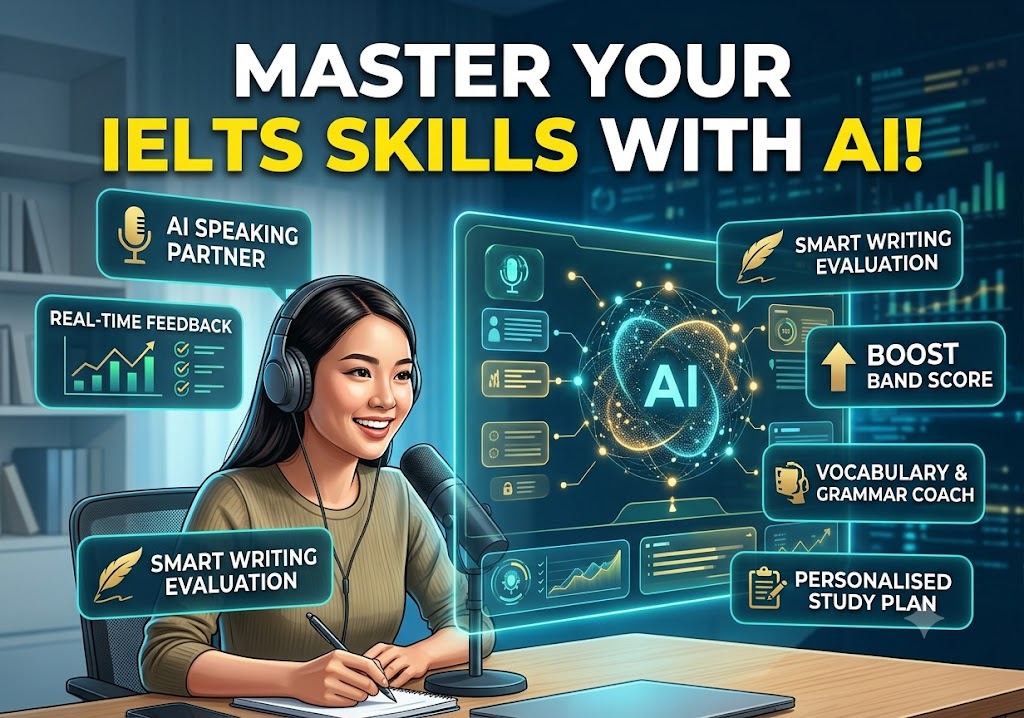
Preparing for IELTS with AI has become increasingly popular because of its flexibility and ability to support learners outside regular study hours.
AI can help learners practice vocabulary and grammar, improve pronunciation, develop Speaking and Writing skills, and analyze mistakes. In this article, you will learn how to prepare for IELTS effectively with AI, understand its limitations, and choose suitable learning tools.
What Is IELTS Preparation with AI?
IELTS preparation with AI involves using artificial intelligence tools to support the IELTS learning process. These tools can suggest vocabulary, correct grammatical errors, analyze pronunciation, generate practice questions, and provide feedback on Writing and Speaking.
AI helps learners practice more independently and consistently while receiving quick feedback without having to rely entirely on fixed class schedules.
However, AI should be considered a supporting tool rather than a complete replacement for a suitable study plan, reliable learning materials, and the ability to evaluate personal progress.
Who Is IELTS Preparation with AI Suitable For?
Not every learner should use AI in the same way. Depending on their proficiency level and goals, this approach can be particularly useful for the following groups.
Beginners who need to strengthen their foundations: You can use AI to explain grammar, suggest topic-related vocabulary, correct simple sentences, and generate short exercises before moving on to IELTS practice tests.
Self-learners who need quick feedback: AI can help identify grammatical errors, suggest alternative expressions, and provide initial feedback on Writing essays and Speaking responses. However, you should compare its feedback with reliable learning resources to avoid adopting inaccurate information.
Busy learners who need flexible study options: You can use AI for short daily practice sessions, such as correcting a Writing paragraph, practicing pronunciation, or answering Speaking questions. The key is to maintain a consistent study routine and set a clear objective for each session.
How to Practice Each IELTS Skill with AI
IELTS assesses four main skills: Listening, Reading, Writing, and Speaking. When preparing for IELTS with AI, you should choose tools and methods that suit the specific requirements of each skill rather than applying the same approach to all four.
Practicing IELTS Listening with AI
For Listening, AI can help generate audio transcripts, explain vocabulary from recordings, and analyze the causes of listening mistakes.
An effective approach is to listen to the recording first and write down your answers independently before using AI to check them. You can ask AI to explain why you missed keywords, failed to recognize connected speech, or misunderstood pronunciation in context.
This approach helps you identify weaknesses and improve listening comprehension instead of simply checking the correct answers after each exercise.
Practicing IELTS Reading with AI
For Reading, AI can help analyze complex sentences, explain academic vocabulary, identify paraphrases, and clarify the relationship between questions and information in a passage.
Instead of asking AI to translate an entire reading passage into your native language, focus on understanding sentence structures, identifying main ideas, and recognizing different ways of expressing the same information.
This method helps improve reading comprehension and information-searching skills while reducing dependence on translation.
Practicing IELTS Writing with AI
For Writing, AI can help identify grammatical errors, suggest better word choices, and improve the coherence of an essay.
You should ask AI to review your writing according to the four IELTS assessment criteria: Task Response, Coherence and Cohesion, Lexical Resource, and Grammatical Range and Accuracy.
For example:
- Incorrect: The number of people were increased in 2020.
- Correct: The number of people increased in 2020.
In this sentence, “were increased” is not appropriate when describing a numerical figure that increased. The verb “increased” is more suitable for the intended meaning.
When receiving feedback from AI, try to understand the reason behind each correction and record recurring mistakes so you can avoid repeating them in future essays. Do not simply copy the corrected version without understanding how the structure works.
Practicing IELTS Speaking with AI
Practicing IELTS Speaking with AI is suitable for learners who want to improve their response speed, practice topic-based questions, and check basic pronunciation.
You can ask AI to generate questions for Speaking Parts 1, 2, and 3. Then, answer the questions independently, record your responses, and ask AI to provide feedback on content, vocabulary, coherence, and pronunciation if the tool supports these features.
In addition to correcting errors, you can ask AI to suggest ways to develop your ideas, provide relevant examples, and make your answers sound more natural.
However, Speaking is not assessed solely on grammatical accuracy. Learners also need to develop their ideas, express themselves naturally, use relevant examples, and maintain a steady speaking pace.
Therefore, prioritize speaking aloud and practicing spontaneous responses instead of simply reading or memorizing AI-generated sample answers.
Benefits and Limitations of IELTS Preparation with AI
AI offers many advantages for IELTS preparation, but learners should understand both its strengths and limitations to use these tools effectively.
For vocabulary learning, AI can suggest topic-related words, explain their meanings, and provide example sentences. However, you should check the context in which words are used to avoid choosing vocabulary that is too advanced or sounds unnatural.
For grammar, AI can identify basic errors and suggest sentence corrections. Nevertheless, it may overlook subtle differences in meaning or fail to fully understand the writer’s intended message.
For Writing, AI can correct errors, recommend sentence structures, and provide feedback on coherence. Learners should treat this feedback as a reference rather than relying entirely on AI-generated scores.
For Speaking, AI can generate questions, suggest sample answers, and support response practice. However, you still need to practice speaking aloud regularly instead of simply reading model answers.
AI can also recommend study plans based on individual learning goals. These plans should be adjusted according to your actual proficiency level, personal needs, and available study time.
The key principle is to use AI as a practice assistant rather than allowing it to determine your entire IELTS study strategy.
Common Mistakes When Preparing for IELTS with AI
To make IELTS preparation with AI more effective, especially when studying independently at home, you should avoid the following common mistakes.
Depending entirely on AI: Using AI as your only learning resource without consulting reliable materials or checking your knowledge may lead you to accept inaccurate feedback.
Memorizing sample answers: Learning ready-made responses by heart does not fully develop your ability to think independently, organize ideas, or respond spontaneously to unfamiliar questions.
Failing to verify feedback: AI may provide suggestions that are inappropriate for the context or your intended meaning. You should review important corrections before applying them.
Using overly difficult vocabulary: Including too many complex words in essays or Speaking responses can make your language sound unnatural. Prioritize accuracy and appropriate word choice instead.
Practicing without a plan: Studying randomly makes it difficult to monitor progress and identify areas that need improvement. A structured schedule can help you maintain consistent habits and evaluate your results more effectively.

A Weekly IELTS Study Plan Using AI
To prepare for IELTS effectively with AI, organize your goals by day instead of studying randomly. Focusing on a few clear tasks each day makes it easier to track your progress.
Monday – Reading: Ask AI to analyze complex sentences, explain vocabulary, and identify equivalent expressions or paraphrases in reading passages.
Tuesday – Listening: Use AI to check transcripts, investigate the causes of listening mistakes, and learn additional topic-related vocabulary.
Wednesday – Writing Task 1: Ask AI to correct errors in data descriptions, improve sentence structures, and suggest appropriate linking words.
Thursday – Speaking Part 1: Ask AI to generate questions, practice short answers, and provide feedback on basic pronunciation.
Friday – Writing Task 2: Use AI to suggest essay outlines, check the logic of arguments, and improve the development of ideas.
Weekend – Review: Summarize recurring mistakes, review previously learned material, and ask AI to generate short exercises to reinforce your knowledge and prepare for the following week.
You do not need to study for long periods during every session. What matters most is practicing consistently, reviewing previous mistakes, and adjusting your learning methods according to your actual ability.
Preparing for IELTS with AI is a flexible learning approach for people who want to study independently and receive quick feedback throughout their learning journey.
However, to achieve effective results, learners need to use AI selectively, verify its feedback, and maintain a clear study plan. Combining AI tools with suitable learning materials, effective practice methods, and regular self-assessment can help you improve your IELTS skills systematically.
When used appropriately, AI can become a valuable additional resource throughout your IELTS preparation journey.
Frequently Asked Questions
Can AI grade IELTS accurately?
AI can provide feedback on Writing and Speaking, including grammatical errors, vocabulary usage, and coherence. However, AI-generated scores are not official IELTS results and may differ from assessments made by IELTS examiners.
What criteria should I use when choosing free IELTS learning apps?
You should prioritize apps that offer practice materials for individual skills, clear feedback on mistakes, exercises suited to your proficiency level, and progress-tracking features. You should also check the usage limits of free versions to find a tool that suits your learning needs.
Should beginners use AI to learn IELTS?
Yes. Beginners can use AI to learn vocabulary, strengthen their grammar, practice pronunciation, and improve basic reading comprehension. Once they have established a solid foundation, they can gradually move on to individual IELTS skills and full practice tests.
Keywords:
- Free AI-powered websites for IELTS Speaking practice
- Learn IELTS for free at home
- Where to study IELTS online
- Free IELTS learning websites
- Self-study IELTS at home
- Free AI tools for IELTS Speaking practice
