
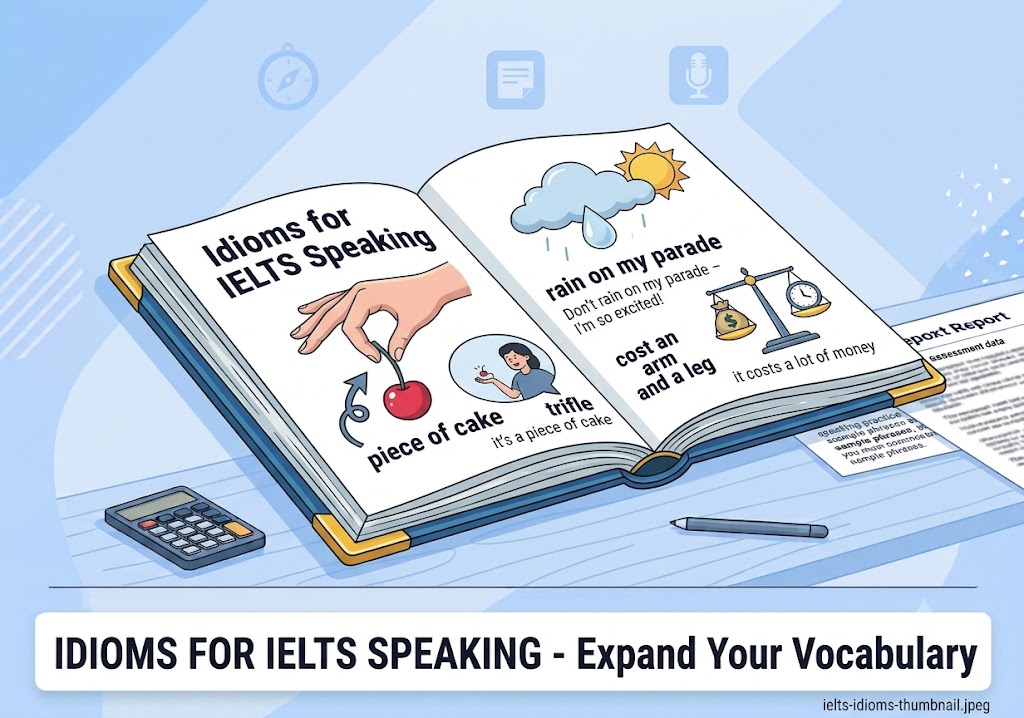
Having a rich vocabulary is an advantage in the IELTS Speaking test. Using idioms can make your speech more fluent and help you sound more like a native speaker.
The Lexical Resource criterion accounts for 25% of the total score in the Speaking test. Examiners always value candidates who know how to use vocabulary flexibly.
This article will provide a high-quality list of idioms for IELTS Speaking. Let’s explore them and upgrade your speaking skills today.
Why Should You Use Idioms for IELTS Speaking in the Test?
Many candidates often focus on complex grammatical structures and overlook the importance of natural language. Using idioms skillfully can make your speech more fluid and expressive.
When you use idioms in the right context, examiners can see your in-depth understanding of the language. This is the key to moving beyond average scores and aiming for a higher band.

The Role of IELTS Idioms in the Lexical Resource Criterion
Idioms are an essential part of everyday communication among native speakers. Therefore, understanding and using them demonstrates your language proficiency.
For candidates aiming for Band 7.0 or above in Speaking, using fixed expressions can be highly beneficial. They add emphasis to your sentences and make your speech more expressive.
However, you should not overuse idioms in a single answer. Doing so can backfire and make your speech sound forced and unnatural.
Common Mistakes When Using English Idioms in the Speaking Test
The biggest mistake learners make is memorizing vocabulary lists and forcing idioms into their answers. Examiners can easily notice hesitation when you struggle to remember an idiom.
Another common mistake is using an idiom in the wrong context or using an incorrect preposition within the expression. Changing just one small word can completely alter the meaning of a phrase.
Instead of learning idioms indiscriminately, you should focus on expressions with a wide range of practical applications. Understanding how to use them correctly will help you feel more confident when responding to the examiner.
A Collection of IELTS Idioms by Popular Topic
To study effectively, categorizing idioms by topic is an optimal approach. This method helps you make connections and apply expressions when you encounter related questions.
Below are carefully categorized expressions covering topics that frequently appear in the Speaking test. You can write them down and practise using them during your daily speaking sessions.
Image
IELTS Idioms About Emotions and People
Emotions are a common topic in Parts 1 and 2 of the Speaking test. You may need to describe happiness, sadness, or someone’s personality.
The expression “over the moon” is a common idiom used to describe a state of extreme happiness. For example, you can use it to talk about how you felt when you received a meaningful gift.
- Over the moon: Extremely happy.
- Down in the dumps: Feeling sad or disappointed.
- A piece of cake: Describing something that is very easy to do.
When describing a hardworking person, the expression “eager beaver” is a suitable choice. Replacing ordinary adjectives with idioms can make your speech more impressive.
Popular Idioms About Time and Work
Time and work pressure are always relevant topics. Candidates often encounter questions about time management or their dream jobs.
Using idioms in this category helps you describe the pressures of everyday life more vividly. Examiners will appreciate your ability to use language expressively.
- Once in a blue moon: Something that happens very rarely.
- Burn the midnight oil: Staying up late to study or work.
- At all costs: Doing whatever is necessary to achieve a goal.
See also: Effective Strategies for Managing Time in the Speaking Test
For example, instead of saying, “I rarely go to the cinema,” you can use a different structure: “I only go to the cinema once in a blue moon.” This sounds more expressive and natural.
Effective Ways to Learn Idioms for IELTS Speaking at Home
Memorizing hundreds of expressions is not easy within a short period. You need a learning plan and scientific study methods to retain them for longer.
Do not try to memorize a long list without practising speaking every day. Instead, make new vocabulary part of your daily communication habits.
Image
Learn to Apply IELTS Idioms in Real-Life Contexts
The best way to master an idiom is to make a sentence with it immediately. You should connect the expression to a real story from your own life.
When you make a personal connection, your brain can retain information more effectively. You will also spend less time translating from Vietnamese into English in your head.
Try writing a short paragraph of about five sentences using the new expressions you have learned. Then read the paragraph aloud to practise your pronunciation and intonation.
Use Flashcards and Mind Maps to Memorize Vocabulary
Mind maps are excellent tools for organizing knowledge visually. You can draw a main topic branch and develop related idioms around it.
Flashcards are also a convenient option for studying anytime and anywhere. Write the expression on one side and its meaning and an illustrative example on the other.
You should learn only three to five expressions a day to ensure quality learning. Consistency is more important than studying too much and forgetting everything shortly afterward.
Important Tips for Achieving a High Score When Using Idioms
Using idioms can be a double-edged sword if you do not know how to use them properly. Incorrect usage can negatively affect the fluency and naturalness of your speech.
Pay attention to your tone and speaking speed when incorporating these expressions into your answers. Naturalness should always be your top priority in the test.
Keep Your Speech Natural and Avoid Overusing Idioms
The purpose of the Speaking test is to assess your ability to communicate in real-life situations. People do not normally use idioms in every sentence during everyday conversations.
You should use only around two to three expressions throughout a section of the test. Using them sparingly can create a memorable impact on your speech.
Focus on answering the examiner’s question directly and accurately first. Idioms are simply a supplementary tool to make your answers more engaging.

Pay Attention to Intonation and Accurate Pronunciation
Mispronouncing a word in an idiom can cause the listener to misunderstand its meaning completely. You need to practise linking sounds and placing stress correctly.
Your intonation when using idioms should rise and fall naturally according to the emotions expressed in the sentence. This helps prevent your speech from sounding monotonous and boring.
You can record your speaking practice to check your pronunciation. This method helps you identify weaknesses and correct them before test day.
Mastering idioms for IELTS Speaking requires a process of consistent practice. It is not a skill you can fully develop after just a few days of studying.
Start with simple expressions that suit your current level. Using vocabulary accurately is always more effective than trying to use difficult expressions.
We hope this collection of idioms will be helpful for your preparation. Good luck with your studies, and we wish you the results you are aiming for in your upcoming test!
Frequently Asked Questions
How many idioms should beginners learn each week?
For beginners, learning three to five idioms per week is a good starting point. Instead of trying to memorize a large number of expressions, focus on understanding their contexts and practising how to use them in real sentences. Repetition and accurate application in everyday communication will help you remember them naturally, preventing rote learning and awkward usage during the test.
Can using idioms make up for grammar mistakes?
Idioms cannot completely compensate for grammatical errors. In the IELTS Speaking test, Lexical Resource and Grammatical Range and Accuracy are assessed as separate criteria, each accounting for 25% of the total score. Therefore, excellent vocabulary and idiom usage can help improve your lexical resource score, but they cannot make up for errors in grammatical structures.
Should you use idioms in Part 3 of the Speaking test?
You can certainly use idioms in Part 3, but you need to be careful. Unlike the more conversational nature of Part 1, Part 3 involves a more formal and analytical discussion of social issues. Therefore, you should prioritize expressions that are appropriate in tone and avoid overly informal slang to maintain an objective and professional style.
Keyword:
- idioms for IELTS Speaking
- idioms for IELTS
- common idioms
- IELTS Speaking idioms
- idioms for IELTS
- idioms in English
- popular idioms
- IELTS idioms
