
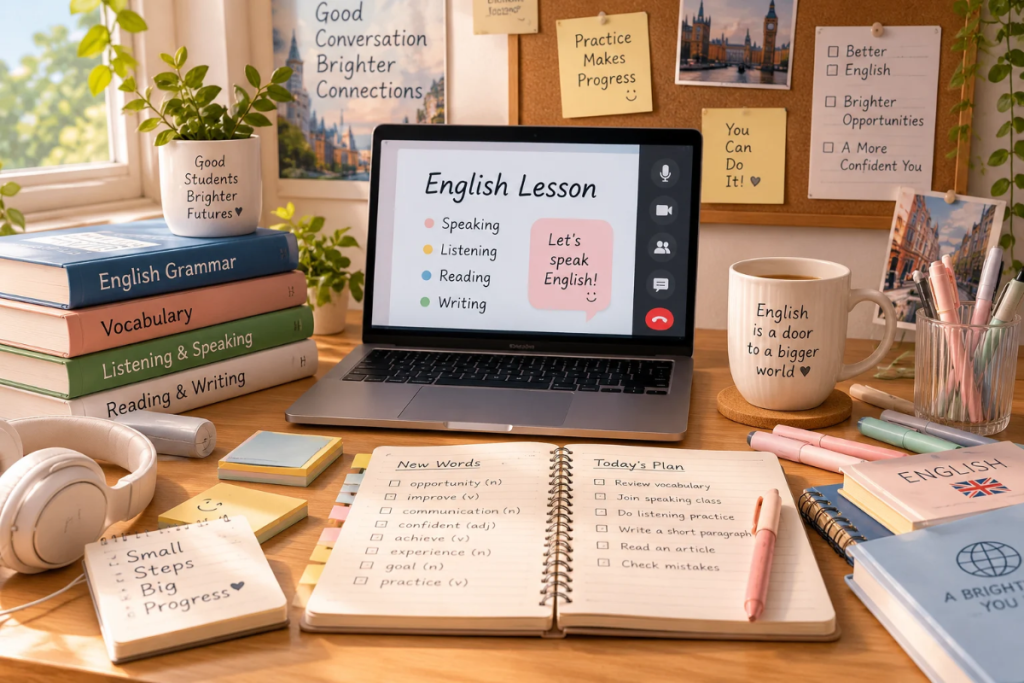
Primary School English Grammar provides the basic rules children need to use vocabulary correctly, build sentences, and express their ideas in English. At the primary school level, students begin learning familiar structures for introducing themselves, describing objects, talking about family and school, and discussing everyday activities.
Instead of memorizing too many rules at once, children should learn grammar one topic at a time, using clear examples and regular practice. This approach helps them understand how grammatical structures work in context rather than simply remembering formulas.
This guide covers essential Primary School English Grammar topics, with illustrative examples, practice exercises, answer keys, and practical study tips to help parents support their children’s learning at home.
Why Is Primary School English Grammar Important?
Grammar helps children connect individual words to form meaningful sentences. When students understand basic structures, they can introduce themselves, describe people and objects, ask questions, and respond in familiar communication situations.
Learning Primary School English Grammar offers several practical benefits:
- Using vocabulary correctly: Children learn how to combine nouns, verbs, and adjectives to form sentences.
- Developing communication skills: Basic sentence patterns help students ask and answer questions in the classroom and everyday life.
- Supporting reading and writing: Understanding sentence structure helps children read more easily and make fewer mistakes when writing.
- Preparing for future learning: A solid foundation helps students approach more advanced grammar topics in higher grades.
At this stage, parents should prioritize understanding and practical application rather than asking children to memorize too many grammatical terms.
Essential Primary School English Grammar Topics
Personal Pronouns and the Verb To Be
Personal pronouns replace the names of people, animals, or things in sentences. They are among the first concepts children learn when studying Primary School English Grammar.
Common personal pronouns include:
| Pronoun | Meaning |
| I | The person speaking |
| You | The person or people being addressed |
| He | A male person |
| She | A female person |
| It | An animal or thing |
| We | The speaker and other people |
| They | Two or more people, animals, or things |
The verb to be has three basic forms: am, is, and are. The correct form depends on the subject.
- I + am: I am a student.
- He/She/It + is: She is my sister.
- You/We/They + are: They are my friends.
Students can also learn common contractions, such as I’m, he’s, she’s, we’re, and they’re.
Singular and Plural Nouns
Nouns name people, objects, places, animals, and things. In English, nouns can be singular or plural depending on the number of items being discussed.
Singular nouns usually refer to one person or thing. Examples include:
- a book
- a cat
- a student
Plural nouns generally refer to two or more people or things. Common spelling rules include the following.
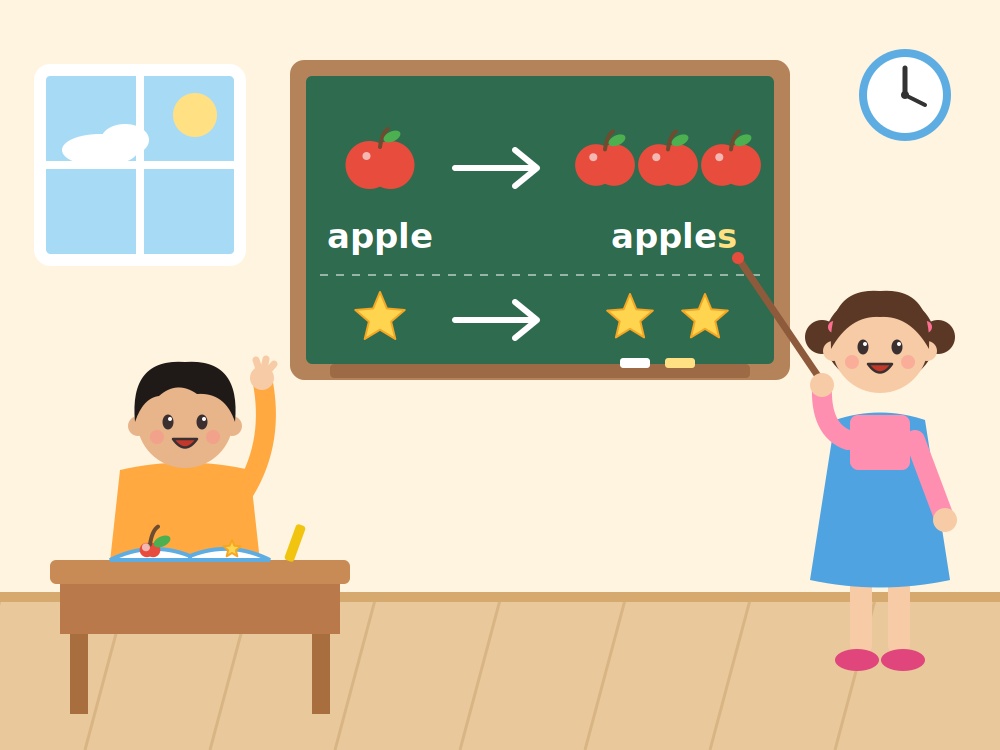
Add -s to many nouns:
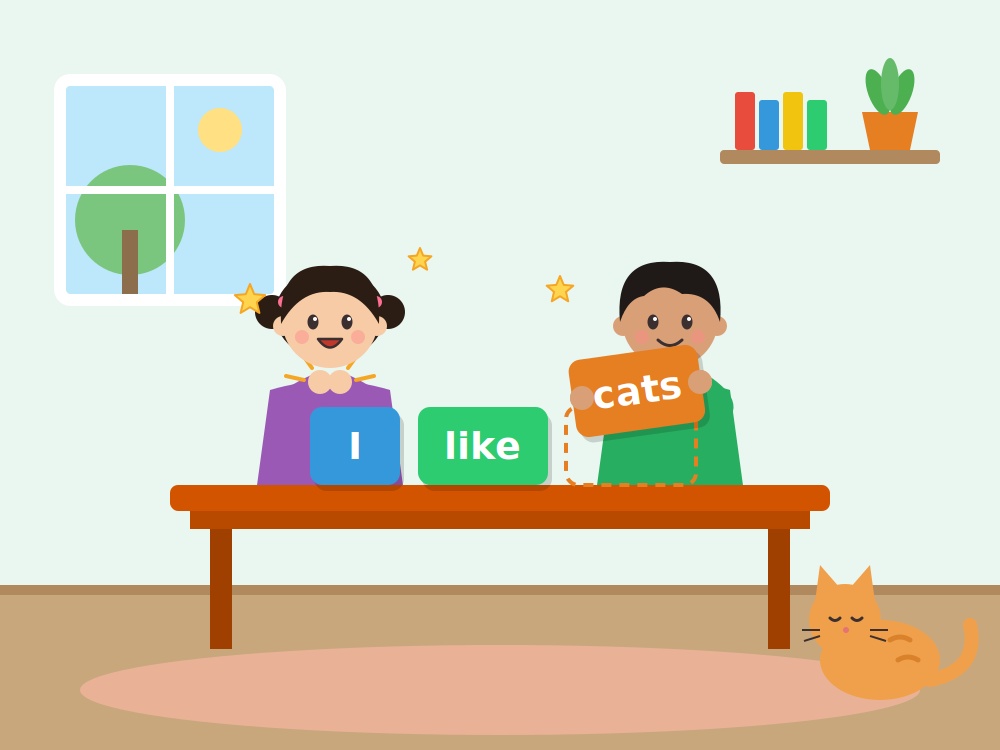
- book → books
- pen → pens
- cat → cats
Add -es to some nouns ending in -s, -sh, -ch, or -x:
- bus → buses
- dish → dishes
- watch → watches
- box → boxes
Change -y to -ies when a noun ends in a consonant + y:
- baby → babies
- family → families
Children should also become familiar with irregular plural nouns, such as child → children, man → men, and woman → women.
The Articles A and An
The articles a and an usually appear before singular countable nouns. The choice depends on the initial sound of the following word, not simply its first letter.
Use a before a word that begins with a consonant sound:
- a book
- a teacher
- a university
Use an before a word that begins with a vowel sound:
- an apple
- an egg
- an umbrella
- an hour
In hour, the letter h is silent, so the word begins with a vowel sound.
Children can practice this rule by looking at pictures and saying phrases such as a dog, an orange, and a pencil.
Descriptive Adjectives and Possessive Adjectives
Descriptive adjectives provide information about the characteristics, size, color, or feelings of people and things.
Common adjectives include:
| Adjective | Meaning |
| Big | Large in size |
| Small | Little in size |
| Tall | Having greater height |
| Short | Not tall or not long |
| Beautiful | Attractive |
| Happy | Feeling pleased |
| New | Recently made or acquired |
| Old | Not new; also used to describe age |
Examples:
- It is a big house.
- She is happy.
- I have a new bag.
Possessive adjectives show who owns or is associated with something.
| Possessive adjective | Meaning |
| My | Belonging to me |
| Your | Belonging to you |
| His | Belonging to him |
| Her | Belonging to her |
| Its | Belonging to an animal or thing |
| Our | Belonging to us |
| Their | Belonging to them |
Possessive adjectives come before nouns. Examples include my book, her pencil, and their classroom.
The Simple Present Tense
The simple present tense describes habits, repeated actions, preferences, and general truths. It is one of the essential topics in Primary School English Grammar.
Affirmative sentences:
- With I/You/We/They: Subject + base verb.
- With He/She/It: Subject + verb ending in -s or -es.
Examples:
- I go to school every day.
- We like English.
- He plays football after school.
Negative sentences:
- I/You/We/They + don’t + base verb.
- He/She/It + doesn’t + base verb.
Examples:
- I don’t like coffee.
- She doesn’t play tennis.
Questions:
- Do + I/you/we/they + base verb?
- Does + he/she/it + base verb?
Examples:
- Do you like cats? — Yes, I do.
- Does he play football? — No, he doesn’t.
Remember that the main verb returns to its base form after does or doesn’t. For example, write She doesn’t like milk, not She doesn’t likes milk.
The Structures There Is and There Are
There is and there are introduce the existence or presence of people, animals, and things.
Use there is with a singular noun or an uncountable noun.
- There is a book on the desk.
- There is a cat in the room.
Use there are with plural countable nouns.
- There are two pens in my bag.
- There are three students in the classroom.
To choose the correct structure, students should identify whether the noun is singular or plural.
Demonstratives: This, That, These, and Those
Demonstratives identify people or things based on their distance from the speaker and the number of items being discussed.
| Demonstrative | Usage | Example |
| This | One person or thing nearby | This is my book. |
| That | One person or thing farther away | That is your bag. |
| These | Several people or things nearby | These are my pencils. |
| Those | Several people or things farther away | Those are birds. |
Students should pay attention to the correct combination of demonstratives and the verb to be:
- This is…
- That is…
- These are…
- Those are…
A practical way to learn these structures is to use objects around the classroom or home. For example, point to a nearby book and say, “This is my book.” Then point to several books farther away and say, “Those are books.”
The Modal Verb Can and Its Negative Form Can’t
Can expresses ability or the possibility of doing something. Can’t is the negative form and indicates that someone is unable to perform an action.
Affirmative structure:
Subject + can + base verb.
Examples:
- I can swim.
- She can sing.
- They can dance.
Negative structure:
Subject + can’t + base verb.
Examples:
- I can’t fly.
- He can’t ride a bike.
Question structure:
Can + subject + base verb?
Examples:
- Can you swim? — Yes, I can.
- Can she dance? — No, she can’t.
An important rule is that the verb following can or can’t always stays in its base form. Do not add -s or -es.
Primary School English Grammar Exercises with Answers
After learning the rules, children should complete short exercises to check their understanding and apply what they have learned.
Multiple-Choice Grammar Exercises
Choose A, B, or C to complete each sentence.
Question 1: I ___ a student.
- am
B. is
C. are
Question 2: She ___ my sister.
- am
B. is
C. are
Question 3: There ___ two books on the table.
- is
B. am
C. are
Question 4: He ___ football every afternoon.
- play
B. plays
C. playing
Question 5: I have ___ orange.
- a
B. an
C. are
Question 6: ___ you swim?
- Is
B. Does
C. Can
Answer key:
- Question 1: A — am
- Question 2: B — is
- Question 3: C — are
- Question 4: B — plays
- Question 5: B — an
- Question 6: C — Can
Fill-in-the-Blank Exercises
Complete each sentence with the correct word.
Question 1: They ___ my friends. (is/are)
Question 2: She ___ a new schoolbag. (have/has)
Question 3: I ___ like milk. (don’t/doesn’t)
Question 4: There ___ a cat under the table. (is/are)
Question 5: ___ you like English? (Do/Does)
Answer key:
- Question 1: are
- Question 2: has
- Question 3: don’t
- Question 4: is
- Question 5: Do
Word-Ordering Exercises
Arrange the words to make complete sentences.
Question 1: my / This / is / book
Question 2: can / She / sing
Question 3: like / They / apples
Question 4: is / a / There / desk / in / the / room
Answer key:
- Question 1: This is my book.
- Question 2: She can sing.
- Question 3: They like apples.
- Question 4: There is a desk in the room.
When checking answers, parents should encourage children to explain why they chose a particular answer. Understanding the rule helps students apply their knowledge to unfamiliar questions.
Effective Ways to Teach Primary School English Grammar
Grammar becomes easier to understand when it is taught in a way that suits children’s ages and learning needs. Instead of studying many formulas in one session, children should combine short lessons with practical activities.
Learn One Small Topic at a Time
Parents can divide grammar into manageable topics, such as personal pronouns, to be, plural nouns, and the simple present tense.
Each study session can focus on one topic, followed by a few short questions. This approach helps children avoid confusing structures that have different uses.
Use Pictures and Familiar Situations
Household objects, school supplies, pictures, and toys can all become learning materials. For example, when studying there is and there are, children can describe the objects in their rooms.
Connecting grammar with familiar situations helps children understand the meaning of sentences and remember how to use them.
Combine Listening, Speaking, Reading, and Writing
Grammar practice should not be limited to written exercises. Children can listen to a model sentence, repeat it aloud, read it, and then write a similar example.
For instance, after learning “I can swim,” a child can replace the verb to make sentences such as “I can sing” or “I can dance.”
Practice in Short Sessions and Correct Mistakes Gently
A study session of around 10–15 minutes may include vocabulary review, one grammar rule, and a short exercise. The duration should be adjusted according to the child’s age and concentration.
When a child makes a mistake, parents can briefly explain the rule, provide a correct example, and give the child another opportunity to try. Rather than asking children to memorize answers, help them understand why the mistake occurred.
Building a Strong Foundation in Primary School English Grammar
Learning Primary School English Grammar does not mean memorizing as many rules as possible in a short time. The key is to understand basic structures, recognize common mistakes, and apply grammar to simple spoken and written sentences.
Parents can support their children by reviewing one topic at a time, using familiar examples, and maintaining a manageable practice schedule. As children strengthen their foundations step by step, they can become more confident and better prepared for English lessons in higher grades.
Frequently Asked Questions About Primary School English Grammar
What Topics Are Included in Primary School English Grammar?
Common topics include personal pronouns, the verb to be, singular and plural nouns, the articles a/an, adjectives, possessive adjectives, the simple present tense, there is/there are, this/that/these/those, and can/can’t. The exact content may vary depending on the grade and curriculum.
At What Grade Should Children Start Learning English Grammar?
Children can begin learning simple sentence patterns and basic grammar structures in the early years of primary school. The material should gradually become more advanced according to the curriculum and each child’s learning progress.
How Can Parents Make Primary School English Grammar Easier to Understand?
Parents can use short sentences, visual aids, and familiar situations. Each session can focus on one rule, followed by games, question-and-answer activities, and short exercises to reinforce understanding.
Should Children Do English Grammar Exercises Every Day?
Children do not necessarily need to complete written grammar exercises every day. They can alternate between vocabulary review, English listening, simple speaking activities, and written practice. If they study daily, sessions should be short enough to suit their age and concentration.
How Can Parents Choose Suitable Primary School English Grammar Materials?
Choose materials that match the child’s grade and current curriculum. Look for clear explanations, age-appropriate examples, and exercises with answer keys. These resources help parents check progress and identify topics that need further review.
Keywords:
- Primary School English Grammar Exercises
- Primary School English Grammar PDF
- Primary School English Grammar Books
- Primary School English Grammar Worksheets
- Basic English Grammar for Primary Students
