
Reflexive pronouns are an essential part of English grammar. They allow speakers and writers to describe actions directed back at the person or thing performing them.
Words such as myself, yourself, herself, and themselves are frequently used in everyday conversations, academic writing and English proficiency tests. Although their forms are relatively easy to remember, using them accurately requires an understanding of how they relate to subjects, objects and sentence meaning.
Learners sometimes confuse reflexive pronouns with personal pronouns or use them unnecessarily to make sentences sound more formal.
This guide explains how reflexive pronouns work, when to use them, how they differ from other pronouns and which mistakes to avoid.
What Are Reflexive Pronouns?
Reflexive pronouns are pronouns that refer back to the subject of a clause when the subject and the object represent the same person or thing.
They commonly indicate that someone performs an action on themselves.
Consider these examples:
- I accidentally cut myself.
- She taught herself to play the piano.
- The children introduced themselves to their teacher.
In each sentence, the reflexive pronoun refers to the person or people performing the action.
For instance, in She taught herself, the subject she and the object herself refer to the same individual.
Reflexive pronouns generally end in -self for singular forms and -selves for plural forms.
The same words can also function as intensive pronouns, emphasizing who performed an action rather than serving as reflexive objects.
Understanding this distinction is important for accurate sentence construction.
Complete List of Reflexive Pronouns
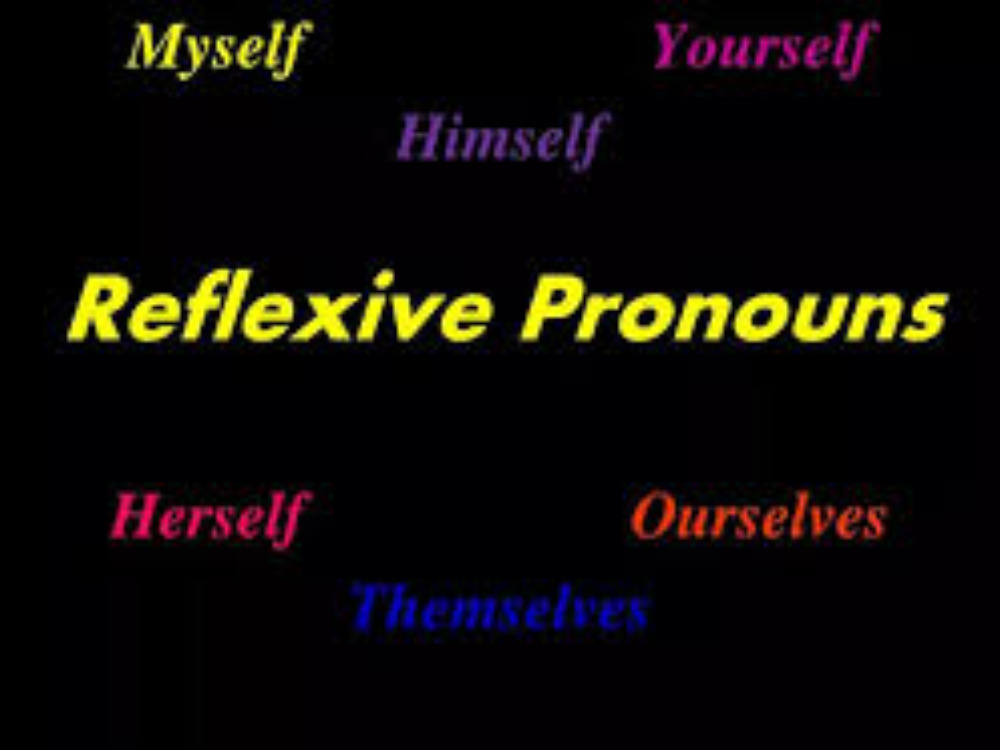
English has eight standard reflexive pronoun forms, corresponding to different personal pronouns.
| Personal pronoun | Reflexive pronoun | Example |
| I | myself | I taught myself Spanish. |
| You (singular) | yourself | You should trust yourself. |
| He | himself | He introduced himself. |
| She | herself | She blamed herself. |
| It | itself | The cat cleaned itself. |
| We | ourselves | We prepared ourselves. |
| You (plural) | yourselves | Make yourselves comfortable. |
| They | themselves | They enjoyed themselves. |
These forms remain the same regardless of whether they appear after verbs or prepositions.
For example:
She looked at herself in the mirror.
She bought herself a new notebook.
In both sentences, herself refers to the subject she.
How Reflexive Pronouns Are Formed
Reflexive pronouns are formed using two common endings.
The singular forms typically end in -self:
- myself
- yourself
- himself
- herself
- itself
The plural forms end in -selves:
- ourselves
- yourselves
- themselves
The first part of these words comes from either a possessive form or an object pronoun.
For example, myself contains my, while himself contains him.
It is therefore inaccurate to assume that all reflexive pronouns are formed exclusively from possessive adjectives.
Reflexive Pronouns and Singular They
Modern English frequently uses singular they when someone’s gender is unknown, irrelevant or expressed through that pronoun.
For example:
Every applicant should prepare themselves for the interview.
Here, themselves refers to the singular noun phrase every applicant.
The form themself also appears in contemporary usage, particularly with singular they. However, themselves remains widely accepted across many formal and everyday contexts.
How to Use Reflexive Pronouns Correctly
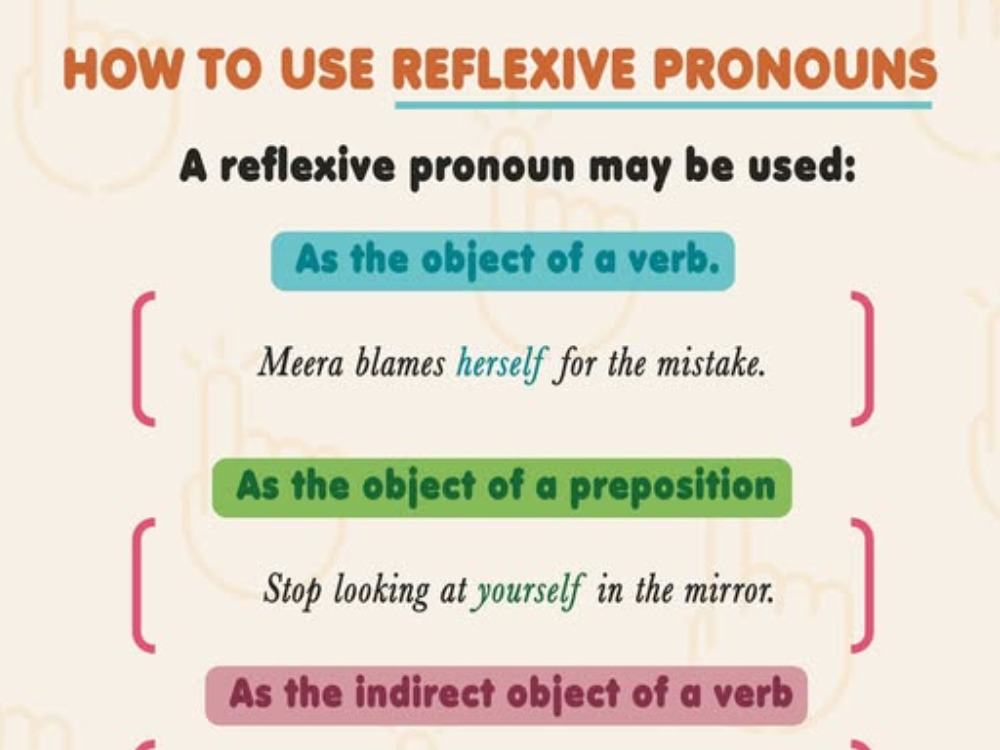
Reflexive pronouns serve several grammatical purposes. Their correct use depends on whether they function as objects, follow prepositions or appear in established expressions.
When the Subject and Object Are the Same
The most common use of a reflexive pronoun occurs when the subject performs an action on itself.
Basic structure:
Subject + Verb + Reflexive Pronoun
Examples:
- He injured himself during the football match.
- I reminded myself to finish the assignment.
- The students introduced themselves at the beginning of the lesson.
In these sentences, the reflexive pronouns act as objects of their respective verbs.
Without them, the meaning may become incomplete or change significantly.
Compare:
She blamed him.
She blamed herself.
The first sentence refers to two different people. The second describes someone directing blame toward herself.
However, not every action performed independently requires a reflexive pronoun. Many ordinary verbs are used without one when the meaning is already clear.
Reflexive Pronouns After Prepositions
Reflexive pronouns can follow prepositions when they refer back to the subject.
Examples:
- He was talking to himself.
- She is proud of herself.
- I bought this present for myself.
- They kept the information to themselves.
Common prepositions used with reflexive pronouns include to, for, of, by and with.
The correct pronoun depends on the intended meaning.
Compare:
She bought a gift for him.
She bought a gift for herself.
The first sentence indicates that someone else receives the gift. The second indicates that the subject is also the recipient.
Reflexive pronouns are therefore not automatically required after prepositions; they are used when the grammatical relationship calls for them.
Reflexive Pronouns for Emphasis
The forms of reflexive pronouns can also emphasize that a particular person or thing performed an action.
In this function, they are called intensive pronouns.
Examples:
- I myself reviewed the documents.
- The director herself announced the decision.
- We completed the entire project ourselves.
The emphasis highlights the identity or direct involvement of the subject.
An intensive pronoun is generally optional. Removing it does not make the sentence grammatically incomplete.
Compare:
The director approved the proposal.
The director herself approved the proposal.
Both sentences communicate the same basic action, but the second emphasizes the director’s personal involvement.
This use is particularly helpful when correcting assumptions or highlighting responsibility.
Common Expressions with Reflexive Pronouns
Reflexive pronouns occur in several frequently used English expressions.
Learning these expressions as complete phrases can make your speaking and writing more natural.
| Expression | Meaning |
| enjoy oneself | to have a pleasant time |
| help oneself to something | to take food or drink freely |
| introduce oneself | to tell others who one is |
| teach oneself | to learn independently |
| behave oneself | to act appropriately |
| express oneself | to communicate thoughts or feelings |
| blame oneself | to hold oneself responsible |
| make oneself at home | to feel comfortable in a place |
Consider the following sentences:
Did you enjoy yourself at the concert?
Please help yourself to some coffee.
He taught himself how to code.
She finds it easier to express herself through writing.
These expressions are common in both informal communication and more structured writing.
Some verbs, such as enjoy in the expression enjoy oneself, require particular attention because the reflexive pronoun is part of the established construction.
Reflexive Pronouns vs. Other Pronouns
Distinguishing reflexive pronouns from other pronoun types helps prevent grammatical errors.
Reflexive Pronouns vs. Object Pronouns
Object pronouns include me, you, him, her, it, us and them.
They identify the person or thing receiving an action but do not necessarily refer back to the subject.
Compare:
The teacher called me.
The teacher called herself.
In the first sentence, me refers to someone other than the teacher.
In the second sentence, herself refers to the teacher.
Another important distinction involves formal communication.
Incorrect: Please send the document to myself.
Correct: Please send the document to me.
Using myself instead of me does not automatically make a sentence more professional.
Reflexive Pronouns vs. Possessive Pronouns
Possessive pronouns indicate ownership.
Examples include mine, yours, his, hers, ours and theirs.
Compare:
This laptop is mine.
I repaired the laptop myself.
In the first sentence, mine identifies the owner.
In the second, myself emphasizes who repaired the laptop.
Although both pronouns may refer to the same person, their grammatical functions are different.
Reflexive Pronouns vs. Each Other
Reflexive pronouns describe actions directed back at the subject.
By contrast, each other describes reciprocal actions between people or things.
Compare:
The children looked at themselves.
The children looked at each other.
The first sentence suggests that the children looked at their own reflections or bodies.
The second indicates that they looked at one another.
Similarly:
They blamed themselves.
They blamed each other.
These sentences communicate different relationships between the people involved.
Choosing the appropriate expression is essential for preserving the intended meaning.
Myself vs. By Myself: What Is the Difference?
Although myself and by myself are related, they are not interchangeable in every context.
Using Myself
Myself can function as a reflexive object or an intensive pronoun.
For example:
I taught myself to swim.
Here, myself is the object of the verb taught.
I designed the website myself.
Here, myself emphasizes that the speaker personally designed the website.
Using By Myself
The phrase by myself commonly means alone or without assistance.
Examples:
- I live by myself.
- She completed the assignment by herself.
- He travelled across the country by himself.
Depending on the context, the phrase may emphasize solitude or independence.
Compare:
I cooked dinner myself.
This emphasizes that I personally cooked dinner.
I cooked dinner by myself.
This emphasizes that I cooked without assistance or without anyone else present.
The expression on my own often has a similar meaning to by myself.
For example:
I learned English on my own.
The sentence emphasizes independent learning.
Practical Tips for Mastering Reflexive Pronouns
A reliable way to choose the correct pronoun is to examine the relationship between the subject and the object.
Start by identifying who performs the action.
Next, determine who receives or experiences it.
If both refer to the same person or thing, a reflexive pronoun may be appropriate.
For example:
She congratulated herself on passing the exam.
The subject she and object herself identify the same person.
Then consider whether the pronoun is used only for emphasis.
She herself organized the event.
Here, removing herself leaves a complete sentence.
It is also useful to study reflexive pronouns through familiar collocations, such as believe in yourself, take care of yourself, express yourself and enjoy yourself.
When editing written work, check whether you have accidentally used a reflexive pronoun instead of an ordinary object pronoun.
Finally, pay attention to authentic examples in reading and listening materials. Observing how pronouns function in context is often more effective than memorizing isolated rules.
Mastering reflexive pronouns allows you to describe self-directed actions, emphasize responsibility and communicate more precisely. By understanding their grammatical roles and distinguishing them from object pronouns and reciprocal expressions, you can use them naturally in both spoken and written English.
Frequently Asked Questions About Reflexive Pronouns
Can reflexive pronouns be used as subjects?
In standard English, reflexive pronouns are generally not used as independent subjects; personal pronouns such as I, she and they should be used instead.
Are reflexive pronouns always necessary?
No. They are necessary in some reflexive constructions but optional when used purely for emphasis, depending on the verb and intended meaning.
Are reflexive pronouns important for IELTS?
Yes. Accurate use of reflexive pronouns can support grammatical precision in IELTS Speaking and Writing, particularly when discussing personal experiences, independence or responsibility.
Keywords:
- Reflexive pronouns examples
- Reflexive pronouns rules
- Reflexive vs intensive pronouns
- Myself vs by myself
- Common reflexive pronoun mistakes
