
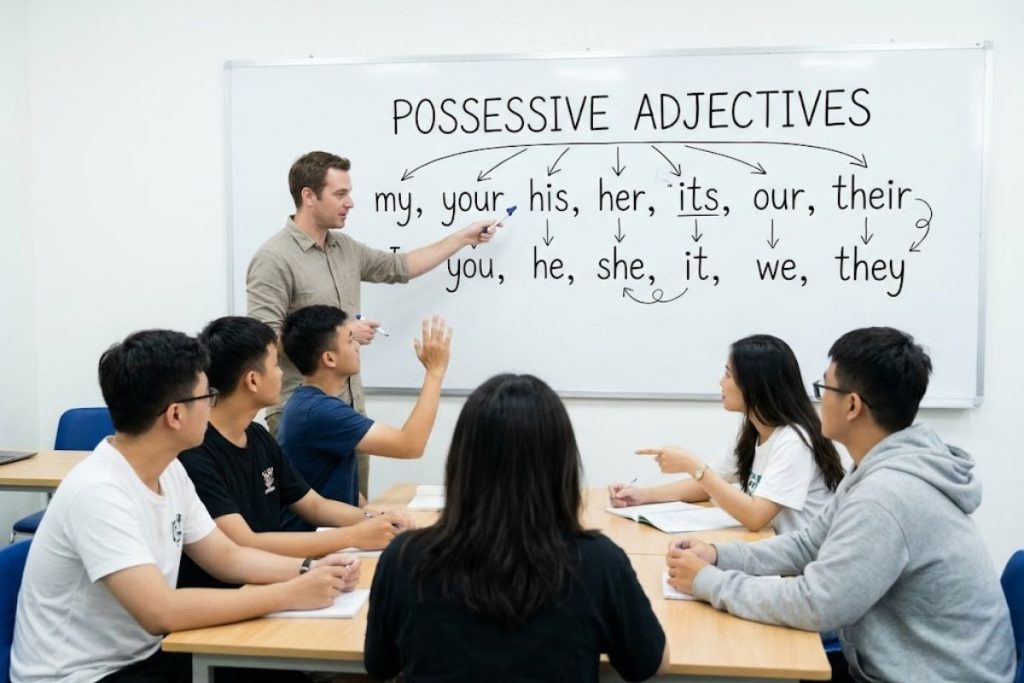
Possessive adjectives are essential in English grammar because they show who owns or is connected to something. Words such as my, your, his, and their help us identify the person or thing that something belongs to. Understanding how to use possessive adjectives correctly makes your speaking and writing clearer and more natural.
In this article, you will learn the meaning of possessive adjectives, explore a complete table with examples, discover the differences between possessive adjectives and possessive pronouns, and practice using them through exercises.
What Are Possessive Adjectives?
Possessive adjectives are words used before nouns to indicate ownership, possession, or a relationship between people and things. They tell us who something belongs to or who it is associated with.
For example:
- This is my book.
- Is that your phone?
- She loves her dog.
- They are visiting their grandparents.
In these sentences, my, your, her, and their are possessive adjectives. Each word appears before a noun and provides information about its owner or relationship.
Unlike ordinary adjectives that describe qualities, such as beautiful, small, or expensive, possessive adjectives indicate possession or association.

The Complete Table of Possessive Adjectives
There are seven possessive adjectives in English. Each corresponds to a subject pronoun.
| Subject pronoun | Possessive adjective | Example |
| I | my | This is my bag. |
| You | your | Is this your pen? |
| He | his | His car is new. |
| She | her | Her room is tidy. |
| It | its | The cat is eating its food. |
| We | our | Our house is large. |
| They | their | Their children are playing. |
My
My indicates that something belongs to or is associated with the speaker.
Examples:
- My name is Anna.
- I forgot my keys at home.
- This is my favorite restaurant.
Your
Your indicates possession or association with the person or people being addressed.
Examples:
- What is your name?
- Please bring your notebook tomorrow.
- Is this your first visit to Vietnam?
His
His indicates that something belongs to or is associated with a male person.
Examples:
- His brother works in a bank.
- David has lost his wallet.
- I like his new haircut.
Her
Her indicates that something belongs to or is associated with a female person.
Examples:
- Her parents live in Da Nang.
- She is looking for her glasses.
- I really like her ideas.
Its
Its indicates possession or association with an animal, object, organization, or other entity when referred to as it.
Examples:
- The dog is wagging its tail.
- The company has changed its policy.
- The tree has lost its leaves.
Remember that its does not use an apostrophe. The word it’s is a contraction of it is or it has, which has a different meaning.
Our
Our indicates something that belongs to or is associated with the speaker and at least one other person.
Examples:
- Our teacher is very friendly.
- We need to finish our homework.
- Our team won the competition.
Their
Their indicates possession or association with two or more people or with someone whose gender is unknown or irrelevant.
Examples:
- Their house is near the beach.
- The students have submitted their assignments.
- Someone left their umbrella in the classroom.
How to Use Possessive Adjectives in English
Possessive adjectives follow a straightforward grammatical pattern. Understanding where they belong in a sentence helps you avoid common errors.
Use a possessive adjective before a noun
The most important rule is that a possessive adjective usually comes directly before a noun or before other words that describe that noun.
Structure:
Possessive adjective + (adjective) + noun
Examples:
- This is my phone.
- She drives her new car.
- We love our beautiful garden.
- They are cleaning their large office.
In these examples, the possessive adjective identifies the owner, while the noun names the thing being discussed.
Use possessive adjectives to show relationships
Possessive adjectives do not only express ownership. They can also indicate family relationships, friendships, and other connections.
Examples:
- My sister is a doctor.
- He often visits his grandparents.
- We invited our friends to dinner.
- She called her manager this morning.
In these sentences, the possessive adjectives describe relationships rather than ownership of physical objects.
Use possessive adjectives with singular and plural nouns
A possessive adjective does not change according to whether the noun is singular or plural. The choice depends on the owner, not the number of things owned.
Examples:
- This is my book.
- These are my books.
- She likes her dress.
- She likes her dresses.
- They sold their house.
- They sold their houses.
Notice that my, her, and their remain unchanged even when the nouns become plural.
Use possessive adjectives with body parts and personal belongings
Possessive adjectives frequently appear with body parts, clothing, and everyday personal items.
Examples:
- He hurt his leg while playing football.
- She brushed her teeth before bed.
- I left my jacket in the office.
- Please wash your hands before eating.
Using possessive adjectives in these contexts makes the relationship between the person and the body part or belonging clear.
Possessive Adjectives vs. Possessive Pronouns
Possessive adjectives and possessive pronouns both indicate possession, but they serve different grammatical functions.
A possessive adjective comes before a noun, while a possessive pronoun replaces a noun phrase to avoid repetition.
| Possessive adjective | Possessive pronoun | Example |
| my | mine | This is my bag. The bag is mine. |
| your | yours | This is your seat. The seat is yours. |
| his | his | This is his book. The book is his. |
| her | hers | This is her phone. The phone is hers. |
| its | No commonly used independent equivalent | The bird has its nest. |
| our | ours | This is our room. The room is ours. |
| their | theirs | This is their house. The house is theirs. |
Compare the sentence structures
Possessive adjective + noun
- This is my laptop.
- That is her bag.
- These are their shoes.
Possessive pronoun without a following noun
- This laptop is mine.
- That bag is hers.
- These shoes are theirs.
Do not put a noun directly after a possessive pronoun. For example, say This book is mine, not This is mine book.
Its vs. It’s: What Is the Difference?
One common mistake in English grammar is confusing its with it’s. Although they look similar, they have different grammatical functions.
| Word | Meaning | Example |
| its | Possessive adjective | The cat is licking its paw. |
| it’s | Contraction of it is or it has | It’s cold today. |
| it’s | Contraction of it has | It’s been a long day. |
A useful way to check your sentence is to replace it’s with it is or it has. If the sentence still makes sense, the contraction may be correct. If you want to show possession, use its.
Examples:
- Correct: The company updated its website.
- Correct: It’s a useful website.
- Incorrect: The company updated it’s website.
Common Mistakes When Using Possessive Adjectives
Even though possessive adjectives are relatively simple, learners often make several recurring errors.
Using a possessive adjective without a noun
Possessive adjectives normally require a noun after them.
- Incorrect: This pen is my.
- Correct: This is my pen.
- Correct: This pen is mine.
Use my before a noun and mine when replacing the noun phrase.
Confusing subject pronouns with possessive adjectives
Subject pronouns identify who performs an action, while possessive adjectives indicate possession or association.
- Incorrect: She bag is on the table.
- Correct: Her bag is on the table.
- Incorrect: They house is beautiful.
- Correct: Their house is beautiful.
Remember the difference between he and his, she and her, and they and their.
Adding an apostrophe to its
The possessive adjective its does not contain an apostrophe.
- Incorrect: The dog is eating it’s food.
- Correct: The dog is eating its food.
Use it’s only when you mean it is or it has.
Changing possessive adjectives to match plural nouns
Possessive adjectives depend on the owner, not on the number of objects.
- Incorrect: These are mys books.
- Correct: These are my books.
- Incorrect: She loves hers cats.
- Correct: She loves her cats.
Possessive adjectives do not take plural endings.
Practice Exercises: Possessive Adjectives
Complete the following exercises to check your understanding. Choose the correct possessive adjective for each sentence.
Fill in the blanks
- I have a new laptop. This is _____ laptop.
- Sarah loves _____ younger brother.
- They are doing _____ homework.
- We invited _____ friends to the party.
- The dog is sleeping in _____ bed.
- Is this _____ phone, or does it belong to someone else?
- Peter forgot _____ wallet at home.
- The children are playing with _____ toys.
- My sister and I are visiting _____ grandparents.
- You should bring _____ passport when you travel.
Choose the correct answer
- Anna is looking for (her / hers) keys.
- This is (our / ours) classroom.
- The bird is building (it’s / its) nest.
- Tom and Jack have finished (their / theirs) project.
- Is that (your / yours) jacket?
Correct the mistakes
Rewrite each sentence using the correct possessive adjective or possessive pronoun.
- This is mine notebook.
- She forgot his umbrella at work. (The umbrella belongs to her.)
- The cat is playing with it’s toy.
- They are proud of theirs children.
- This bag is my.

Answers to the Exercises
Fill in the blanks
- my
- her
- their
- our
- its
- your
- his
- their
- our
- your
Choose the correct answer
- her
- our
- its
- their
- your
Correct the mistakes
- This is my notebook.
- She forgot her umbrella at work.
- The cat is playing with its toy.
- They are proud of their children.
- This bag is mine.
Possessive adjectives are easy to use once you understand their relationship with subject pronouns and nouns. Remember the seven forms—my, your, his, her, its, our, and their—and place them before the nouns they modify. Distinguishing possessive adjectives from possessive pronouns and remembering the difference between its and it’s will help you avoid common grammar mistakes in everyday English.
Frequently Asked Questions
How many possessive adjectives are there in English?
There are seven commonly taught possessive adjectives: my, your, his, her, its, our, and their. Each corresponds to a subject pronoun.
What is the difference between a possessive adjective and a possessive pronoun?
A possessive adjective comes before a noun, as in my book. A possessive pronoun replaces the noun phrase, as in The book is mine.
Can possessive adjectives be used with plural nouns?
Yes. Possessive adjectives can be used with both singular and plural nouns. For example, my friend and my friends. The possessive adjective does not change.
Is “its” a possessive adjective?
Yes. Its is the possessive adjective associated with it. For example, The company changed its name. Do not confuse it with it’s, which means it is or it has.
Can a sentence end with a possessive adjective?
In standard usage, a possessive adjective normally appears before a noun rather than standing alone at the end of a sentence. Use a possessive pronoun instead: This book is mine, not This book is my.
Keywords:
- possessive adjectives in English
- possessive adjectives examples
- possessive adjectives table
- possessive adjectives vs possessive pronouns
- possessive adjectives exercises with answers
