

Phrasal verbs are an essential part of everyday English. They appear in conversations, films, workplace communication, reading materials and language examinations. Understanding them helps learners interpret natural expressions and communicate with greater confidence.
However, phrasal verbs can be challenging because their meanings are not always predictable from their individual words. For example, take and take off have different meanings, while get over can describe recovering from an illness or overcoming an emotional difficulty.
This guide explains how phrasal verbs work, introduces common expressions, explores important grammar rules and provides practical exercises to reinforce your learning.
What Are Phrasal Verbs?
Phrasal verbs are combinations of a main verb and one or more particles that function together as a meaningful unit.
The particle may be an adverb or a preposition, depending on the grammatical structure.
Consider these examples:
- Wake up: Stop sleeping.
- Turn off: Stop a device from operating.
- Give up: Stop trying or abandon an activity.
- Look up: Search for information.
- Run out of: Use all of something.
For example:
She gave up eating fast food.
Here, give up means to stop a habit or activity. Translating the words separately would not accurately convey the intended meaning.
Some phrasal verbs are relatively literal, while others are idiomatic. Recognizing this distinction helps learners understand unfamiliar expressions.
How Are Phrasal Verbs Formed?
Phrasal verbs are commonly introduced through three structural patterns. In more detailed grammatical descriptions, verb-preposition combinations may be classified separately as prepositional verbs.
Verb + Adverb
This structure combines a verb with an adverbial particle.
Pattern: Verb + Adverb
Examples include:
- Sit down: Move into a sitting position.
- Go out: Leave a building or home.
- Wake up: Stop sleeping.
- Break down: Stop functioning.
- Turn up: Appear or increase a setting.
Our car broke down on the way home.
The particle down contributes to the overall meaning of the expression.
Some combinations are easy to interpret, while others must be learned as complete vocabulary items.
Verb + Preposition
These combinations are often taught alongside phrasal verbs, although they are more precisely called prepositional verbs in many grammar frameworks.
Examples include:
- Look after: Take care of.
- Deal with: Handle a situation.
- Believe in: Have confidence in.
- Depend on: Rely on.
She looks after her younger brother.
In this example, after introduces the object her younger brother.
Unlike separable verb-adverb combinations, these expressions do not allow the object to move between the verb and preposition.
Verb + Adverb + Preposition
These three-part combinations are commonly called phrasal-prepositional verbs.
Examples include:
- Get along with: Have a good relationship with.
- Put up with: Tolerate.
- Look forward to: Anticipate with pleasure.
- Run out of: Have none remaining.
- Come up with: Produce an idea or solution.
The team came up with a creative solution.
These expressions usually need to be learned as complete units.
A particularly important example is look forward to. Because to is a preposition here, it must be followed by a noun or an -ing form.
Correct: I look forward to hearing from you.
Incorrect: I look forward to hear from you.
Essential Grammar Rules for Phrasal Verbs
Understanding meaning is only one part of mastering phrasal verbs. Learners must also know whether an expression takes an object and where that object belongs.
Transitive and Intransitive Phrasal Verbs
An intransitive phrasal verb does not require a direct object.
Examples:
The plane took off at noon.
He grew up in a small town.
Both sentences are grammatically complete without a direct object.
A transitive phrasal verb, by contrast, requires an object.
Examples:
Please turn off the lights.
She put on her jacket.
Some phrasal verbs can be transitive or intransitive depending on their meaning.
For instance:
The meeting broke up at five.
The police broke up the crowd.
The first sentence describes a meeting ending, while the second describes the police dispersing a crowd.
Separable Phrasal Verbs
With certain transitive phrasal verbs, a noun object can appear either before or after the particle.
Both of these sentences are correct:
She turned off the television.
She turned the television off.
However, when the object is a personal pronoun, it must appear between the verb and the particle.
Correct: She turned it off.
Incorrect: She turned off it.
Other common separable expressions include put on, take off, pick up, clean up and throw away.
Inseparable Phrasal Verbs
Some multiword verbs do not permit the object to move between their components.
For example:
I ran into an old friend.
I ran into her.
The following sentence is incorrect:
I ran her into. (when run into means meet unexpectedly)
Expressions such as look after, get over, run into and put up with follow fixed word-order patterns in these meanings.
Learning whether a phrasal verb is separable or inseparable can prevent many common grammar mistakes.
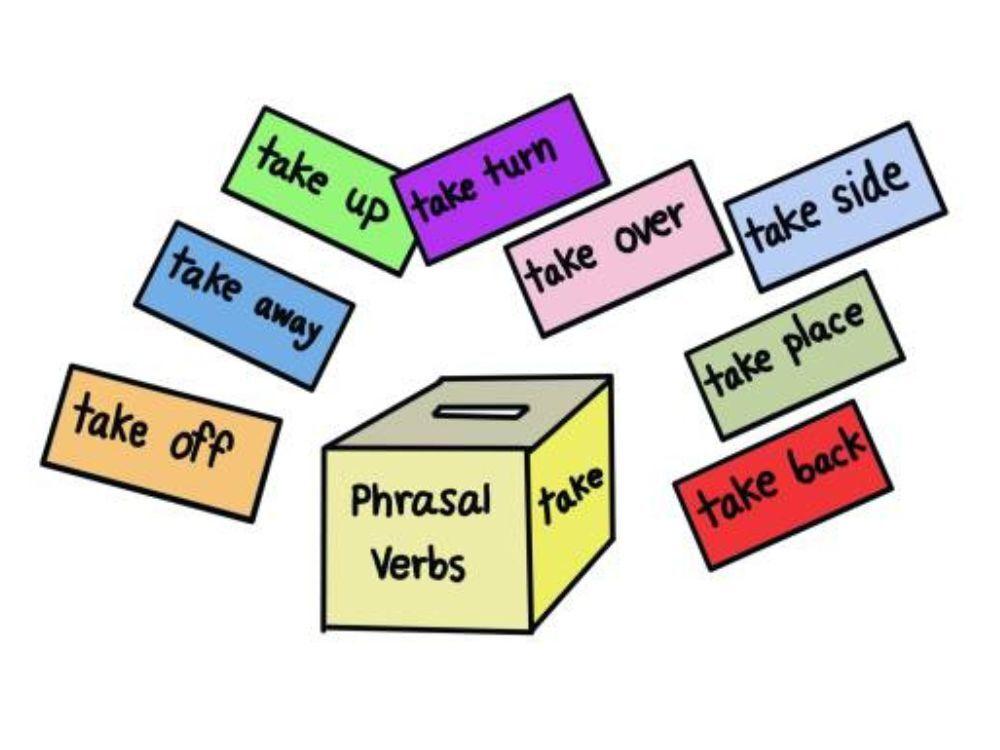
Common Phrasal Verbs with Take
The verb take forms several useful expressions related to movement, responsibility, personal interests and change.
| Phrasal verb | Meaning |
| Take off | Remove clothing; leave the ground |
| Take on | Accept responsibility |
| Take up | Start a hobby; occupy space |
| Take back | Retrieve; withdraw a statement |
| Take after | Resemble a family member |
| Take over | Gain control or responsibility |
Examples:
She decided to take up painting.
The aircraft took off on time.
He takes after his mother.
Notice that take off can describe completely different actions depending on the context.
Learners should record separate examples for each meaning rather than assuming that one translation will work in every sentence.
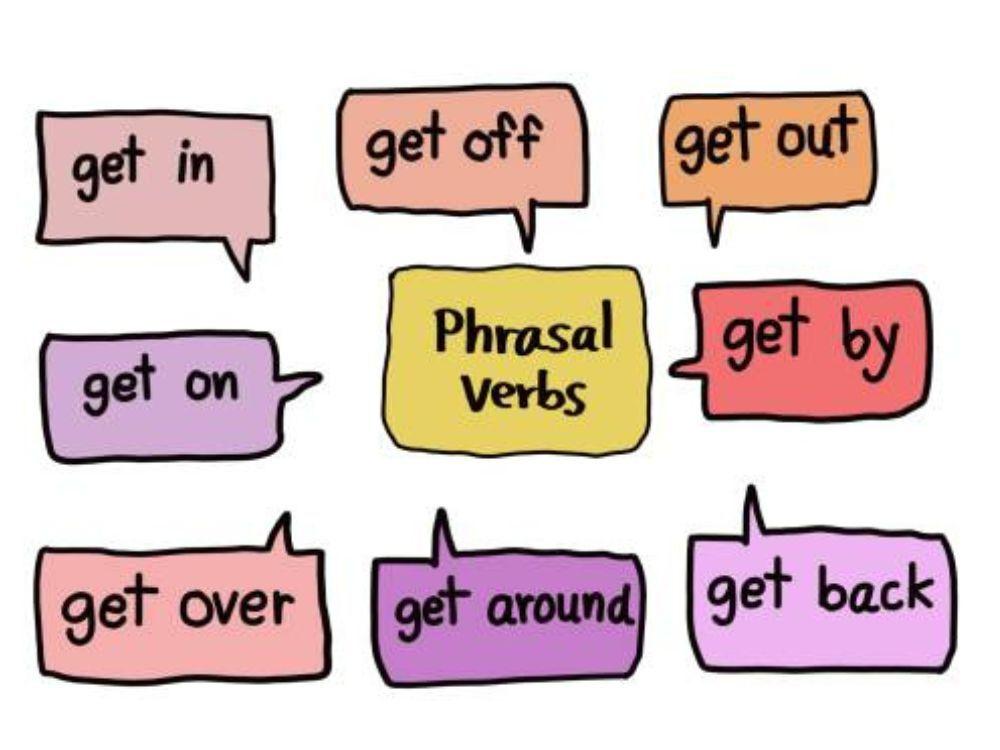
Common Phrasal Verbs with Get
Expressions with get are especially frequent in informal communication.
| Phrasal verb | Meaning |
| Get up | Leave bed |
| Get back | Return |
| Get on | Board public transport |
| Get off | Leave public transport |
| Get over | Recover from something |
| Get along with | Have a good relationship |
| Get through | Complete or survive something |
Examples:
I usually get up at seven.
She gets along with her colleagues.
It took several weeks to get over the illness.
The difference between get on and get off is particularly useful when discussing transportation.
For cars and taxis, English commonly uses get in and get out of instead.
Common Phrasal Verbs with Put
Many phrasal verbs with put describe arranging objects, postponing activities or responding to situations.
| Phrasal verb | Meaning |
| Put on | Wear clothing; switch on equipment |
| Put off | Postpone |
| Put away | Return something to its place |
| Put out | Extinguish |
| Put up with | Tolerate |
| Put down | Place something down; write something |
Examples:
Please put away your books.
They put off the appointment until Thursday.
Firefighters managed to put out the fire.
An important distinction is that put off means to postpone something, whereas put up with means to tolerate an unpleasant situation.
Although both expressions begin with put, their meanings and grammatical structures differ.
Common Phrasal Verbs with Go
Phrasal verbs with go frequently describe movement, change and ongoing activities.
| Phrasal verb | Meaning |
| Go on | Continue; happen |
| Go out | Leave home; stop burning |
| Go up | Increase |
| Go down | Decrease |
| Go through | Experience; examine |
| Go back | Return |
Examples:
The lights went out during the storm.
The cost of living has gone up.
She went through a difficult period.
These expressions are particularly useful when discussing personal experiences, economic changes and everyday events.
For example, go up and go down can describe changes in prices, temperatures, numbers and other measurable quantities.
Other Useful Phrasal Verbs for Everyday English
Beyond the four major verb groups, several expressions appear frequently in conversations and written communication.
| Phrasal verb | Meaning | Example |
| Look up | Search for information | Look up the word. |
| Find out | Discover | I found out the answer. |
| Give up | Stop trying | Don’t give up. |
| Bring up | Mention a topic | She brought up a concern. |
| Call off | Cancel | They called off the event. |
| Carry on | Continue | Carry on with your work. |
| Come across | Find unexpectedly | I came across an old letter. |
| Set up | Establish or arrange | They set up a business. |
| Work out | Exercise; solve | We worked out the problem. |
| Make up | Invent; reconcile | He made up an excuse. |
What Does the Phrasal Verb Make Up Mean?
Make up is a useful example of a phrasal verb with multiple meanings.
Invent something:
He made up a story about his journey.
Become friends again after an argument:
They made up after their disagreement.
Apply cosmetics:
She made herself up for the performance.
The correct interpretation depends on the surrounding words and situation.
This is why learning phrasal verbs through complete sentences is more effective than memorizing isolated translations.
How to Learn Phrasal Verbs Effectively
Learn Expressions in Context
Memorizing definitions alone does not guarantee that you can use an expression correctly.
For example, instead of recording only run out of = have none left, learn the complete sentence:
We have run out of milk.
This helps you remember both the meaning and the grammatical pattern.
Try creating an additional sentence based on your own experiences.
Organize Vocabulary by Topic
Grouping phrasal verbs by everyday situations can make vocabulary practice more manageable.
Useful categories include:
- Daily routines: wake up, get up, put on.
- Studying: look up, find out, hand in.
- Work: take on, carry out, put off.
- Relationships: get along with, make up, fall out.
Choose a small number of expressions from one category and practise using them in conversation.
Use Spaced Repetition
Spaced repetition involves reviewing vocabulary at increasing intervals.
For example, you might revisit new expressions the following day, several days later and again after a week.
Flashcards can be useful, especially when they include a definition, an example sentence and information about word order.
However, active practice is equally important. Try completing sentences, writing short paragraphs or speaking aloud using the expressions.
Avoid Common Learning Mistakes
Translating word by word: The meaning of give up cannot be reliably understood by translating give and up separately.
Misplacing pronouns: Use turn it off, not turn off it.
Confusing particles: Look for means search for, whereas look after means take care of.
Ignoring fixed structures: Use look forward to meeting, not look forward to meet.
Recognizing these patterns can improve accuracy in both speaking and writing.
Phrasal Verbs Exercises with Answers
Exercise: Complete the Sentences
Use the following expressions: look after, turn off, give up, run out of, put on.
- Please ______ the television before bed.
- Can you ______ my dog this weekend?
- We have ______ sugar.
- Never ______ on your goals.
- ______ your coat before going outside.
Exercise: Choose the Correct Particle
- Please sit ______ and listen.
- She gets along ______ her classmates.
- Could you turn ______ the music? It’s too loud.
- Come ______! The door is open.
- Please fill ______ this application form.
Exercise: Replace the Object with a Pronoun
Rewrite each sentence using an appropriate pronoun.
- Turn off the television.
- Put on your shoes.
- Take off your glasses.
- Clean up the room.
- Throw away those papers.
Answer Key
Sentence completion:
- turn off
- look after
- run out of
- give up
- Put on
Correct particles:
- down
- with
- down
- in
- in / out
Pronoun replacement:
- Turn it off.
- Put them on.
- Take them off.
- Clean it up.
- Throw them away.
The final exercise demonstrates how pronouns are positioned in separable phrasal verbs.
Developing a strong understanding of phrasal verbs can make everyday English easier to understand and use. Focus on common expressions, learn their grammatical patterns and practise them in meaningful situations. With consistent exposure and regular revision, these combinations can gradually become a natural part of your vocabulary.
Frequently Asked Questions About Phrasal Verbs
Are phrasal verbs only used in informal English?
No. Although many are common in informal speech, some also appear in professional and academic contexts, depending on the expression.
How many phrasal verbs should beginners learn?
There is no fixed number; beginners can start with a manageable selection of common expressions and gradually expand their vocabulary through practice.
Are long phrasal verb lists useful for learning?
Yes, they can serve as reference materials, but learning selected expressions through examples and regular practice is generally more productive than memorizing an entire list.
Keywords:
- Common phrasal verbs
- Phrasal verbs list
- Phrasal verbs with examples
- Phrasal verbs exercises with answers
- Phrasal verbs with take, get, put and go
