
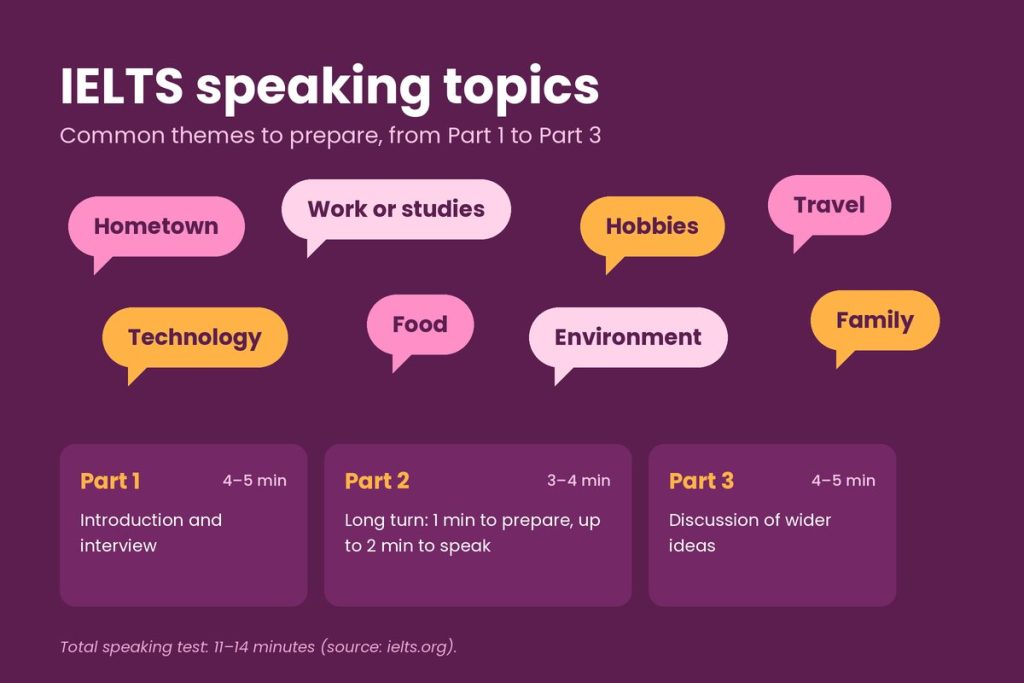
The Speaking test makes many learners feel nervous because they have to respond in English within a limited amount of time. However, most IELTS Speaking Topics revolve around familiar subjects from everyday life.
In this article, you will discover:
- Popular Speaking Topics for Parts 1, 2, and 3
- Speaking Topics with Answers that are easy to apply
- How to develop ideas in the Speaking test
- Frequently asked questions about IELTS Speaking Topics
Speaking Test Format
Speaking Topics Part 1
Part 1 Speaking Topics usually focuses on simple, familiar personal questions.
The examiner will ask about your life, interests, or daily habits for approximately 4–5 minutes.
Some popular Speaking Topics for Part 1 include:
- Hometown
- Study or Work
- Family
- Music
- Hobbies
- Food
- Weather
- Shopping
- Travel
- Daily Routine
In this part, you should answer naturally and avoid memorising model answers.

Speaking Topics Part 2
Speaking Topics in Part 2 require you to speak continuously for approximately 1–2 minutes based on a cue card.
You will have one minute to prepare before you begin speaking.
Some popular topics include:
- Describe a memorable trip
- Describe a person you admire
- Describe a useful skill you learned
- Describe a favourite movie
- Describe a happy experience
- Describe an important decision
This part requires strong storytelling skills and the ability to develop ideas logically.
IELTS Topics Part 3
Speaking Topics in Part 3 involve a more advanced discussion related to the topic in Part 2.
The examiner will explore your personal opinions, the reasons behind them, or the social impact of an issue in greater depth.
Some popular topics include:
- Technology
- Education
- Environment
- Communication
- Lifestyle
- Transportation
- Social Media
- Culture
Part 3 requires you to provide longer answers and explain your opinions more clearly than in Part 1.
Common Speaking Topics
Speaking Topics: Education
Education is one of the most frequently encountered IELTS Speaking Topics.
You may be asked about schools, teachers, learning methods, or academic pressure.
When practising this topic, you should prepare useful expressions such as online learning, academic performance, and extracurricular activities.
Speaking Topics: Technology
Technology is a popular topic in both Parts 1 and 3.
Questions often relate to mobile phones, social media, artificial intelligence (AI), or the impact of technology on modern life.
This topic is relatively easy to develop ideas for because it is closely connected to the everyday lives of IELTS learners.
Speaking Topics: Travel
Travel is one of the most popular IELTS Speaking Topics.
You may be asked to describe a memorable trip, a favourite destination, or an interesting travel experience.
To answer more effectively, practise telling stories in chronological order and adding personal feelings to your responses.
Speaking Topics: Environment
Environment frequently appears in IELTS Speaking Part 3.
Questions often relate to environmental pollution, climate change, or eco-friendly habits.
This topic is a good opportunity to use academic vocabulary such as renewable energy, carbon emissions, and environmental awareness.

Speaking Topics with Answers: Effective Practice
Many learners search for IELTS Speaking Topics with Answers to understand how to develop their ideas.
However, the most important thing is not memorising answers but learning how to organise your ideas naturally and logically.
For example:
Question: Do you enjoy listening to music?
Answer: Yes, absolutely. I listen to music almost every day because it helps me relax after studying or working. I especially enjoy pop music since it has catchy melodies and positive energy.
Practising IELTS Speaking Topics with Answers like this can help you learn new vocabulary and develop your responses more effectively.
What Has Changed in Speaking Topics 2026?
IELTS Speaking Topics in 2026 are expected to continue focusing on familiar subjects related to everyday life.
However, topics related to AI, technology, the environment, mental health, and social media may receive greater attention.
In addition to practising familiar topics, learners should keep up with emerging trends to expand their ideas and vocabulary.
IELTS Speaking Topics are an important foundation for effective preparation for the IELTS Speaking test. By familiarising yourself with common IELTS Speaking Topics and practising with the right techniques, you can improve your response speed, develop ideas more effectively, and become more confident when communicating in English.
Frequently Asked Questions
Do IELTS Speaking Topics Change Frequently?
Yes. IELTS Speaking topics may be updated periodically to reflect modern life and social trends. However, most topics still revolve around familiar subjects such as education, work, technology, travel, hobbies, and everyday activities.
Therefore, instead of trying to memorise too many model answers, you should focus on developing your speaking fluency and practising how to expand your ideas across common topics.
Do You Need to Use Academic Vocabulary in IELTS Speaking?
Yes, but you do not need to use complicated vocabulary in every answer.
What matters more is choosing words that fit the context, pronouncing them clearly, and expressing yourself naturally. Using appropriate academic vocabulary can make your responses more varied and sophisticated.
However, overusing difficult words or choosing incorrect collocations can make your answers sound unnatural and negatively affect your Lexical Resource score in the Speaking test.
How Can You Practise Speaking Effectively at Home?
You should practise speaking on different topics every day to improve your communication skills and fluency.
In addition to learning topic-specific vocabulary, you can record your answers and listen to them again to identify pronunciation errors and practise more natural expressions.
Furthermore, shadowing podcasts, videos, or IELTS Speaking model answers can help improve your pronunciation and intonation.
Most importantly, maintain a consistent Speaking practice routine rather than focusing only on theory or memorising model answers.
Keywords:
- IELTS Speaking Topics with Answers PDF
- IELTS Speaking Topics Part 1
- IELTS Speaking Topics 2026
