
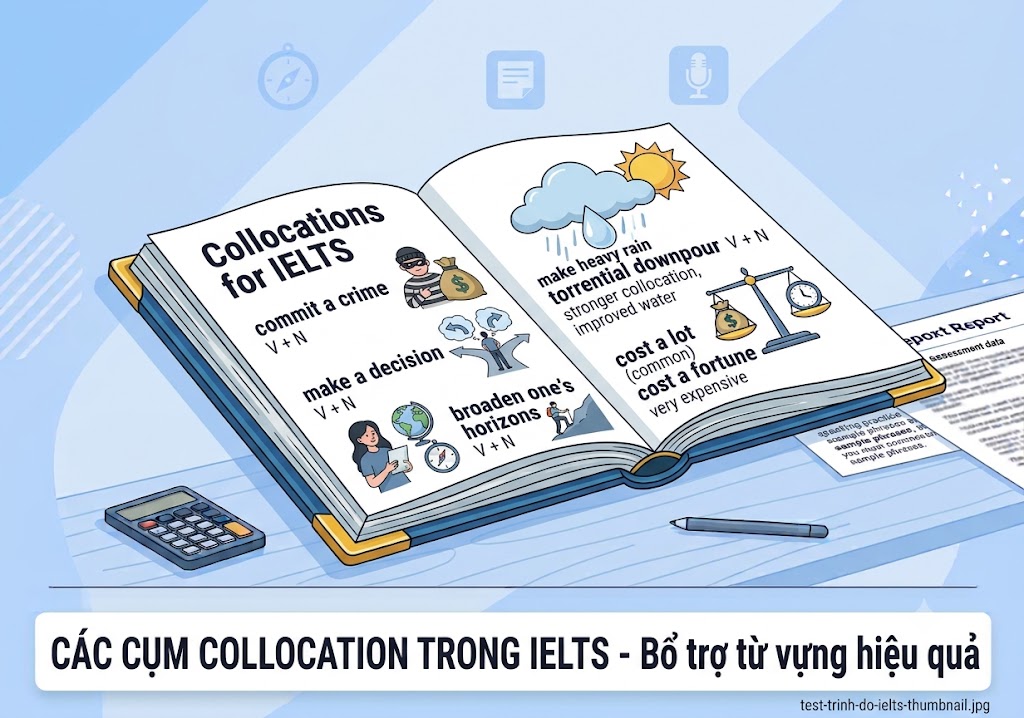
Learn collocations for IELTS to improve your Speaking and Writing scores and sound more natural. Discover the most comprehensive collection of commonly used collocations. Click to read now!
Collocations in IELTS: The Secret to Achieving a High Score
Are you wondering how to make your Speaking and Writing sound more natural, like a native speaker? Have you accumulated a lot of individual vocabulary words, but still find that your sentences sound awkward when you put them together?
The secret lies in using collocations in IELTS. They are the golden key to making a strong impression on examiners.
Let’s explore this guide to optimizing your word choice below.
What Are Collocations in IELTS?
Simply put, collocations in IELTS are groups of words that commonly occur together according to the habits of native speakers.
When you combine words correctly, your sentences sound natural. Conversely, translating word for word from Vietnamese into English can make your writing sound awkward or unclear.
IELTS examiners always appreciate candidates who know how to use these fixed expressions. This demonstrates that you have a deeper understanding of the language.
The Importance of Collocations in IELTS Assessment Criteria
In the IELTS scoring system, collocations play an extremely important role. Specifically, they contribute to the Lexical Resource criterion, which accounts for 25% of the score in both Speaking and Writing.
If your goal is Band 7.0 or above, using collocations proficiently is essential.
Instead of awkwardly using overly advanced words, choosing the correct word combinations will be much more effective.
Benefits of Using Collocations Correctly in the Test
When you use the correct word combinations, your writing becomes more fluent and coherent. You do not need to spend too much time thinking about which words should go together.
In addition, this helps you avoid common language errors. Your speaking and writing speed can also improve significantly as a result.
See also: Tips for Effectively Managing Your Time in the IELTS Test
A Collection of IELTS Collocations by Popular Topic
To study effectively, organizing vocabulary into smaller topic-based groups is one of the best approaches.
Below are the core topics that you are likely to encounter in the test.
Education Vocabulary
Education is a topic that has appeared frequently in IELTS questions in recent years.
- Academic performance: The results of a student’s learning or studies.
- Core curriculum: The essential subjects and content included in a course of study.
- Gain deep knowledge: To acquire an in-depth understanding of a subject.
For example, instead of saying “get knowledge,” use “gain deep knowledge” to improve the quality of your sentences.
Environment Vocabulary
The environment is a prominent topic in IELTS Writing Task 2. You need to prepare strong expressions to support your arguments.
- Environmental degradation: The deterioration of the natural environment.
- Renewable energy: Energy generated from naturally replenished sources.
- Toxic waste: Waste containing harmful or poisonous substances.
Using these expressions flexibly can make your arguments sharper and more persuasive.
Image 1: An IELTS candidate confidently taking the test with a rich vocabulary.
Common IELTS Collocations Classified by Word Type
In addition to learning vocabulary by topic, you should also study collocations according to their grammatical structures.
This approach helps you construct sentences more easily without worrying about grammatical errors.
Adjective + Noun Collocations
This is one of the most common and practical types of collocation, suitable for a wide range of IELTS tasks.
- Mitigating factor: A factor that reduces the severity or seriousness of something.
- Sharp decline: A significant and rapid decrease.
- Pressing issue: An urgent problem that requires attention.
Example: “Global warming is a pressing issue that requires immediate action.”
Verb + Noun Collocations
These combinations help express actions more clearly and precisely.
- Address a problem: To deal with or take action to resolve a problem.
- Formulate a plan: To develop or devise a plan.
- Meet the demand: To satisfy or fulfill a particular need or requirement.
Instead of using the word “solve,” you can use the phrase “address a problem” to make your writing sound more professional.
IELTS Speaking Collocations That Help You Make a Strong Impression
Your Fluency and Lexical Resource performance in the Speaking test can improve when you use natural word combinations.
Below are some suggestions to help you make a good impression on the examiner from the very first sentences.
Expressions for Interests and Habits
In Speaking Part 1, questions about personal interests and hobbies appear frequently.
- Have a passion for: To have a strong interest in or enthusiasm for something.
- Pass the time: To spend time doing something, especially while waiting.
- Amuse oneself: To entertain oneself or enjoy an activity.
These expressions help make your answers less monotonous than simply using “I like” or “I love.”
Expressions for Personal Opinions
To present convincing arguments in Part 3, you need expressions that are suitable for discussion and analysis.
- Hold the view that: To believe or maintain that something is true.
- From my perspective: From my point of view or according to my understanding.
- Deeply convinced: Strongly persuaded that something is true or correct.
Image 2: Using natural vocabulary helps improve English communication skills and responsiveness.
Methods for Learning and Remembering Common IELTS Collocations
Memorizing a long list of expressions is not a smart learning strategy. You need a systematic approach to retain vocabulary and apply it effectively.
The rate of vocabulary forgetting can reach 70% after 24 hours if you do not review what you have learned appropriately.
Learn Vocabulary in Specific Contexts
Never record individual words in isolation. Whenever you encounter a new collocation, write down the entire sentence containing it.
Learning words in context helps your brain build stronger connections. You will understand when and where each expression is appropriate.
Use Specialized Dictionaries
Develop the habit of consulting specialized dictionaries, such as the Oxford Collocations Dictionary, or practise by reading articles from international newspapers.
This helps you check whether your word combinations are accurate and natural before using them in the actual test.
Mastering collocations in IELTS requires consistent learning and daily practice.
Investing time in learning fixed expressions can bring substantial benefits to your test performance.
We hope this article has provided you with a comprehensive overview and useful knowledge. Start practising today to take your IELTS band score to the next level!
See also: Effective Methods for Practising IELTS Listening at Home, from Basic to Advanced
Frequently Asked Questions
How many collocations should I learn each day for the best results?
For the best results, you should learn five to ten collocations per day. Rather than trying to memorize a large number of expressions, focus on understanding them thoroughly and applying them in real-life situations. Practise making sentences, writing short paragraphs, or speaking immediately after learning them. This helps turn these expressions into part of your active vocabulary.
Should I use too many advanced collocations in my writing?
You should avoid overusing advanced collocations in your writing. Forcing too many sophisticated expressions into your work can make your sentences sound awkward, unnatural, and difficult to understand. The most important goal is to communicate your ideas clearly and accurately. Only use advanced expressions when you fully understand their context to ensure the best possible results.
Which resources are best for learning collocations today?
The book English Collocations in Use, published by Cambridge, is an excellent resource for learning collocations. The series is divided into intermediate and advanced levels, providing clearly organized topic-based expressions along with practice exercises. In addition, consulting specialized dictionaries such as the Oxford Collocations Dictionary will help you understand contexts more deeply and apply expressions accurately in the test.
Keyword:
- Collocations in IELTS
- Common IELTS collocations
- Collocations frequently used in IELTS
- IELTS collocations
- A collection of IELTS collocations
- Collocations for IELTS Speaking
- Commonly used collocations in IELTS
