

 Tiếng Việt
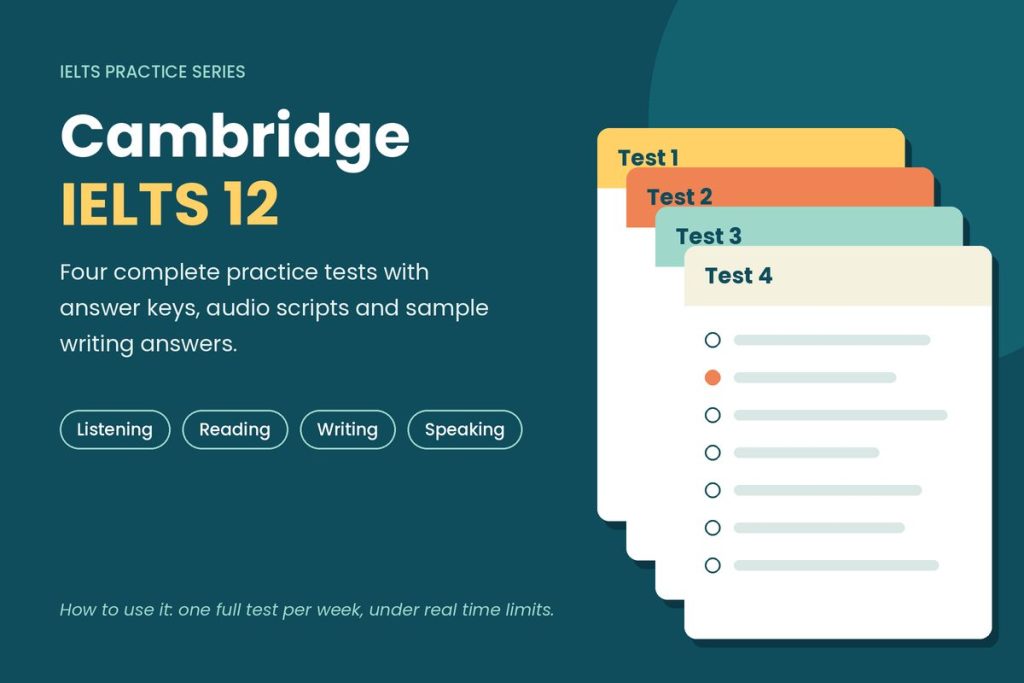
The Cambridge Practice Tests for IELTS series is an essential study resource for IELTS candidates. Among these materials, Cambridge 12 stands out as a valuable practice guide for learners who are aiming to improve their band scores during the intensive preparation stage.
Practicing with this book helps you become familiar with time pressure and the structure of the actual IELTS examination. It also reflects important aspects of IELTS question formats and the approaches used in official examinations.
An Overview of Cambridge 12 Academic
Cambridge 12 Academic was developed and published by Cambridge University Press. As part of the Cambridge IELTS practice-test series, it provides valuable materials for preparing for the IELTS Academic examination.
The book contains four complete practice tests designed for the Academic module. The Reading and Listening passages cover a wide range of subjects, including science, archaeology, and behavioral psychology.
The book also provides answer keys and Listening transcripts at the end. In addition, sample Writing answers accompanied by examiner comments help learners evaluate their performance and better understand the assessment criteria.

A Detailed Analysis of the Test Structure in Cambridge 12
To achieve the best results, you need to understand how each section is structured and what skills it assesses. This book allows you to practice all four core IELTS skills: Listening, Reading, Writing, and Speaking.
Listening Skills with Cambridge 12 Listening
The Listening section is generally considered comparable in format and challenge to the IELTS examination. Practicing with this book helps you become familiar with a variety of native English accents.
In particular, Cambridge 12 Listening Test 1 includes situations in Section 1 where information may be corrected or changed during a conversation. If you do not listen carefully, you may write down incorrect numbers, names, or other details.
When practicing Listening, pay attention to how you manage your time before the recording begins. Underlining keywords in the questions and predicting the information you need to hear are important strategies for improving your score.
See also: Grade 4 English Vocabulary by Topic
Mastering Cambridge 12 Reading
The Reading section is a major challenge because it requires both a strong vocabulary and the ability to process information quickly. The passages contain a considerable amount of academic terminology.
For example, Cambridge 12 Reading Test 1 includes familiar question types such as Matching Headings and True/False/Not Given. Candidates should apply skimming and scanning techniques flexibly to locate the correct answers.
Avoid trying to read every single word in a long passage. Instead, focus on identifying synonyms and paraphrases that connect the questions with the relevant sections of the text. This approach can help you locate information more quickly and efficiently.
A Step-by-Step Guide to Cambridge 12 Test 1 and Test 2
When entering the intensive practice stage, allocating your time appropriately is essential. Rather than rushing through the tests, you should follow a clear and structured plan.
Strategies for Cambridge 12 Test 1
Treat Cambridge 12 Test 1 as your first full practice assessment to evaluate your current ability. Set a timer and complete each section under the appropriate time limit. For the Reading and Writing sections, work within the official 60-minute limit and avoid using a dictionary during the test.
After completing the test, check your answers and spend at least 45 minutes analyzing your mistakes. Identifying the reasons behind your incorrect answers will help you improve more quickly than simply completing practice tests one after another.
Improving Your Performance with Cambridge 12 Test 2
After reviewing your mistakes from the first test, move on to Cambridge 12 Test 2 with greater confidence and care. Apply the time-management strategies you have learned to improve your speed and accuracy.
The passages and questions may present different challenges from those in the first test. Try to maintain your concentration until the final minutes so that you can achieve the best possible result.
Practice Exercises to Develop Your IELTS Test-Taking Skills
The following exercises are designed to help you improve your vocabulary, grammar awareness, and ability to recognize common academic expressions.
Exercise 1: Match Common Synonyms Found in IELTS Tests
Match the words on the left with their corresponding synonyms on the right.
- Incorporate
- Jeopardize
- Simultaneous
- Proximity
- Abundant
- Nearness
- Plentiful
- Include
- At the same time
- Endanger
Exercise 2: Choose the Correct Answer
- How many complete Academic practice tests does Cambridge 12 provide?
- Two tests
- Four tests
- Six tests
- How many questions are there in the IELTS Academic Reading test?
- 30 questions
- 40 questions
- 50 questions
Detailed Answers to the Practice Exercises
Below are the correct answers. Compare them with your responses to evaluate your understanding.
Answers to Exercise 1
- C
- E
- D
- A
- B
Answers to Exercise 2
- B
- B
Cambridge 12 remains a valuable companion on your journey toward achieving your IELTS goals. Consistent practice and thorough analysis of the tests can help you make significant progress in both your analytical thinking and test-taking skills.
Create a clear study plan and balance knowledge development with daily practice. This structured preparation can help you work toward your target band score in the actual examination.
We wish you success in your IELTS preparation!
Frequently Asked Questions
What IELTS band level is Cambridge 12 suitable for?
This book is most suitable for learners who already have a solid English foundation, approximately IELTS Band 5.0 or above, and are preparing to enter the intensive test-practice stage.
How can I correct mistakes effectively when using Cambridge 12?
After completing a practice test, review the Listening transcripts or carefully reread the relevant Reading passages. Identify the keywords, synonyms, and paraphrases that lead to the correct answers, and determine why your original answers were incorrect.
Should I memorize the sample answers?
You should avoid memorizing entire sample essays. Instead, analyze how the writers organize their ideas, structure paragraphs, and use linking words and vocabulary. Then apply these techniques to your own writing.
Keywords
- Cambridge 12 Listening Test 1
- Cambridge 12 Test 1
- Cambridge 12 Reading Test
