
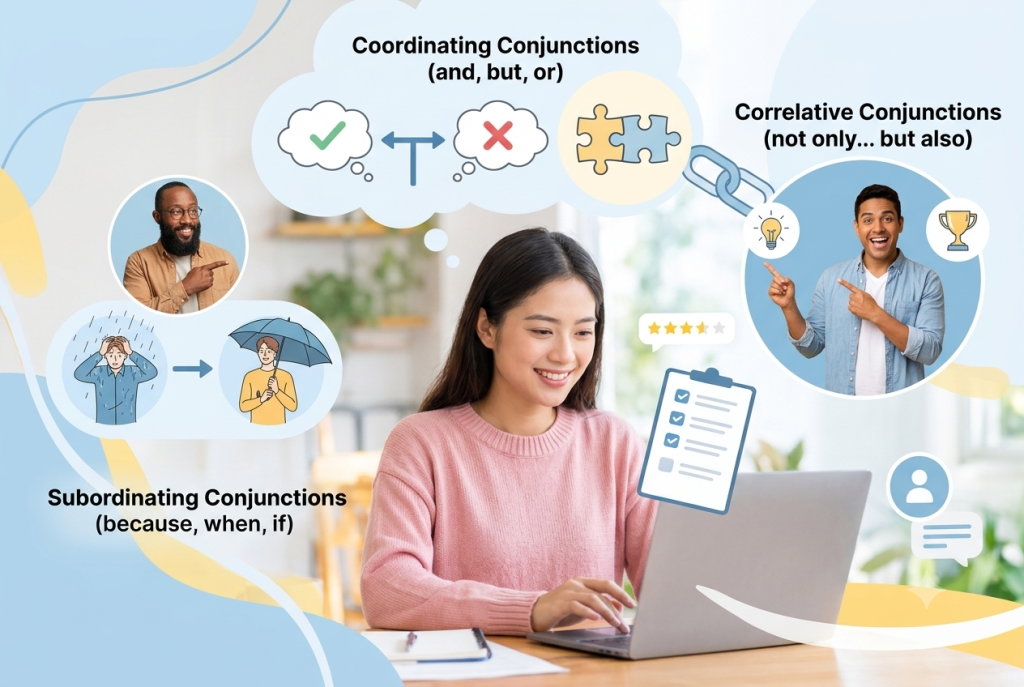
English conjunctions are essential grammar elements that connect words, phrases, and clauses to make sentences clearer and more logical. Understanding how to use conjunctions correctly helps learners express relationships between ideas, improve sentence structure, and communicate more effectively in both spoken and written English.
But what are English conjunctions, what types should learners know, and how can they use them accurately? This guide explores the main categories of conjunctions, provides practical examples, explains common grammar mistakes, and includes exercises with answers to help you strengthen your English skills.
What Are English Conjunctions?
English conjunctions are words used to connect words, phrases, or clauses within a sentence. They help establish relationships between ideas, such as addition, contrast, reason, result, condition, choice, and time.
Consider the following examples:
- I like apples and oranges.
- She was tired, but she continued studying.
- We stayed at home because it was raining.
In these sentences, and connects two nouns, but expresses contrast, and because introduces a reason.
In English dictionaries, the abbreviation for conjunction is commonly written as conj. The full grammatical term is conjunction.
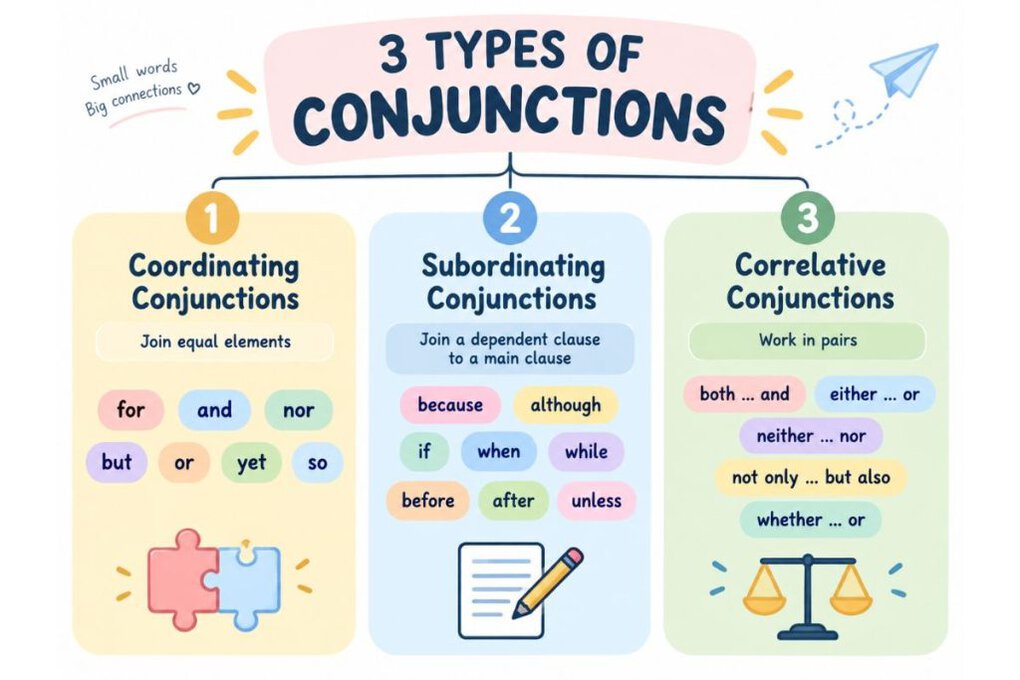
Conjunctions are commonly studied in three groups: coordinating conjunctions, subordinating conjunctions, and correlative conjunctions. Each group serves a different purpose and follows particular grammatical patterns.
Types of English Conjunctions
Coordinating Conjunctions
Coordinating conjunctions connect grammatical elements that have equivalent functions. These elements may be individual words, phrases, or independent clauses.
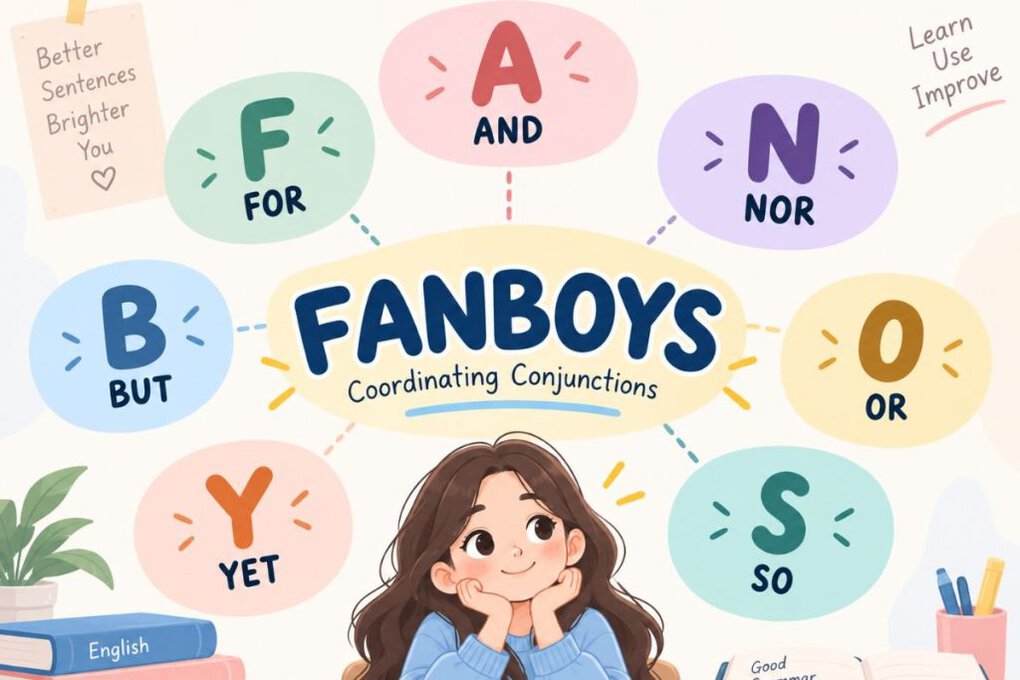
The seven coordinating conjunctions are commonly remembered through the acronym FANBOYS, which stands for For, And, Nor, But, Or, Yet, and So.
| Conjunction | Meaning or function | Example |
| For | Introduces a reason or explanation | I stayed home, for I was feeling sick. |
| And | Adds information | She bought a book and a notebook. |
| Nor | Adds a negative idea | He doesn’t eat meat, nor does he drink milk. |
| But | Expresses contrast | The task was difficult, but I completed it. |
| Or | Presents a choice | Would you like tea or coffee? |
| Yet | Expresses unexpected contrast | He is young, yet very experienced. |
| So | Introduces a result | It was getting dark, so we went home. |
How to use coordinating conjunctions
- And: Use and to add information or connect related ideas.
- But: Use but to show contrast between two ideas.
- Or: Use or to present alternatives or choices.
- So: Use so to introduce a result or consequence.
- Yet: Use yet to express contrast, often with a sense of surprise.
- Nor: Use nor to add a negative idea. When it begins a clause, subject-auxiliary inversion is commonly required.
- For: Use for to introduce an explanation or reason. This use is relatively formal and less common in everyday conversation than because.
Examples:
I wanted to go shopping, but I didn’t have enough money.
She practiced every day, so her English improved.
When a coordinating conjunction connects two independent clauses, a comma is generally placed before the conjunction. However, a comma is usually unnecessary when the conjunction connects short words or phrases.
Subordinating Conjunctions
Subordinating conjunctions connect a dependent clause to an independent clause. They express relationships involving reason, time, condition, contrast, purpose, and other circumstances.
The following table summarizes common English conjunctions and their functions.
| Function | Conjunctions | Example |
| Reason | Because, since, as | I stayed home because I was sick. |
| Contrast | Although, though, even though | Although it was cold, we went outside. |
| Condition | If, unless | If you study regularly, you will improve. |
| Time | When, while, before, after, until | Call me when you arrive. |
| Purpose | So that, in order that | She spoke slowly so that everyone could understand. |
| Result | So…that, such…that | It was so cold that we stayed indoors. |
| Concession | Even if | Even if it rains, we will go. |
How to use common subordinating conjunctions
Because, since, and as
These conjunctions introduce reasons. Because often emphasizes a direct explanation, whereas since and as frequently introduce reasons that are already known or are not the main focus.
Example:
Since it was getting late, we decided to leave.
Although, though, and even though
These conjunctions express contrast or concession. Even though often emphasizes a stronger contrast between two situations.
Example:
Even though she was nervous, she gave a confident presentation.
If and unless
If introduces a condition, while unless generally means “if not” or “except if.”
Example:
You won’t pass the exam unless you study harder.
When, while, before, after, and until
These conjunctions establish a time relationship between actions or events.
Example:
Wash your hands before you eat.
Remember that some words, such as since and while, can have different meanings depending on context. Understanding the complete sentence is more useful than memorizing only one meaning for each word.
Correlative Conjunctions
Correlative conjunctions are pairs of words that work together to connect grammatically equivalent elements. They are common in everyday communication, academic writing, and English grammar exercises.
| Structure | Meaning | Example |
| Both…and | Includes two things | She speaks both English and French. |
| Either…or | Presents two alternatives | You can either stay here or come with us. |
| Neither…nor | Excludes both options | Neither Tom nor John was available. |
| Not only…but also | Emphasizes two related facts | She is not only intelligent but also hardworking. |
| Whether…or | Presents alternatives or uncertainty | I don’t know whether he will agree or refuse. |
Maintaining parallel structure
When using correlative conjunctions, keep the connected elements grammatically parallel. This makes sentences easier to read and understand.
Correct: She enjoys both reading and writing.
Less natural: She enjoys both reading and to write.
In the correct example, reading and writing are both gerunds, creating a parallel structure.
With either…or and neither…nor, when the connected subjects differ in number, the verb generally agrees with the nearer subject in standard constructions commonly taught to English learners.
Example:
Neither the students nor the teacher is ready.
A List of English Conjunctions by Function
Learning conjunctions by function can be more effective than memorizing them as isolated words. The following list provides a useful reference for common English conjunctions.
| Function | Common conjunctions | Example |
| Addition | And | I bought bread and milk. |
| Choice | Or | You can walk or take a bus. |
| Contrast | But, yet, although, whereas | He is rich, but he is unhappy. |
| Reason | Because, since, as | I left because I felt tired. |
| Result | So | It was late, so we went home. |
| Condition | If, unless | If you need help, call me. |
| Time | When, while, before, after, until | Wait here until I return. |
| Purpose | So that | I took notes so that I wouldn’t forget. |
| Concession | Although, even though, even if | Although it was raining, we went out. |
| Paired relationships | Both…and, either…or, neither…nor | Both Anna and Peter joined us. |
This list covers many frequently used conjunctions and conjunction structures, but it is not an exhaustive list of every expression that can connect ideas in English.
Some words may perform different functions depending on context. For example, so can be a coordinating conjunction that introduces a result, while so that commonly introduces a purpose clause.
Recognizing complete structures will help you choose the right expression for each sentence.
How to Use English Conjunctions Correctly
Connecting Words and Phrases
Conjunctions can connect two or more elements that serve equivalent grammatical functions in a sentence.
Examples:
- My brother and I enjoy swimming.
- She is kind but strict.
- He wants to travel by train or by plane.
In these examples, and, but, and or connect nouns, adjectives, and phrases.
When writing, identify the elements you want to connect and check that their grammatical structures are compatible.
Connecting Two Independent Clauses
Some coordinating conjunctions, including and, but, or, and so, can connect two independent clauses. Each clause contains a subject and a verb and can generally function as a complete sentence.
Example:
I wanted to call you, but my phone ran out of battery.
The sentence contains two independent clauses connected by but.
Another example:
The weather was nice, so we had lunch outside.
A comma is generally used before the coordinating conjunction when it connects two independent clauses. However, punctuation may vary in short sentences or specific stylistic contexts.
Connecting Independent and Dependent Clauses
Subordinating conjunctions connect a main clause with a dependent clause that provides additional information.
Examples:
Because I had an important meeting, I arrived early.
I arrived early because I had an important meeting.
Both sentences are grammatically correct and communicate the same basic idea.
When a dependent clause comes before the main clause, a comma is generally used to separate the clauses. When the main clause comes first, a comma is usually unnecessary.
Choosing a Conjunction Based on Meaning
Before selecting a conjunction, determine the relationship you want to express. Are you adding information, explaining a reason, presenting a contrast, or introducing a condition?
Examples:
- Addition: I study English and practice speaking every day.
- Reason: I stayed home because I was sick.
- Contrast: Although he was tired, he kept working.
- Condition: If you practice regularly, you will make progress.
- Result: She missed the bus, so she took a taxi.
Learning conjunctions according to their functions helps prevent errors caused by choosing familiar words that do not accurately express the intended meaning.
Common Mistakes When Using English Conjunctions
Using Although with But
Both although and but can express contrast. However, when although introduces a dependent clause in a standard sentence structure, but is not needed to introduce the main clause.
Incorrect: Although it was raining, but we went outside.
Correct: Although it was raining, we went outside.
Alternatively:
It was raining, but we went outside.
Using Because with So
Because introduces a reason, while so commonly connects a reason with its result. In the following sentence pattern, using both together is unnecessary.
Incorrect: Because I was tired, so I went to bed.
Correct: Because I was tired, I went to bed.
Alternatively:
I was tired, so I went to bed.
Confusing Because and Because Of
Both expressions communicate a reason, but they are followed by different grammatical structures.
| Because | Because of |
| Followed by a clause | Followed by a noun, noun phrase, or gerund |
| Because she was ill | Because of her illness |
| Because it rained heavily | Because of the heavy rain |
Examples:
We canceled the trip because it rained heavily.
We canceled the trip because of the heavy rain.
Both sentences are correct. Check the grammatical structure that follows the expression before deciding which one to use.
Using However Like But
But is a coordinating conjunction, whereas however is a conjunctive adverb. They can communicate similar relationships, but their punctuation patterns differ.
Correct: I was tired, but I continued working.
Correct: I was tired. However, I continued working.
Another correct option:
I was tired; however, I continued working.
Avoid joining two independent clauses with only a comma and however. This creates a punctuation error known as a comma splice.
English Conjunctions: Structures That Are Easy to Confuse
Because vs. Because Of
The main difference is the grammatical structure that follows each expression.
- Because + subject + verb.
- Because of + noun, noun phrase, or gerund.
Examples:
Because she missed the bus, she arrived late.
Because of missing the bus, she arrived late.
The second sentence is grammatically possible, although a noun phrase such as because of the bus delay may sound more natural in some contexts.
Although vs. Despite and In Spite Of
Although is a subordinating conjunction followed by a clause. In contrast, despite and in spite of are prepositions commonly followed by a noun, noun phrase, or gerund.
Examples:
Although he was tired, he continued working.
Despite being tired, he continued working.
In spite of his tiredness, he continued working.
Do not normally place a complete clause directly after despite without an appropriate construction.
For example:
Despite the fact that he was tired, he continued working.
If vs. Whether
Both if and whether can introduce indirect yes-or-no questions and express uncertainty.
Examples:
I don’t know if he will come.
I don’t know whether he will come.
When alternatives are explicitly presented with or, or when the expression or not is included, whether is often preferred in formal writing and certain grammatical constructions.
Example:
I don’t know whether he will come or not.
The structure whether…or can also introduce two alternative possibilities.
English Conjunction Exercises With Answers
Practice the following questions to check your understanding of English conjunctions. Try to answer each question before reviewing the explanations.
Exercise 1: Choose the Correct Answer
Question 1: I was hungry, ___ I made a sandwich.
- but
- so
- although
- because
Question 2: She stayed at home ___ she was sick.
- because
- but
- or
- yet
Question 3: ___ it was raining, they went for a walk.
- Because
- Although
- So
- And
Question 4: You can ___ take the bus ___ walk to school.
- both / and
- either / or
- neither / nor
- not only / but
Question 5: I like coffee, ___ my sister prefers tea.
- because
- but
- so
- if
Exercise 2: Fill in the Blanks
Question 6: Call me ___ you arrive.
Question 7: We stayed inside ___ the weather was bad.
Question 8: You won’t improve ___ you practice regularly.
Exercise 3: Find and Correct the Mistake
Question 9: Although he was tired, but he continued working.
Question 10: Because it was late, so we went home.
Answers and Explanations
| Question | Answer | Explanation |
| 1 | B. so | Shows the result of being hungry. |
| 2 | A. because | Introduces the reason for staying home. |
| 3 | B. Although | Shows contrast between the rain and going for a walk. |
| 4 | B. either / or | Presents two alternatives. |
| 5 | B. but | Expresses contrasting preferences. |
| 6 | when | Refers to the time of arrival. |
| 7 | because | Explains why the people stayed inside. |
| 8 | unless | Means that improvement will not happen if regular practice does not occur. |
| 9 | Although he was tired, he continued working. | Remove but because although already introduces the contrast. |
| 10 | Because it was late, we went home. | Remove so from this sentence pattern because because already introduces the reason. |
To remember English conjunctions more effectively, create your own sentences using each category and practice moving dependent clauses to different positions. Regular practice with realistic contexts will help you choose conjunctions more naturally in speaking and writing.
Frequently Asked Questions About English Conjunctions
What Is the Abbreviation for Conjunction in English?
The abbreviation for conjunction in English is commonly written as conj., which stands for conjunction. This label frequently appears in dictionaries to identify a word’s grammatical category. When studying grammar, learners may also encounter terms such as coordinating conjunctions and subordinating conjunctions, which describe different types of conjunctions and how they function in sentences.
How Many Types of English Conjunctions Are There?
English conjunctions are commonly studied in three groups: coordinating conjunctions, subordinating conjunctions, and correlative conjunctions. Each group connects sentence elements in a different way. Understanding these categories helps learners identify grammatical relationships, construct clearer sentences, and select appropriate conjunctions when writing or speaking English.
What Does FANBOYS Stand For?
FANBOYS is a mnemonic for the seven coordinating conjunctions: For, And, Nor, But, Or, Yet, and So. These words express relationships such as explanation, addition, negation, contrast, choice, and result. When FANBOYS conjunctions connect two independent clauses, a comma is generally placed before the conjunction.
How Can I Use English Conjunctions Correctly?
Start by identifying the relationship between the ideas you want to connect. Then choose a conjunction that expresses that relationship and check its grammatical pattern. For example, because is followed by a clause, while because of is followed by a noun phrase or gerund. You should also avoid common mistakes, such as combining although with but or using incorrect punctuation with however.
Keywords:
- types of English conjunctions
- English conjunctions and their meanings
- how to use conjunctions in English
- English conjunction exercises with answers
- coordinating and subordinating conjunctions
