

Possessive Pronouns are an important part of English grammar. They express ownership or a relationship between a person, an animal, an object, or another entity. Instead of repeating a noun or noun phrase that is already clear from the context, speakers can use a possessive pronoun to make sentences shorter and more natural.
Many English learners confuse possessive pronouns with possessive adjectives, especially when learning pairs such as my and mine, her and hers, or our and ours. Although both forms express possession, they serve different grammatical functions.
This guide explains what possessive pronouns are, provides a possessive pronouns chart, explores their usage, compares them with possessive adjectives, and includes practical exercises with answers to help you review the rules.
What Are Possessive Pronouns?
Possessive pronouns are words that indicate ownership or a relationship of belonging. They can replace a noun phrase when the person or object being discussed is already understood.
For example:
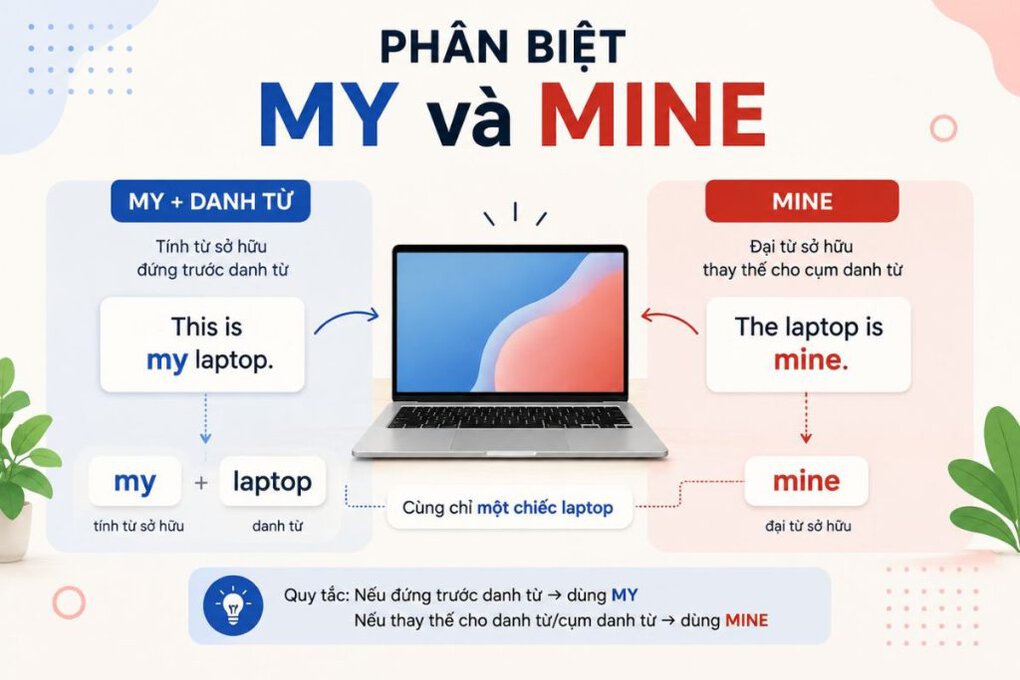
- This is my laptop. The laptop is mine.
- Your room is bigger than ours.
- This bag is hers.
- Their house is near the park, and ours is across the street.
In these examples, mine, ours, and hers replace noun phrases such as my laptop, our room, and her bag. This prevents unnecessary repetition and helps make sentences more concise.
In modern English grammar, words such as my, your, her, our, and their are commonly classified as possessive determiners when they appear before nouns. However, many English-learning resources still refer to them as possessive adjectives. This article uses the familiar term possessive adjectives when comparing the two groups.
Possessive Pronouns Chart in English
A possessive pronouns chart makes it easier to understand the relationship between personal pronouns, possessive adjectives, and possessive pronouns.
| Personal Pronoun | Possessive Adjective | Possessive Pronoun | Meaning |
| I | my | mine | Belonging to me |
| You | your | yours | Belonging to you |
| He | his | his | Belonging to him |
| She | her | hers | Belonging to her |
| It | its | No commonly used independent equivalent | Belonging to it |
| We | our | ours | Belonging to us |
| They | their | theirs | Belonging to them |
The commonly used possessive pronouns are mine, yours, his, hers, ours, and theirs. The form his is the same whether it appears before a noun or replaces a noun phrase.
The word its expresses possession before a noun, but it does not normally function as an independent possessive pronoun in everyday English.
Common Possessive Pronouns and Their Meanings
Mine means belonging to the speaker.
Example: This phone is mine.
Yours means belonging to the person or people being addressed.
Example: Is this umbrella yours?
His means belonging to a male person or someone referred to as he.
Example: This is his jacket. The black jacket is his.
Hers means belonging to a female person or someone referred to as she.
Example: My desk is near the window, and hers is by the door.
Ours means belonging to the speaker and one or more other people.
Example: Their classroom is upstairs, and ours is downstairs.
Theirs means belonging to another person or group of people.
Example: These seats are theirs.
Learning these forms in pairs with their corresponding possessive adjectives can make them easier to remember and use correctly.
What Is the Possessive Pronoun of “It”?
English learners sometimes wonder whether it has a possessive pronoun equivalent to mine or theirs.
The word its is used before a noun to indicate possession by an object, animal, organization, or other entity referred to as it. However, standard everyday English does not generally use its independently in the same way as mine, yours, hers, or theirs.
Examples:
- The company changed its policy.
- The dog wagged its tail.
- The computer has lost its connection.
In each sentence, its appears before a noun: policy, tail, or connection.
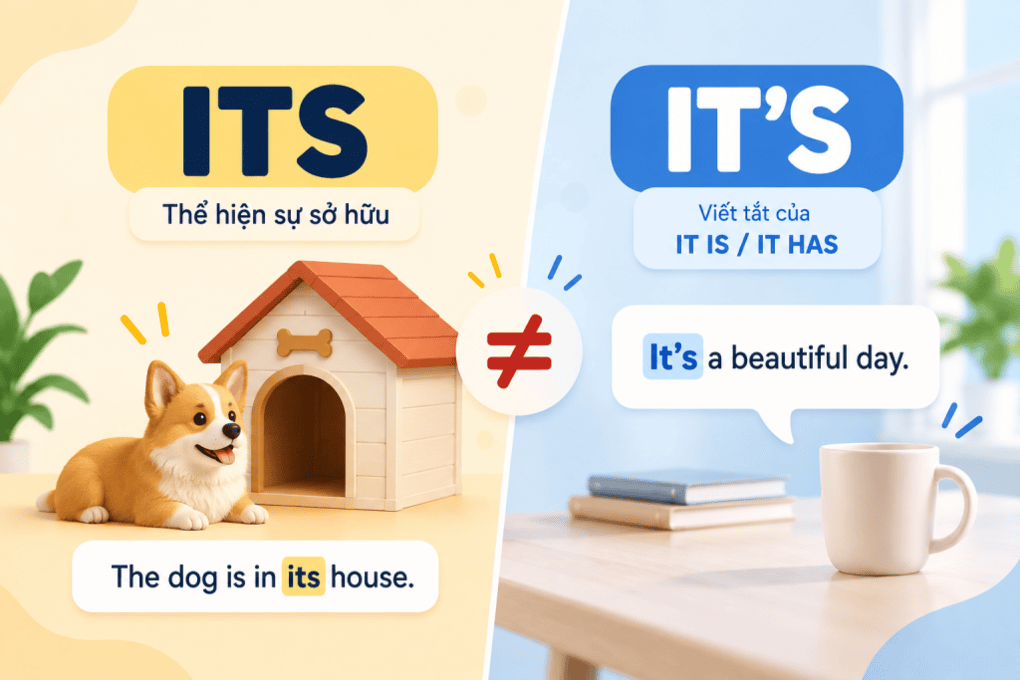
It is also important to distinguish between its and it’s:
- Its: A possessive form used before a noun.
- It’s: A contraction of it is or it has.
For example, It’s raining outside means It is raining outside. In contrast, The company changed its policy uses its to express possession.
How to Use Possessive Pronouns
Possessive pronouns appear in several common sentence structures. Understanding their position and function will help you choose the correct form.
Use Possessive Pronouns to Replace Nouns
One of the main functions of possessive pronouns is to replace a noun or noun phrase that has already been mentioned or is clear from the context.
Common structure:
Noun phrase + verb + possessive pronoun
Examples:
- This is my pen. That one is yours.
- Their apartment is spacious, but ours is smaller.
- The red bicycle is hers.
- My presentation is detailed, but his is shorter.
In these examples, the possessive pronouns replace noun phrases such as your pen, our apartment, her bicycle, and his presentation.
Use Possessive Pronouns in Comparisons
Possessive pronouns are frequently used in comparative sentences to compare objects, belongings, or things associated with different people.
Examples:
- Your presentation is more detailed than mine.
- Their garden is larger than ours.
- This solution is better than his.
- Her computer is newer than yours.
Here, mine, ours, his, and yours prevent the speaker from repeating the same nouns.
Use Possessive Pronouns with “Of”
Another common pattern is a noun phrase followed by of and a possessive pronoun.
Structure:
Noun or noun phrase + of + possessive pronoun
This construction can express relationships, associations, or belongings.
Examples:
- She is a friend of mine.
- I met a colleague of hers yesterday.
- That idea of yours sounds interesting.
- He introduced us to an old friend of his.
This structure is not limited to physical ownership. It can also describe personal relationships and associations.
Use Possessive Pronouns in Everyday Conversations
Possessive pronouns are useful when asking who owns something, confirming ownership, or distinguishing between objects that belong to different people.
Example conversation:
A: Is this your notebook?
B: No, mine is in my bag.
A: Whose keys are these?
B: They’re hers.
Another example:
A: Is that your seat?
B: No, ours is near the window.
Practicing short conversations like these can help you use possessive pronouns naturally in everyday English.
Possessive Adjectives and Possessive Pronouns: Key Differences
Possessive adjectives and possessive pronouns both express possession, but their grammatical functions are different. Recognizing this distinction is essential for constructing correct sentences.
| Possessive Adjective | Possessive Pronoun | Example |
| My | Mine | my book → The book is mine. |
| Your | Yours | your bag → The bag is yours. |
| His | His | his phone → The phone is his. |
| Her | Hers | her laptop → The laptop is hers. |
| Our | Ours | our room → The room is ours. |
| Their | Theirs | their house → The house is theirs. |
Possessive Adjectives Come Before Nouns
Possessive adjectives are placed before nouns to identify the person or entity associated with something.
Structure:
Possessive adjective + noun
Examples:
- This is my computer.
- Her bag is on the chair.
- They are cleaning their classroom.
- We have finished our project.
In these sentences, my, her, their, and our appear directly before the nouns they modify.
Possessive Pronouns Stand Independently
Possessive pronouns replace noun phrases and therefore do not directly precede a noun.
Common structures:
Possessive pronoun
Subject + be + possessive pronoun
Examples:
- This is my seat. This seat is mine.
- Their house is new. Ours is old.
- Is that your bag? No, it’s hers.
- Our office is upstairs. Theirs is downstairs.
A simple rule can help you choose the correct form: if a noun follows the possessive word, use a possessive adjective; if the word replaces the entire noun phrase, use a possessive pronoun.
Remember that his has the same spelling in both roles, so its function depends on how it is used in the sentence.
Common Mistakes with Possessive Pronouns
English learners often make mistakes when choosing between possessive adjectives and possessive pronouns. Spelling errors and confusion between similar-looking words can also cause problems.
Using Possessive Pronouns Before Nouns
Possessive pronouns such as mine, yours, hers, ours, and theirs do not directly modify nouns.
Incorrect: This is mine laptop.
Correct: This is my laptop.
In the correct sentence, my appears before laptop. If you want to use mine, you can write: This laptop is mine.
Using Possessive Adjectives Without Nouns
Possessive adjectives such as my, your, her, our, and their normally need a noun when used to express possession.
Incorrect: This book is my.
Correct: This book is mine.
The word mine replaces the phrase my book, so the noun does not need to be repeated.
Adding an Apostrophe to Possessive Pronouns
The possessive pronouns yours, hers, ours, and theirs do not take an apostrophe.
Incorrect: That bag is her’s.
Correct: That bag is hers.
Similarly, write yours, ours, and theirs, rather than your’s, our’s, or their’s.
Confusing “Its” and “It’s”
Its indicates possession, while it’s is a contraction of it is or it has.
Incorrect: The company changed it’s policy.
Correct: The company changed its policy.
In the correct sentence, its appears before the noun policy to indicate that the policy belongs to the company.
Misunderstanding “His”
The word his can function as a possessive adjective or a possessive pronoun without changing its form.
Examples:
- This is his jacket.
- This jacket is his.
In the first sentence, his comes before the noun jacket. In the second, it stands independently and replaces the phrase his jacket.
To identify its function, examine the word’s position and role in the sentence.
Possessive Pronouns Exercises with Answers
The following possessive pronouns exercises help you practice choosing between possessive adjectives and possessive pronouns, completing sentences, and correcting common mistakes.
Exercise 1: Choose the Correct Answer
Choose the correct option to complete each sentence.
Question 1: This is my desk. That one is ______.
- your
- yours
- you
Question 2: We have our own meeting room. They have ______.
- theirs
- their
- them
Question 3: This isn’t her laptop. It’s ______.
- my
- mine
- me
Question 4: Is this ______ umbrella?
- hers
- her
- she
Question 5: The blue car belongs to him. The car is ______.
- his
- him
- he
Answers:
- B — yours
- A — theirs
- B — mine
- B — her
- A — his
Explanation: In Questions 1, 2, 3, and 5, the missing words replace noun phrases that are clear from the context, so possessive pronouns are required. In Question 4, the word comes before the noun umbrella, so the possessive adjective her is correct.
Exercise 2: Complete the Sentences
Fill in each blank with the appropriate possessive form.
- I forgot ______ password, so I couldn’t log in.
- This isn’t my seat. ______ is near the window.
- They brought ______ documents to the meeting.
- We have finished our report. Have you finished ______?
- She left ______ phone at the office.
- The decision was ______, not ours.
Answers:
- my
- Mine
- their
- yours
- her
- theirs
Explanation: My, their, and her appear before nouns and function as possessive adjectives. Mine, yours, and theirs replace noun phrases that are understood from the context.
Exercise 3: Find and Correct the Mistakes
Each sentence contains an error involving possessive adjectives or possessive pronouns. Rewrite each sentence correctly.
- This is mine laptop.
- That bag is her’s.
- The blue folder is my.
- The company changed it’s policy.
- This is theirs office.
Answers:
- This is my laptop.
- That bag is hers.
- The blue folder is mine.
- The company changed its policy.
- This is their office.
Explanation: My and their appear before nouns, while mine and hers stand independently to replace noun phrases. In addition, its expresses possession, whereas it’s means it is or it has. The possessive pronoun hers does not contain an apostrophe.
Understanding possessive pronouns, their positions in sentences, and their differences from possessive adjectives will help you use English more accurately. Remember the common pairs my–mine, your–yours, her–hers, and our–ours, and pay attention to special cases such as his and its/it’s. After reviewing the grammar rules, complete the exercises again without looking at the answers to check your understanding.
Frequently Asked Questions About Possessive Pronouns
Do Possessive Pronouns Always Appear at the End of a Sentence?
No. Possessive pronouns can appear in different positions depending on the sentence structure. For example, Mine is on the table means that something belonging to the speaker is on the table, while This book is mine identifies the book as the speaker’s. The key rule is that a possessive pronoun can replace a noun phrase and does not directly precede a noun.
Can You Use Possessive Pronouns with “Of”?
Yes. The structure noun or noun phrase + of + possessive pronoun is commonly used to express relationships or associations. For example, a friend of mine means one of my friends, while a colleague of hers refers to one of her colleagues. This construction is natural in many everyday English contexts.
Can Possessive Pronouns Refer to Objects and Animals?
Yes. Possessive forms can refer to belongings associated with objects, animals, and other entities. However, English normally uses its before a noun rather than as an independent possessive pronoun equivalent to mine or theirs. For example, The dog wagged its tail uses its to indicate that the tail belongs to the dog.
How Can You Memorize Possessive Pronouns More Easily?
Learn possessive pronouns alongside their corresponding possessive adjectives, such as my–mine, your–yours, her–hers, and their–theirs. When completing a sentence, check whether a noun follows the possessive word. Use a possessive adjective when it modifies a noun and a possessive pronoun when it replaces an entire noun phrase.
Are Possessive Pronouns Important for English Conversation?
Yes. Possessive pronouns are useful when asking who owns something, confirming ownership, comparing belongings, or talking about relationships. For example, Is this yours? means that the speaker is asking whether something belongs to the listener. Understanding these forms helps reduce repetition and makes everyday conversations clearer and more natural.
Keywords:
- Possessive pronouns in English
- What are possessive pronouns
- Possessive adjectives and possessive pronouns
- How to use possessive pronouns
- Possessive pronouns exercises
