

Learning how to tell time in English is an essential skill for everyday communication, schoolwork, and international exams. However, many learners find it challenging to distinguish between past and to, use expressions such as quarter and half, or tell the difference between the 12-hour and 24-hour clock systems.
This guide explains how to tell time in English, from basic rules to more advanced expressions. You will also find practical examples, memorization tips, and exercises with answers to help you use time expressions accurately and confidently.
Why Is Learning How to Tell Time in English Important?
How to Tell Time in English for Everyday Communication
Time is an important part of daily conversations. You need to know how to tell time when meeting friends, checking a bus schedule, confirming a work appointment, or asking when an event begins.
For example, if you want to say that a meeting starts at 9:30, you can say:
The meeting starts at half past nine.
Understanding different time expressions helps you communicate clearly and avoid misunderstandings about schedules and appointments.
How to Tell Time in English for School
Telling time is a fundamental topic in elementary English, especially in lessons about numbers, daily routines, and schedules. For fourth-grade students, learning to read and say the time also strengthens listening, speaking, and vocabulary skills.
Building a strong foundation early makes it easier to understand more complex time expressions later.
How to Tell Time in English for IELTS and TOEIC
Time-related information frequently appears in English listening exercises and international exams such as IELTS and TOEIC. Questions may involve appointment times, travel schedules, departure times, or event timetables.
Recognizing expressions such as a quarter past eight and ten to nine helps you identify the correct information and avoid common listening mistakes.
How to Tell Time in English: Basic Rules and Examples
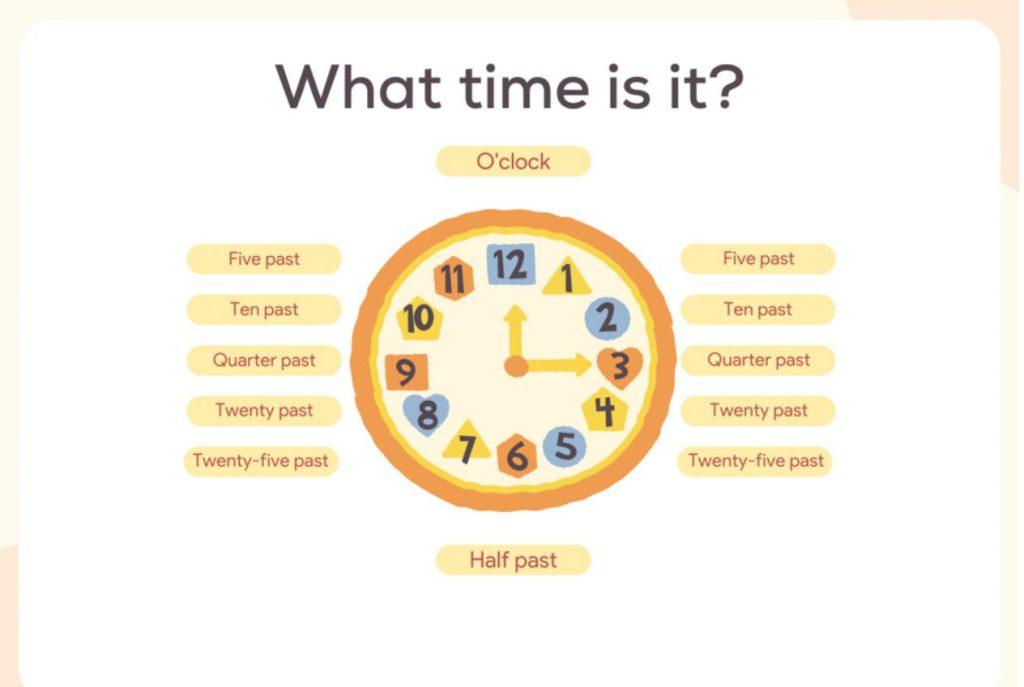
There are two common ways to tell time in English: using traditional expressions with past, to, quarter, and half, or reading the hour followed by the minutes.
Both methods are correct. The most suitable option depends on the context and your communication preferences.
How to Tell Time in English Using O’clock
When the minute hand points to 12, indicating an exact hour, you can use the following structure:
Hour + o’clock
Examples:
| Time | English Expression |
| 1:00 | One o’clock |
| 6:00 | Six o’clock |
| 9:00 | Nine o’clock |
| 12:00 | Twelve o’clock |
The word o’clock emphasizes an exact hour. In everyday conversation, speakers may omit it when the context is clear.
Example:
It’s six o’clock. (It is exactly six.)
How to Tell Time in English Using Past
The word past indicates the number of minutes that have elapsed since the current hour. In the traditional system, it is generally used for times from minute 1 to minute 30.
Formula: Minutes + past + current hour
Examples:
| Time | English Expression |
| 6:05 | Five past six |
| 6:10 | Ten past six |
| 6:15 | A quarter past six |
| 6:20 | Twenty past six |
| 6:25 | Twenty-five past six |
For 15 minutes past the hour, a quarter past is a common expression. You can also use the direct form, such as six fifteen.
Example:
It’s ten past seven. (It is 7:10.)
How to Tell Time in English Using To
The word to expresses the number of minutes remaining before the next hour. It is generally used for times from minute 31 to minute 59 in the traditional system.
Formula: Remaining minutes + to + next hour
To calculate the remaining minutes, subtract the current minute value from 60. Then, move to the next hour.
Examples:
| Time | English Expression |
| 5:40 | Twenty to six |
| 5:45 | A quarter to six |
| 5:50 | Ten to six |
| 5:55 | Five to six |
| 8:50 | Ten to nine |
Example:
I leave home at ten to seven. (I leave home at 6:50.)
Remember: When using to, the hour that follows is the next hour, not the current one.
How to Tell Time in English Using Half Past
The word half means one-half. In time expressions, half past indicates that 30 minutes have passed since the beginning of the current hour.
Formula: Half past + current hour
Examples:
- 2:30 – Half past two.
- 4:30 – Half past four.
- 7:30 – Half past seven.
- 10:30 – Half past ten.
You can also read the hour and minutes directly. For example, seven thirty means the same as half past seven.
Example:
My class starts at half past seven. (My class starts at 7:30.)
How to Tell Time in English Using Quarter Past and Quarter To
A quarter is one-fourth of an hour, which equals 15 minutes.
- A quarter past + hour: 15 minutes after the stated hour.
- A quarter to + next hour: 15 minutes before the next hour.
Examples:
| Time | English Expression | Meaning |
| 8:15 | A quarter past eight | 15 minutes after eight |
| 8:45 | A quarter to nine | 15 minutes before nine |
| 10:15 | A quarter past ten | 15 minutes after ten |
| 10:45 | A quarter to eleven | 15 minutes before eleven |
Although the expressions differ by only one word, they refer to different times. Pay attention to past and to when speaking or listening.
How to Tell Time in English by Reading the Numbers
Another common method is to read the hour first and then the minutes. This approach is straightforward and widely used in everyday conversation.
Examples:
| Time | English Expression |
| 6:12 | Six twelve |
| 7:20 | Seven twenty |
| 8:30 | Eight thirty |
| 9:45 | Nine forty-five |
| 10:55 | Ten fifty-five |
With this method, you do not need to calculate the remaining minutes or move to the next hour. It is especially useful for times that do not fall on familiar quarter-hour or half-hour intervals.
How to Tell Time in English Using the 12-Hour and 24-Hour Clocks
How to Tell Time in English Using AM and PM
The 12-hour clock divides the day into two periods. The abbreviations a.m. and p.m. help identify whether a time falls before or after noon.
- a.m. (ante meridiem): From midnight to before noon.
- p.m. (post meridiem): From noon to before midnight.
Examples:
- 7:00 a.m. – Seven a.m.
- 10:30 a.m. – Ten thirty a.m.
- 2:00 p.m. – Two p.m.
- 8:15 p.m. – Eight fifteen p.m.
Two special cases are worth remembering: 12 a.m. refers to midnight, while 12 p.m. refers to noon.
How to Tell Time in English Using the 24-Hour Clock
The 24-hour clock is commonly used in transportation schedules, flight information, timetables, and official announcements. Speakers can read the hour followed by the minutes.
Examples:
| Time | English Expression |
| 08:00 | Eight o’clock |
| 08:30 | Eight thirty |
| 14:15 | Fourteen fifteen |
| 18:45 | Eighteen forty-five |
| 21:10 | Twenty-one ten |
Expressions such as fourteen fifteen are useful when reading 24-hour schedules. In military or specialized operational contexts, other conventions, including expressions with hundred hours, may also be used.
How to Tell Time in English: British vs. American Usage
Both British and American English use expressions such as past, to, quarter past, and half past. The main difference is that certain expressions may be more common in some contexts than others.
British English commonly uses traditional time expressions with past and to. American English speakers also use these expressions, but direct number-based forms are very common in everyday conversation.
For example, 7:45 can be expressed in two ways:
- Traditional form: A quarter to eight.
- Direct form: Seven forty-five.
Both expressions are correct and understandable. Rather than memorizing a strict rule for each variety of English, practice listening to different speakers and become familiar with both forms.
How to Tell Time in English: Questions and Answers
Knowing how to ask about the time is just as important as knowing how to read a clock.
How to Tell Time in English by Asking Questions
Here are several common questions about time:
- What time is it? – Asking for the current time.
- What’s the time? – Another way to ask for the current time.
- What time does the movie start? – Asking when a movie begins.
- When does the train leave? – Asking about a train’s departure time.
How to Tell Time in English by Giving Answers
You can use the following expressions to answer time-related questions:
- It’s five o’clock. – It is exactly five.
- It’s half past six. – It is 6:30.
- It’s a quarter to nine. – It is 8:45.
- The train leaves at seven fifteen. – The train departs at 7:15.
Use at before a specific time when explaining when an activity takes place.
Example:
The meeting starts at nine a.m.
How to Tell Time in English for Fourth-Grade Students
For elementary learners, combining visual aids, listening activities, and practical exercises can make learning easier and more enjoyable.
How to Tell Time in English With a Movable Clock
Parents and teachers can use a toy clock or draw a clock face on paper. Move the hands to different positions and ask students to say the time in English.
Start with simple times such as 3:00, 5:30, and 6:15 before introducing more challenging examples.
How to Tell Time in English Using the Clock Face
Imagine dividing the clock face into two halves:
- The right half: From minute 1 to minute 30, where past is generally used.
- The left half: From minute 31 to minute 59, where to is generally used.
This visual method helps students understand the difference between the minutes that have passed and the minutes remaining before the next hour.
How to Tell Time in English Through Daily Conversations
Encourage students to practice questions about their routines, such as:
What time do you get up?
What time do you go to school?
Students can answer using their actual schedules. Connecting time expressions to familiar activities helps them remember vocabulary and develop more natural speaking habits.
Common Mistakes When Learning How to Tell Time in English
Confusing Past and To
Past refers to minutes after the current hour, whereas to refers to minutes remaining before the next hour.
For example, 4:50 can be expressed as ten to five, not ten to four, when using the traditional system.
Confusing Quarter and Half
Quarter represents 15 minutes, while half represents 30 minutes.
- 6:15 – A quarter past six.
- 6:30 – Half past six.
- 6:45 – A quarter to seven.
Mixing Up AM and PM
Using the wrong abbreviation can cause confusion about appointments and schedules. Always check the context to determine whether a time refers to the morning, afternoon, or evening.
Practicing Speaking but Ignoring Listening
Some learners can read time expressions correctly but struggle to recognize them in spoken English. Words such as fifteen and fifty can be difficult to distinguish when spoken quickly.
Practice listening carefully to pronunciation, paying attention to word stress and final sounds. Then write down the time you hear and check your answer.
How to Tell Time in English: Practice Exercises With Answers
Complete the exercises below before checking the answers.
Exercise: Write the Time in English
Write each time using the traditional time expressions.
- 07:00 → __________
- 04:15 → __________
- 09:30 → __________
- 10:45 → __________
- 02:10 → __________
Exercise: Choose the Correct Answer
How do you express 03:50 using the traditional system?
- Fifty past three
- Ten to four
- Ten to three
Which expression means 06:15?
- A quarter past six
- A quarter to six
- Half past six
Exercise: Convert Words Into Numbers
Write the correct time in numbers.
- Twenty past eight → __________
- Five to eleven → __________
- A quarter to seven → __________
- Half past three → __________
How to Tell Time in English: Answer Key
Exercise 1: Write the time
- 07:00 – Seven o’clock.
- 04:15 – A quarter past four.
- 09:30 – Half past nine.
- 10:45 – A quarter to eleven.
- 02:10 – Ten past two.
Exercise 2: Choose the correct answer
- Question 1: B. Ten to four. At 3:50, ten minutes remain before four o’clock.
- Question 2: A. A quarter past six. This expression means 15 minutes after six.
Exercise 3: Convert words into numbers
- Twenty past eight – 08:20.
- Five to eleven – 10:55.
- A quarter to seven – 06:45.
- Half past three – 03:30.
How to Tell Time in English: Tips for Faster Learning
To use time expressions confidently, practice a little every day instead of memorizing all the rules at once.
- Remember the 30-minute rule: Use past for minutes 1–30 and to for minutes 31–59 when using the traditional system.
- Learn common phrases: Practice o’clock, quarter past, half past, and quarter to as complete expressions.
- Combine listening and speaking: Listen to English conversations and repeat the time expressions aloud to improve recognition and pronunciation.
- Practice with a clock: Choose several times each day and try to express each one using both methods.
- Use time expressions in context: Talk about your school schedule, meals, work hours, and appointments to make practice more meaningful.
Mastering how to tell time in English helps you communicate more clearly, strengthen your classroom knowledge, and understand listening tasks involving schedules and appointments. Start with exact hours, practice past and to, and gradually move on to the 12-hour and 24-hour clock systems and everyday conversations.
Frequently Asked Questions About How to Tell Time in English
How do you say 6:30 in English?
You can say six thirty or half past six. Both expressions mean 6:30 and are commonly used in everyday English.
How do you tell the time using To in English?
Use the number of remaining minutes + to + the next hour. For example, 6:50 is ten to seven, meaning ten minutes before seven.
How do you say 6:15 in English?
You can say six fifteen or a quarter past six. The first expression reads the hour and minutes directly, while the second uses the traditional time-telling structure.
How do you say 4:30 in English?
You can say four thirty or half past four. The expression half past four means that 30 minutes have passed since four o’clock.
How do you say 6:50 in English?
You can say six fifty or ten to seven. When using the second form, remember that the hour after to is the next hour.
How do you say 30 minutes in English?
Thirty minutes can also be expressed as half an hour. In time expressions, half past six means 6:30.
How do you tell the time on the hour in English?
Read the hour and add o’clock when you want to emphasize an exact hour. For example, 6:00 is six o’clock, 8:00 is eight o’clock, and 12:00 is twelve o’clock.
Related Keywords:
- Learning to Tell Time in English
- English Time-Telling Rules
- How to Say the Time in English
- Telling Time in English Exercises
- How to Tell Time Using AM and PM
