

IELTS Listening practice is an essential part of preparing for the IELTS exam. It helps candidates develop their ability to understand spoken English, identify key information, recognize paraphrasing, and select accurate answers under time pressure.
Many learners spend hours listening to English but still struggle to improve their Listening scores. This often happens because they focus on completing practice tests without identifying why they make mistakes. Difficulties with pronunciation, unfamiliar vocabulary, connected speech, and misleading answer choices can all affect performance.
A more effective approach combines focused listening exercises, vocabulary development, question-type practice, and detailed answer analysis. By following a structured study plan, learners can identify weaknesses and gradually build the skills needed to perform more confidently in the IELTS Listening test.
This guide explains the IELTS Listening format, provides practical study methods, and introduces strategies for using answer keys and transcripts effectively. It also covers how to organize IELTS Listening practice at home and track progress over time.
Understanding the IELTS Listening Test
Before starting an IELTS Listening study plan, it is important to understand the test format. Knowing what each section involves allows you to choose appropriate practice materials and focus on the skills required for different question types.
The Four Parts of IELTS Listening
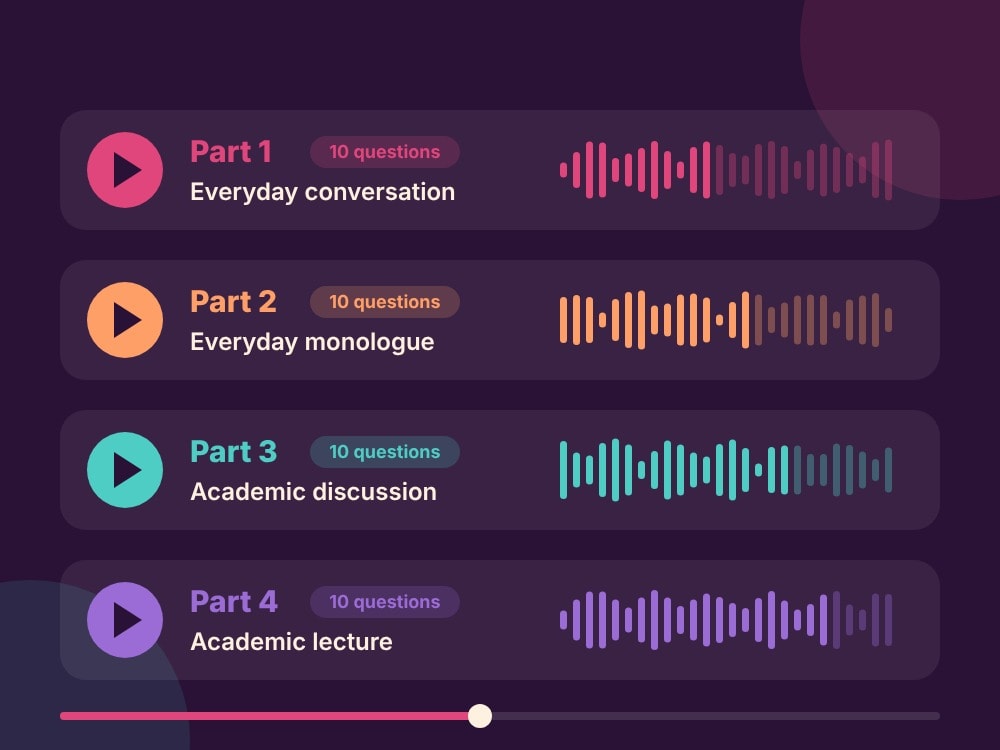
The IELTS Listening test contains four parts and 40 questions. The content progresses from everyday conversations to discussions and talks involving educational or academic subjects.
Part 1: Everyday Conversation
This section usually features two speakers discussing a familiar situation, such as booking a service, registering for an activity, or requesting information.
Candidates often need to identify practical details, including names, addresses, dates, prices, and telephone numbers.
Part 2: Everyday Monologue
This part features one speaker talking about a social or everyday topic. Examples include introducing a location, explaining an activity, or providing information about an event.
Understanding the overall structure of the talk and recognizing directions or descriptive details can be particularly useful.
Part 3: Educational Conversation
This section typically involves two to four speakers discussing an academic or training-related topic. They may talk about an assignment, research project, course, or study plan.
Candidates need to follow the discussion, distinguish different opinions, and recognize when a speaker changes or clarifies an idea.
Part 4: Academic Monologue
The final section consists of one speaker delivering a talk on an academic subject. It requires learners to follow a longer explanation and identify important details without the support of a conversation.
Each part contains 10 questions. In the paper-based test, candidates have approximately 30 minutes to listen and answer questions, followed by 10 minutes to transfer their answers to the answer sheet. Computer-delivered IELTS follows a different answer-entry process.
Common IELTS Listening Question Types
IELTS Listening practice should cover the main question types because each requires a slightly different strategy.
Multiple Choice: Select the correct answer from the available options.
Matching: Match people, statements, characteristics, or pieces of information.
Form, Note, Table, and Summary Completion: Complete missing information in a form, notes, a table, or a summary.
Map, Plan, and Diagram Labelling: Identify locations or complete labels on a map, floor plan, or diagram.
Sentence Completion: Fill in missing words to complete a sentence.
Short Answer Questions: Answer questions using information from the recording while following the word limit.
For completion tasks, spelling and word limits are particularly important. Multiple-choice questions require careful attention to differences between similar options, while map questions often involve directions and spatial relationships.
IELTS Listening Practice Plan for Beginners and Intermediate Learners
A structured IELTS Listening study plan should progress from basic listening comprehension to question-type practice and full-length tests. Attempting complete practice tests too early may be frustrating if you cannot yet recognize common words and connected speech.
Stage 1: Build Basic Listening Skills
If you are a beginner, start with short recordings on familiar topics. Choose materials that match your current English level instead of immediately attempting difficult academic talks.
Focus on three fundamental skills.
Recognizing individual sounds: Learn to distinguish similar sounds and pay attention to word endings that may be difficult to hear.
Understanding phrases: Practice listening to groups of words rather than trying to process every word separately.
Identifying the main idea: After listening to a short recording, summarize its main message without attempting to write down everything you hear.
Suitable topics include daily routines, shopping, work, travel, and education. Once you can understand short recordings more comfortably, gradually increase their length and complexity.
The goal is to develop reliable listening habits before moving on to more demanding IELTS Listening exercises.
Stage 2: Improve Vocabulary and Recognize Paraphrasing
In the IELTS Listening test, the wording in a question may differ from the language used in the recording. Therefore, simply waiting to hear the exact keyword is not always effective.
For example, the word cost may be expressed as price, fee, or another phrase depending on the context. Similarly, postpone may be replaced by put off.
To improve your ability to recognize paraphrasing, follow these steps:
- Read the question and identify its key words.
- Predict possible synonyms or alternative expressions.
- Listen for the intended meaning rather than searching for an identical word.
- Review the transcript after checking your answers.
- Record useful expressions and practice using them in new sentences.
Learning vocabulary in context is generally more useful than memorizing isolated word lists. Organize new expressions by topic, such as education, accommodation, transportation, and research, to make them easier to review.
Stage 3: Practice Individual Question Types
Once you have developed basic listening skills, dedicate separate sessions to different question types.
For example, you might practice form completion on Monday, multiple-choice questions on Tuesday, matching on Wednesday, map labelling on Thursday, and summary completion on Friday.
Use the weekend to complete a full Listening test and review the results.
This approach allows you to understand the demands of each question type before combining them under exam conditions. If you consistently struggle with multiple-choice questions, spend additional time identifying distractors and understanding how speakers express changing opinions.
How to Improve IELTS Listening with Answers
IELTS Listening practice with answers helps you measure your performance and identify areas that need improvement. However, checking the answer key alone is not enough. You also need to understand why an answer was incorrect.
A systematic review process can turn each practice session into a useful learning opportunity.
Complete the Exercise Before Checking Answers
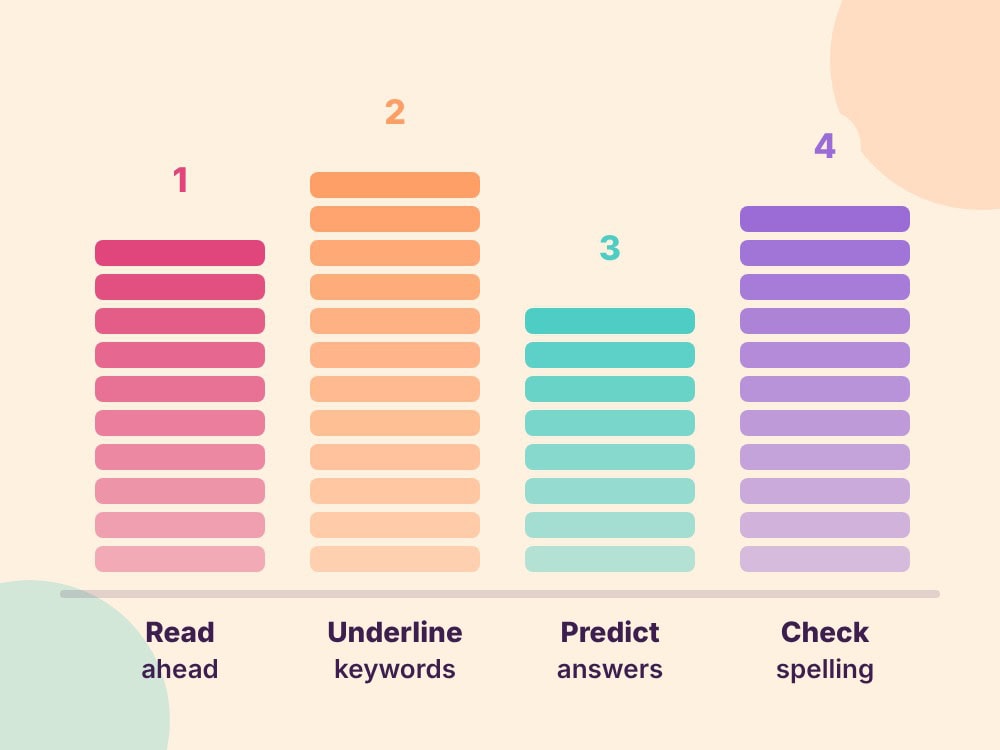
Start by reading the questions and identifying important keywords. For completion questions, predict the type of information required, such as a noun, number, date, or place name.
Listen to the recording and answer the questions without repeatedly pausing or replaying the audio if you are trying to simulate exam conditions.
After finishing, check your answers and categorize your mistakes.
Common reasons for incorrect answers include:
- Unfamiliar vocabulary or expressions.
- Difficulty recognizing familiar words in connected speech.
- Failure to recognize synonyms or paraphrases.
- Losing concentration and missing important details.
- Spelling errors or failure to follow word limits.
Identifying the cause of each mistake helps you decide what to practice next rather than repeating the same exercises without a clear purpose.
Analyze the IELTS Listening Transcript
An IELTS Listening transcript provides a written version of the recording. It helps you locate the information connected to each question and understand why you missed it.
After checking your answers, find the sentence containing the relevant information. Compare the transcript with what you originally heard.
If you knew the word but could not recognize it in the recording, pay attention to pronunciation, word stress, connected speech, and final consonants.
If you understood the words but selected the wrong option, examine the surrounding context. The speaker may have corrected an earlier statement, rejected an initial suggestion, or introduced a contrasting idea.
After reviewing the transcript, listen to the recording again without reading the text. Try to recognize the relevant information directly from the audio.
This final step is important because the objective is to improve your listening ability, not simply to understand the written transcript.
Keep a Record of Your Listening Mistakes
Create a simple error log containing the practice date, question type, number of incorrect answers, reason for each mistake, and action needed to improve.
For example, if you frequently miss names and addresses in Part 1, practice spelling, numbers, and letter recognition. If multiple-choice questions are difficult, focus on identifying distractors and listening for changes in the speaker’s opinion.
Review your error log every one or two weeks. Repeated mistakes indicate which skills deserve more attention in your next study sessions.
IELTS Listening Practice at Home
IELTS Listening practice at home allows you to choose your study schedule and work on specific weaknesses. However, the quality of your resources and the way you use them are just as important as the time you spend studying.
Choose Reliable Online Practice Resources
A useful practice resource should ideally include clear audio, questions, an answer key, and a transcript. Explanations of question types and test strategies can also help you understand how to approach different tasks.
You can explore IELTS and British Council resources for test information and listening practice activities.
Choose materials that match your current level and study objectives. Beginners may benefit from shorter exercises with clear instructions, while more experienced learners can focus on individual question types and full-length practice tests.
Using a consistent set of resources also makes it easier to compare results and monitor your progress.
Combine Focused Listening with Extensive Listening
Focused listening involves completing a specific task. You might listen for a date, identify a speaker’s opinion, or find the location mentioned in a conversation.
Extensive listening involves listening to longer English content to become more familiar with spoken language. Podcasts, educational talks, and other English audio materials can help you build familiarity with different topics, speaking styles, and accents.
Both approaches can support your learning. However, if your primary goal is to improve your IELTS Listening performance, make sure your schedule includes regular IELTS-style exercises and detailed answer analysis.
Create a Realistic Daily Study Schedule
If you have limited time, start with approximately 30–45 minutes of practice each day.
10 minutes: Review vocabulary and expressions from previous sessions.
15–20 minutes: Complete a short listening exercise or practice one question type.
10–15 minutes: Check your answers, analyze the transcript, and replay difficult sections.
When you have more time, complete a full Listening test under exam-like conditions.
Consistency is more important than completing a large number of tests. Make sure your schedule leaves enough time to understand and correct mistakes.
Common Mistakes to Avoid in IELTS Listening
Some study habits can slow your progress even when you practice regularly. Recognizing these problems can help you make better use of your preparation time.
Replaying Audio Without Analyzing Errors
Listening to the same recording repeatedly may help you become familiar with its content, but repetition alone does not explain why you selected an incorrect answer.
After each exercise, locate the relevant section, compare it with the transcript, and identify the specific skill that needs improvement.
Trying to Understand Every Word
You do not need to understand every word in a recording to answer IELTS Listening questions correctly.
Focus on the information required by the question and how the speaker communicates it. If you encounter an unfamiliar word, avoid spending so much time guessing its meaning that you miss the next important detail.
You can review unfamiliar vocabulary after completing the exercise.
Ignoring Spelling and Word Limits
An answer may be marked incorrect if it contains a spelling mistake or exceeds the stated word limit.
Pay attention to names, numbers, plural endings, and words that sound similar. Always read the instructions before answering completion questions.
Developing the habit of checking spelling and word limits can help prevent avoidable mistakes.
Practicing Only One English Accent
IELTS Listening recordings may feature different English accents. If you only listen to one accent, you may find it difficult to recognize unfamiliar pronunciation patterns.
Use suitable resources featuring British, American, Australian, and other English accents. Begin with recordings that you can understand comfortably, then gradually introduce more challenging speakers and topics.
A Four-Week IELTS Listening Study Plan
If you are unsure how to organize your preparation, use the following four-week plan as a starting point.
Week 1: Strengthen the Basics
Practice short recordings, review essential vocabulary, improve sound recognition, and become familiar with answering listening questions.
Week 2: Focus on Question Types
Practice completion tasks, multiple-choice questions, matching, and other common formats. Review each exercise and record recurring mistakes.
Week 3: Increase Practice Intensity
Combine question-specific exercises with full-length Listening tests. Focus on predicting information, recognizing paraphrases, and managing your attention throughout the recording.
Week 4: Evaluate Your Progress
Complete practice tests under exam-like conditions. Record your scores and compare them with earlier results. Use the findings to identify remaining weaknesses and plan your next stage of preparation.
You can adjust this schedule according to your current proficiency, available study time, and target score. Avoid judging your progress based on a single test. Reviewing performance across several practice sessions provides a more useful picture of your development.
IELTS Listening practice is most effective when it combines sound recognition, vocabulary development, paraphrase awareness, and question-solving strategies. By analyzing mistakes, using transcripts appropriately, and selecting suitable resources, you can make your preparation more structured and purposeful.
Start with manageable goals, maintain a consistent routine, and increase the difficulty as your skills develop. Rather than counting only the number of tests you complete, pay attention to the mistakes you have corrected and how well you apply those lessons to unfamiliar recordings.
Frequently Asked Questions About IELTS Listening Practice
How long should I practice IELTS Listening each day?
Beginners can start with approximately 30–45 minutes per day. You can increase the duration as you become more comfortable with the exercises. Make sure you allocate sufficient time to reviewing answers and correcting mistakes.
How should beginners start IELTS Listening practice?
Start by developing basic pronunciation awareness, learning common vocabulary, and listening to short recordings. Once you can understand familiar topics more comfortably, gradually introduce IELTS question types and longer recordings.
Should I use transcripts when practicing IELTS Listening?
Yes. Transcripts help you identify unfamiliar expressions, recognize connected speech, and understand paraphrasing. However, complete the exercise before reading the transcript so that you can assess your actual listening ability.
Is online IELTS Listening practice suitable for self-study?
Yes. Online resources allow you to choose your schedule, practice different question types, and review answers independently. For more effective preparation, select materials with audio, answer keys, and transcripts.
How long does it take to improve IELTS Listening?
The time required depends on your starting level, study frequency, vocabulary, and practice methods. Track your performance across multiple tests, identify recurring mistakes, and adjust your study plan based on measurable progress.
Related Keywords
- IELTS Listening Exercises
- How to Improve IELTS Listening
- IELTS Listening Practice at Home
- IELTS Listening Practice Online
- IELTS Listening Practice with Answers
