
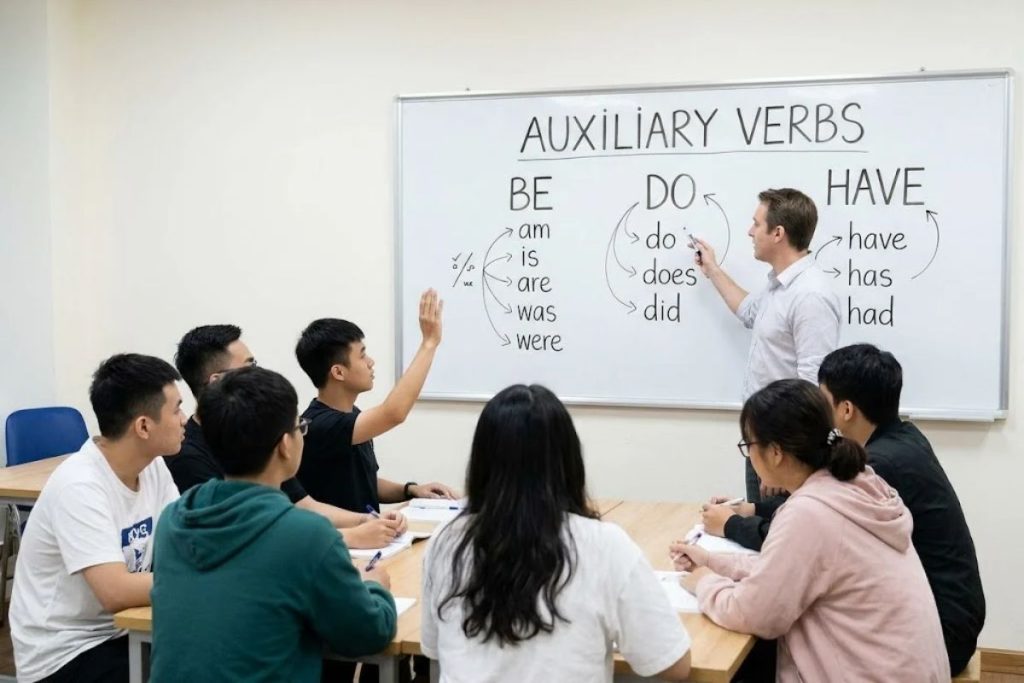
When learning English, many students struggle to form questions, make negative sentences, and use different verb tenses correctly. One common reason is a lack of understanding of auxiliary verbs.
Auxiliary verbs, also known as helping verbs, play an essential role in English grammar. They work with main verbs to form tenses, questions, negative statements, passive sentences, and other grammatical structures. Some auxiliary verbs also help express meanings such as ability, possibility, obligation, and advice.
In this guide, you will learn what auxiliary verbs are, explore the main types and their uses, review common mistakes, and practice with exercises and detailed answers.
What are auxiliary verbs?
Auxiliary verbs are verbs that help main verbs express grammatical information or additional meanings. They are also called helping verbs because they support the structure of a sentence rather than always expressing the main action themselves.
Auxiliary verbs are commonly used to:
- Form different verb tenses.
- Create questions and negative sentences.
- Build passive voice constructions.
- Emphasize actions or statements.
- Express ability, permission, possibility, advice, and obligation.
Examples:
- She is learning English. (She is currently studying English.)
- Do you like coffee? (This asks about someone’s preference.)
- They have finished the project. (The project is complete.)
- You should get more rest. (This expresses advice.)
In these examples, is, do, have, and should perform different supporting functions.
However, some verbs can function as either auxiliary verbs or main verbs, depending on the sentence. For example, have can express possession, while be can describe a person’s identity or condition. Understanding the role each verb plays in context is essential for using auxiliary verbs correctly.

Main types of auxiliary verbs in English
English auxiliary verbs can be divided into two main groups: primary auxiliary verbs and modal auxiliary verbs. Each group has its own grammatical functions and usage rules.
The auxiliary verb be
The verb be has several forms, including am, is, are, was, were, be, being, and been. The correct form depends on the subject, tense, and sentence structure.
The auxiliary verb be is particularly important when forming continuous tenses and passive sentences.
Using be in continuous tenses
Continuous tenses describe actions that are in progress at a particular time. The basic structure is:
Subject + be + verb-ing
Examples:
- I am reading a book. (I am reading at the moment.)
- She is working in the office. (Her work is currently in progress.)
- They were playing football when it started to rain. (The game was in progress when the rain began.)
The form of be changes according to the subject and tense, while the main verb takes the -ing form.
Using be in the passive voice
The auxiliary verb be combines with a past participle (V3) to form the passive voice.
Subject + be + past participle
Examples:
- The room is cleaned every day. (Someone cleans the room every day.)
- The documents were signed yesterday. (Someone signed the documents yesterday.)
The passive voice emphasizes the action or the person or thing affected by it, rather than the person performing the action.
Remember that be can also function as a main verb.
Example: She is a teacher.
Here, is connects the subject she with the noun a teacher. It does not support another verb, so it functions as the main verb.
The auxiliary verbs do, does, and did
Do, does, and did are commonly used to form questions and negative statements with ordinary verbs. They can also emphasize an affirmative statement.
The correct form depends on the subject and the tense.
| Auxiliary verb | Usage | Example |
| Do | Present simple with I, you, we, they, and plural subjects | Do you speak English? |
| Does | Present simple with he, she, it, and singular subjects | Does she work here? |
| Did | Past simple with all subjects | Did they call you? |
Forming questions
Use this structure:
Do/Does/Did + subject + base verb?
Examples:
- Do you like this book?
- Does he live in Hanoi?
- Did she attend the meeting yesterday?
The auxiliary verb appears before the subject, and the main verb remains in its base form.
Forming negative sentences
Use the following structure:
Subject + do/does/did + not + base verb
Examples:
- I do not understand the question.
- He does not play tennis.
- We did not go to school yesterday.
In everyday English, the contractions don’t, doesn’t, and didn’t are very common.
Emphasizing an affirmative statement
In affirmative sentences, do, does, and did can emphasize that an action really happens or happened.
Examples:
- I do want to help you. (I really want to help you.)
- She does understand the problem. (She really understands it.)
- He did call you yesterday. (He really called you yesterday.)
A common mistake is adding -s to the main verb after does or using the past form after did.
Incorrect: She doesn’t likes coffee.
Correct: She doesn’t like coffee.
Incorrect: Did he went home?
Correct: Did he go home?
After do, does, or did, always use the base form of the main verb.
The auxiliary verbs have, has, and had
Have, has, and had are used to form perfect tenses. These structures connect an action to the present or to another point in time.
| Auxiliary verb | Usage | Example |
| Have | Present perfect with I, you, we, and they | I have completed the task. |
| Has | Present perfect with he, she, and it | She has finished her homework. |
| Had | Past perfect with all subjects | They had left before noon. |
Using have and has in the present perfect
Structure:
Subject + have/has + past participle
Examples:
- I have visited Da Nang twice.
- She has just finished her work.
The present perfect is commonly used to talk about experiences, recently completed actions, or past events connected to the present.
Using had in the past perfect
Structure:
Subject + had + past participle
Example:
They had eaten dinner before I arrived.
The action of eating dinner happened before the speaker arrived. The past perfect makes this sequence of past events clear.
It is also important to distinguish between have as an auxiliary verb and have as a main verb.
- Auxiliary verb: She has finished the report.
- Main verb: She has a new laptop.
In the first sentence, has helps form the present perfect. In the second, has expresses possession.
Modal auxiliary verbs
Modal auxiliary verbs, often called modal verbs, express meanings such as ability, permission, possibility, obligation, prediction, and advice.
Common modal verbs include can, could, may, might, must, will, would, and should.
| Modal verb | Common meaning | Example |
| Can | Ability or permission | She can swim. |
| Could | Past ability or a polite request | Could you help me? |
| May | Permission or possibility | May I come in? |
| Might | Possibility | It might rain tonight. |
| Must | Obligation or strong deduction | You must wear a helmet. |
| Will | Future actions or predictions | I will call you tomorrow. |
| Would | Hypothetical situations or polite offers | Would you like some tea? |
| Should | Advice or recommendation | You should exercise regularly. |
Basic modal verb structure
Subject + modal verb + base verb
Examples:
- He can speak English fluently.
- You should study more carefully.
- We might visit our grandparents this weekend.
Unlike ordinary verbs, modal verbs do not take -s when the subject is third-person singular. The main verb that follows them also stays in its base form, without to in the basic structure.
Incorrect: She can speaks English.
Correct: She can speak English.
Incorrect: He must to leave now.
Correct: He must leave now.
Making negative sentences and questions with modal verbs
To make a negative sentence, add not after the modal verb. To form a question, place the modal verb before the subject.
Examples:
- You should not worry.
- Can you drive?
- Must we finish this today?
These structures allow speakers to express opinions, attitudes, and degrees of certainty more naturally.
How to distinguish auxiliary verbs from main verbs
Some English verbs can function as either auxiliary verbs or main verbs. The easiest way to distinguish them is to examine their function in the sentence.
| Example | Function | Explanation |
| She is a doctor. | Main verb | Is links the subject to the noun describing her profession. |
| She is studying. | Auxiliary verb | Is helps form the present continuous tense. |
| I have a car. | Main verb | Have expresses possession. |
| I have bought a car. | Auxiliary verb | Have helps form the present perfect tense. |
| They do their homework. | Main verb | Do means to perform or complete a task. |
| Do they study English? | Auxiliary verb | Do helps form a question. |
A useful rule is to ask whether the verb expresses the main action or state, or whether it supports another verb or a grammatical structure.
If it expresses the main action or state, it is generally a main verb. If it helps form a tense, question, negative statement, or another grammatical construction, it is functioning as an auxiliary verb.
Common mistakes when using auxiliary verbs
Even though auxiliary verbs are used frequently, learners often make several common mistakes.
Using the wrong auxiliary verb for the subject
Incorrect: Does they work here?
Correct: Do they work here?
Use does with he, she, and it, or other singular subjects. Use do with I, you, we, and they, as well as plural subjects.
Using the wrong verb form after do, does, or did
Incorrect: Did she went home?
Correct: Did she go home?
The auxiliary verb did already indicates the past tense, so the main verb must remain in its base form.
Adding do when another auxiliary verb is already present
Incorrect: Do you are tired?
Correct: Are you tired?
When a sentence already contains be or a modal verb, you generally do not need do, does, or did to form a question or negative statement.
Adding to after a modal verb
Incorrect: She can to sing.
Correct: She can sing.
In the basic modal verb structure, use the base form of the main verb directly after the modal.

Auxiliary verbs exercises with answers
Complete the following exercises to review the rules and test your understanding of auxiliary verbs.
Exercise: Fill in the blanks
Complete each sentence using an appropriate form of do, be, or have. Choose from do, does, did, am, is, are, was, were, have, has, and had.
- ___ you like drinking coffee?
- She ___ not understand the lesson.
- They ___ playing football now.
- He ___ finished his homework.
- ___ she at home yesterday?
- We ___ not go to school last Sunday.
- I ___ reading a book at the moment.
- They ___ already eaten dinner.
- ___ he work in this office?
- The students ___ studying in the classroom.
Answers and explanations
| No. | Answer | Explanation |
| 1 | Do | Use do for a present simple question with you. |
| 2 | Does | Use does not with she in the present simple. |
| 3 | Are | Are + verb-ing forms the present continuous. |
| 4 | Has | Has + past participle forms the present perfect with he. |
| 5 | Was | Use was with she in the past. |
| 6 | Did | Use did not + base verb for a past simple negative. |
| 7 | Am | Am reading forms the present continuous with I. |
| 8 | Have | Have eaten forms the present perfect with they. |
| 9 | Does | Use does in a present simple question with he. |
| 10 | Are | Are studying forms the present continuous with a plural subject. |
Exercise: Rewrite the sentences
Rewrite each sentence according to the instruction in parentheses.
- She likes English. (Make it negative.)
- They are watching TV. (Make it negative.)
- He went to school yesterday. (Make it a question.)
- You understand this lesson. (Make it a question.)
- She has finished her work. (Make it negative.)
- They play football every day. (Make it a question.)
- He is a teacher. (Make it a question.)
- We visited Hanoi last year. (Make it negative.)
- I am learning English. (Make it negative.)
- She can swim. (Make it a question.)
Answers
- She does not like English.
- They are not watching TV.
- Did he go to school yesterday?
- Do you understand this lesson?
- She has not finished her work.
- Do they play football every day?
- Is he a teacher?
- We did not visit Hanoi last year.
- I am not learning English.
- Can she swim?
Exercise: Choose the correct answer
Choose the correct auxiliary verb to complete each sentence.
Question 1: ___ your brother speak English?
- Do
- Does
- Is
Question 2: They ___ been to Singapore twice.
- has
- have
- did
Question 3: She ___ not go to work yesterday.
- does
- is
- did
Question 4: You ___ wear a seat belt when driving.
- should
- are
- have
Question 5: ___ they watching a movie now?
- Do
- Are
- Have
Answers and explanations
- Question 1: B. Does. Your brother is a singular subject, so use does in a present simple question.
- Question 2: B. Have. Use have + past participle with they in the present perfect.
- Question 3: C. Did. Use did not + base verb to form a negative sentence in the past simple.
- Question 4: A. Should. Should expresses advice or a recommendation.
- Question 5: B. Are. The present continuous uses be + verb-ing.
In summary, auxiliary verbs are essential for forming questions, negative sentences, verb tenses, passive constructions, and many other grammatical structures in English. Understanding the functions of be, do, have, and modal verbs will help you choose the correct forms and avoid common mistakes. Practice with different sentence patterns and real-life examples to improve your grammar and communicate more confidently.
Frequently asked questions about auxiliary verbs
Are auxiliary verbs the same as main verbs?
No. Auxiliary verbs support main verbs or help form grammatical structures, while main verbs express the primary action or state. However, some verbs, including be, have, and do, can function as either auxiliary or main verbs depending on the context. For example, is is a main verb in She is a teacher but an auxiliary verb in She is working.
When should I use do, does, and did?
Use do and does to form questions and negative sentences in the present simple, and did for the past simple. After these auxiliary verbs, the main verb must remain in its base form.
Examples:
- Do you like coffee?
- Does he work here?
- They did not go out yesterday.
How can I distinguish auxiliary verbs from ordinary verbs?
Look at the function of the verb in the sentence. If it expresses the main action or state, it functions as a main verb. If it helps form a tense, question, negative statement, or another grammatical construction, it functions as an auxiliary verb.
Compare I have a car with I have bought a car. In the first sentence, have expresses possession. In the second, it helps form the present perfect.
Can auxiliary verbs stand alone in a sentence?
Auxiliary verbs usually work with a main verb, but they can appear alone in short answers when the meaning is clear from the context.
Example:
Do you like coffee? — Yes, I do.
Here, do replaces the phrase like coffee, avoiding unnecessary repetition.
Keywords:
- auxiliary verbs definition
- auxiliary verbs in English
- types of auxiliary verbs
- auxiliary verbs examples
- auxiliary verbs exercises with answers
