

Countable and uncountable nouns are essential parts of English grammar. Understanding the difference between them helps you use articles, quantifiers, and verbs correctly. Without this knowledge, you may make common mistakes when speaking or writing in English.
For example, why can you say three apples but not usually three waters? Why do we say some advice instead of an advice? And should you use is or are with words such as money, news, and furniture?
This guide explains the definitions, key differences, grammar rules, common exceptions, and practical exercises you need to understand countable and uncountable nouns.
What are countable nouns?
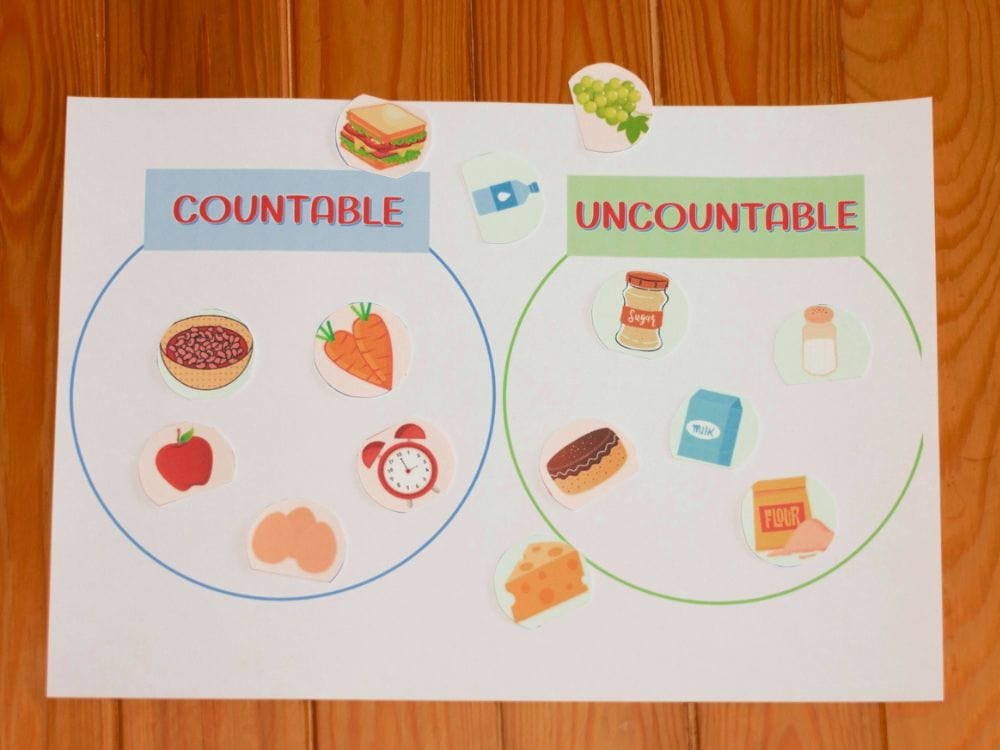
Countable nouns refer to people, animals, objects, or other things that can be counted individually. They can be used with numbers such as one, two, and three.
Examples include:
- one student, two students
- one apple, three apples
- a car, five cars
- a chair, four chairs
Countable nouns have singular and plural forms. Singular countable nouns can be used with articles such as a and an, while plural countable nouns often end in -s or -es.
For example:
- I have a cat.
- She bought three notebooks.
- There are many students in the classroom.
How to identify countable nouns
You can recognize countable nouns by looking at how they behave in a sentence.
- They can be counted directly: one book, two books, three books.
- They usually have singular and plural forms: a student – students.
- Singular forms can take a or an: a table, an orange.
- They can be used with quantifiers such as many, a few, and several.
For example:
- There is a book on the desk.
- I bought two pens yesterday.
- We invited several friends to the party.
Remember that a singular countable noun generally needs a determiner, such as a, an, the, this, or my, depending on the context.
How to form plural countable nouns
Most countable nouns form their plural by adding -s. However, some nouns follow different spelling rules, and others have irregular plural forms.
| Rule | Examples |
| Add -s | book → books; car → cars |
| Add -es after endings such as -s, -sh, -ch, and -x | box → boxes; watch → watches |
| Change consonant + y to -ies | city → cities; baby → babies |
| Change some -f/-fe endings to -ves | leaf → leaves; knife → knives |
| Use an irregular plural form | child → children; person → people; man → men |
| Keep the same singular and plural forms | sheep → sheep; deer → deer |
Not all nouns ending in -f or -fe change to -ves. For example, the plural of roof is usually roofs. Learning common exceptions will help you avoid spelling mistakes.
What are uncountable nouns?
Uncountable nouns, also called non-count nouns, refer to substances, materials, abstract ideas, or other things that are not normally counted as separate units.
Common examples include:
- water
- milk
- sugar
- rice
- information
- advice
- furniture
- money
You would not normally say one water when referring to water as a substance. Instead, you can use a unit or container, such as a glass of water or a bottle of water.
Examples:
- I need some information.
- There is some milk in the fridge.
- She gave me useful advice.
- We need new furniture for the office.
Key characteristics of uncountable nouns
Uncountable nouns have several important grammatical features.
- They do not normally have plural forms when used with their uncountable meaning.
- They cannot usually be counted directly with numbers.
- They do not take a or an directly when used in an uncountable sense.
- They commonly appear with quantifiers such as much, a little, some, and a lot of.
- They generally take singular verbs.
For example:
- The water is cold.
- The information is useful.
- There is some rice in the bowl.
When deciding whether to use is or are with an uncountable noun, remember that the noun generally takes a singular verb.
Countable and uncountable nouns: Key differences
The main difference between countable and uncountable nouns is whether they can be counted directly and how they work with other words in a sentence.
| Feature | Countable nouns | Uncountable nouns |
| Can be counted directly | Yes | Not normally |
| Singular form | Yes | Usually no separate singular/plural distinction |
| Plural form | Usually available | Usually unavailable in the uncountable sense |
| Used with a/an | Yes, in the singular | No, not directly |
| Common quantifier | Many | Much |
| Small quantities | Few, a few | Little, a little |
| Verb agreement | Singular or plural, depending on form | Generally singular |
Compare these examples:
- Countable: There are three apples on the table.
- Uncountable: There is some rice on the table.
To identify a noun correctly, consider both its meaning and its context. Some nouns can be countable or uncountable depending on how they are used.
Commonly confused uncountable nouns
Some English nouns are particularly confusing because their grammar differs from what learners may expect. Understanding these words will help you avoid frequent mistakes.
Is money countable or uncountable?
Money is an uncountable noun when referring to money in general.
Examples:
- I don’t have much money.
- She saved some money last month.
- The money is in my bag.
Although you can count individual banknotes, coins, or units of currency, the word money itself is generally uncountable.
To express specific quantities, you can use expressions such as:
- a banknote
- two coins
- one hundred dollars
Do not normally say a money. Instead, use expressions such as some money, much money, or a lot of money.
Is advice countable or uncountable?
Advice is an uncountable noun. You should not normally use an advice or advices when referring to advice in general.
Examples:
- He gave me some advice.
- Thank you for your helpful advice.
- She asked for a piece of advice.
To refer to one piece of advice, use a piece of advice. To refer to several, say two pieces of advice.
Are furniture and equipment countable?
In their usual meanings, furniture and equipment are uncountable nouns.
Examples:
- The furniture is expensive.
- We need some new equipment.
- The office has a lot of furniture.
Do not normally use furnitures or equipments to express plural quantities. Instead, use expressions such as a piece of furniture or three pieces of equipment.
Is news singular or plural?
Although it ends in -s, news is an uncountable noun that generally takes a singular verb.
Examples:
- The news is surprising.
- This news was unexpected.
- I have some good news for you.
Avoid a news and many news in standard usage. When you need to refer to individual items, you can say a piece of news or several pieces of news.
Countable and uncountable nouns related to food
Food vocabulary can be confusing because a noun’s countability may depend on whether you are referring to an ingredient, a substance, a dish, or an individual animal.
| Noun | Common usage | Example |
| Rice | Uncountable | some rice |
| Sugar | Uncountable | a little sugar |
| Butter | Uncountable | a block of butter |
| Meat | Uncountable | some meat |
| Beef | Uncountable | a piece of beef |
| Bread | Uncountable | two slices of bread |
| Apple | Countable | three apples |
| Egg | Countable | two eggs |
| Chicken | Both, depending on meaning | a chicken / some chicken |
| Food | Usually uncountable | some food |
Examples:
- There is some rice in the pot.
- I bought three apples.
- We need a little sugar.
- She ate two slices of bread.
The word chicken is countable when referring to an individual bird, but uncountable when referring to chicken meat.
- There are two chickens in the garden.
- We had some chicken for dinner.
Similarly, food is usually uncountable when referring to food in general. However, foods can be used when discussing different types or categories of food.
How to use quantifiers with countable and uncountable nouns
Quantifiers express amounts or quantities. Choosing the correct one depends on whether the noun is countable or uncountable.
Much and many
- Many is used with plural countable nouns.
- Much is used with uncountable nouns.
Examples:
- How many books do you have?
- How much water do you drink every day?
- There aren’t many students here.
- We don’t have much time.
In affirmative sentences, a lot of and lots of are often natural choices with both types of nouns.
Examples:
- She has a lot of friends.
- He drinks a lot of water.
Few, a few, little, and a little
These expressions describe small quantities, but they are used with different types of nouns.
| Quantifier | Used with | Meaning |
| Few | Plural countable nouns | Not many; almost none |
| A few | Plural countable nouns | Some; a small number |
| Little | Uncountable nouns | Not much; almost none |
| A little | Uncountable nouns | Some; a small amount |
Examples:
- There are a few chairs in the room.
- Few people understood the question.
- I have a little money left.
- There is little milk in the bottle.
Remember that few and a few are used with plural countable nouns, while little and a little are used with uncountable nouns.
Some and any
Both some and any can be used with plural countable nouns and uncountable nouns.
Some commonly appears in affirmative sentences, as well as certain offers and requests.
- I bought some oranges.
- There is some milk in the fridge.
- Would you like some coffee?
Any is commonly used in negative sentences and questions.
- I don’t have any questions.
- There isn’t any sugar left.
- Do you have any information?
The appropriate choice can also depend on the meaning and purpose of the sentence.
Articles with countable and uncountable nouns
Articles are another important part of learning how to use countable and uncountable nouns correctly.
When should you use a and an?
A and an are used before singular countable nouns when referring to one person or thing that is not specifically identified.
Examples:
- a book
- a university
- an apple
- an hour
The choice between a and an depends on the initial sound of the following word, not simply its first letter.
Do not use a or an directly before an uncountable noun in its usual uncountable meaning. For example, say some information rather than an information.
Can the be used with plural nouns?
Yes. The can be used with singular countable nouns, plural countable nouns, and uncountable nouns when the person or thing being discussed is identifiable from the context.
Examples:
- The book on the desk is mine.
- The students in this class are friendly.
- The water in this bottle is cold.
When speaking about something in general, choose the appropriate noun form and article structure based on the meaning of the sentence.

Exercises on countable and uncountable nouns
Complete the following exercises to check your understanding before reviewing the answers.
Exercise: Identify the noun type
Label each noun as countable (C) or uncountable (U) according to its usual meaning.
- Money: _____
- Apple: _____
- News: _____
- Water: _____
- Furniture: _____
- Student: _____
- Meat: _____
- Advice: _____
- Car: _____
- Rice: _____
Exercise: Choose is or are
Complete each sentence with is or are.
- The news _____ very interesting today.
- There _____ some milk in the fridge.
- These students _____ hard-working.
- The furniture in this room _____ very old.
- Money _____ not the most important thing.
Exercise: Fill in a, an, some, or any
Choose the correct word to complete each sentence.
- I have _____ apple in my bag.
- Would you like _____ water?
- He gave me _____ good advice.
- There isn’t _____ furniture in the new house.
- She bought _____ oranges at the market.
Answers and explanations
Exercise: Identify the noun type
- Money: U
- Apple: C
- News: U
- Water: U
- Furniture: U
- Student: C
- Meat: U
- Advice: U
- Car: C
- Rice: U
Exercise: Choose is or are
- The news is very interesting today.
- There is some milk in the fridge.
- These students are hard-working.
- The furniture in this room is very old.
- Money is not the most important thing.
Explanation: News, milk, furniture, and money are treated as uncountable nouns and generally take singular verbs. Students is a plural countable noun, so it takes are.
Exercise: Fill in a, an, some, or any
- I have an apple in my bag.
- Would you like some water?
- He gave me some good advice.
- There isn’t any furniture in the new house.
- She bought some oranges at the market.
Explanation: Use an before apple because it is a singular countable noun beginning with a vowel sound. Water and advice are uncountable nouns and can be used with some. In negative sentences, any is commonly used to express the absence of something.
Understanding countable and uncountable nouns will help you use nouns, verbs, articles, and quantifiers more accurately. Practice with familiar words such as books, money, water, advice, and food, and pay attention to nouns that can change their usage depending on context. With regular practice, you can become more confident in grammar exercises, exams, and everyday English communication.
Frequently asked questions
Should you use is or are with water?
Water is an uncountable noun in its usual meaning, so it takes a singular verb.
Example: The water is cold.
Is cheese countable or uncountable?
Cheese is generally uncountable when referring to cheese as a substance or food in general. To express a quantity, you can use a slice of cheese or a block of cheese.
Is paper countable or uncountable?
It depends on the context. Paper is uncountable when referring to the material, as in some paper. However, it can be countable when referring to an academic paper or written essay, as in two academic papers.
Does equipment have a plural form?
Equipment is generally uncountable, so equipments is not used in standard English for ordinary plural quantities. You can say a piece of equipment or three pieces of equipment instead.
Do uncountable nouns always take singular verbs?
Uncountable nouns generally take singular verbs, as in The information is useful. However, it is important to distinguish uncountable nouns from other nouns with unusual forms. For example, news ends in -s but normally takes a singular verb.
Keyword:
- countable nouns examples
- uncountable nouns examples
- countable and uncountable nouns rules
- countable and uncountable nouns exercises
- list of uncountable nouns
