
Many learners spend a considerable amount of time preparing for IELTS without a clear study plan or a thorough understanding of the actual test format. By understanding the structure of all four IELTS skills, you will know which areas to focus on, how to allocate your time, and which test-taking strategies are best suited to your target band score.
In this article, you will discover:
- The latest IELTS test format for 2026
- The differences between IELTS Academic and IELTS General Training
- Detailed information about Listening, Reading, Writing, and Speaking
- An overview of the IELTS test structure
What Does the IELTS Test Format Include?
The IELTS test consists of four main skills:
- Listening
- Reading
- Writing
- Speaking
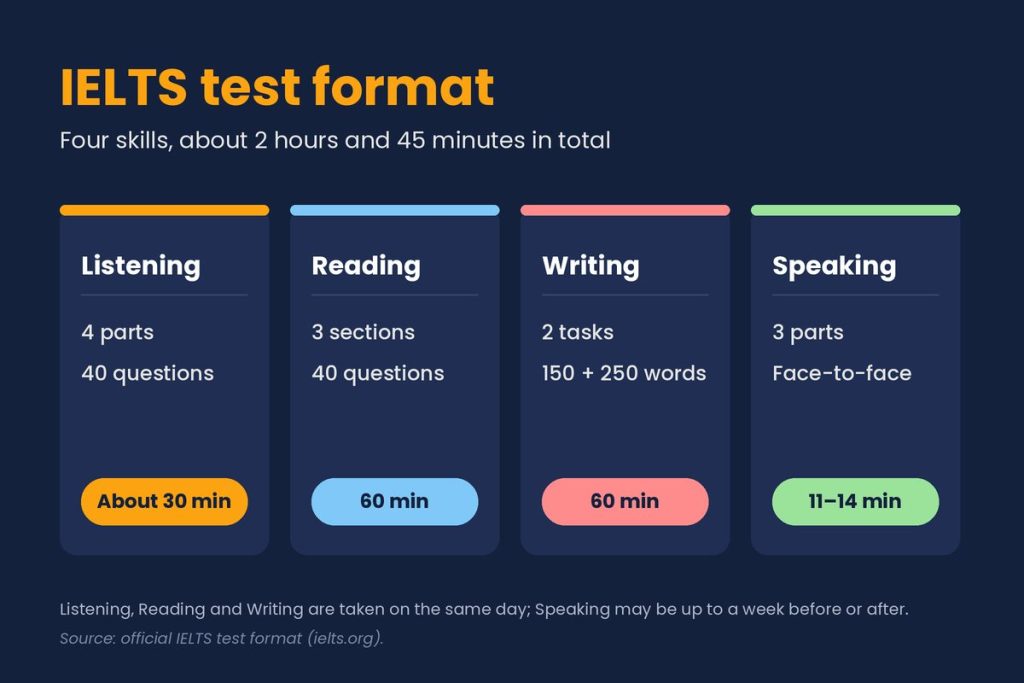
The total testing time is approximately 2 hours and 45 minutes.
Listening, Reading, and Writing are usually completed consecutively on the same day.
The Speaking test may take place on the same day or on a different day, depending on the test centre.
There are currently two popular versions of IELTS:
- IELTS Academic
- IELTS General Training
The two versions have similar structures but differ in the Reading and Writing sections.

IELTS Listening Test Format
The IELTS Listening test consists of 40 questions divided into four sections of increasing difficulty.
The test lasts approximately 30 minutes, with additional time to check answers when taking the paper-based test.
Candidates can listen to each audio recording only once, so concentration is essential.
Details of Each IELTS Listening Section
Section 1
This section usually features a conversation about familiar everyday situations, such as booking a hotel, enrolling in a course, or asking for information about a service.
It is generally easier than the other sections and uses basic vocabulary.
Section 2
Section 2 usually features a monologue related to social situations or public information.
Examples include an introduction to a tourist attraction or an explanation of the rules at a community centre.
Section 3
This section features an academic conversation between several speakers, often related to university life or a group project discussion.
The speakers tend to talk faster, and the recording contains more distracting information than the previous sections.
Section 4
This is generally the most challenging section of the IELTS Listening test.
Section 4 usually consists of a longer academic lecture containing a substantial amount of academic vocabulary, with few pauses.
IELTS Reading Test Format
The IELTS Reading test consists of 40 questions to be completed in 60 minutes.
Common question types include:
- True/False/Not Given
- Matching Headings
- Multiple Choice
- Sentence Completion
- Summary Completion
This skill requires candidates to read quickly, identify keywords, and manage their time effectively.
IELTS Academic Reading Test Format
The IELTS Academic Reading test focuses on texts with a strong academic emphasis.
Passages are often adapted from books, newspapers, research materials, or specialist journals.
The vocabulary is generally more challenging, and the questions may require stronger analytical skills than those in General Training Reading.
This section can be particularly difficult for learners who are just beginning their IELTS Academic preparation.
IELTS General Training Reading Test Format
The IELTS General Training Reading test uses texts that are more closely related to everyday life.
Examples include emails, advertisements, notices, and workplace instructions.
Although the content is less academic than that of the Academic version, candidates still need good reading comprehension and information-processing skills.
IELTS Writing Test Format
The IELTS Writing test consists of two tasks, with a total duration of 60 minutes.
Task 2 carries more weight in the Writing score, so learners should dedicate more time to practising it.
IELTS Writing Task 1
In IELTS Academic, Task 1 requires candidates to describe a chart, table, process, or map using academic English. You need to analyse data, compare trends, and write a clear overview.
In IELTS General Training, Task 1 requires candidates to write a letter. Common letter types include:
- Apology letters
- Letters requesting information
- Thank-you letters
- Complaint letters
IELTS Writing Task 2
Task 2 is an essay-writing task with a minimum word count of 250 words.
Common essay types include:
- Opinion Essays
- Discussion Essays
- Problem-Solution Essays
- Advantages and Disadvantages Essays
The IELTS Writing test assesses candidates’ ability to develop ideas, use academic vocabulary, and maintain grammatical accuracy.
IELTS Speaking Test Format
The IELTS Speaking test consists of three parts and lasts approximately 11–14 minutes.
Since this is a face-to-face interview with an examiner, many candidates feel more pressure during this section than during the other skills tests.
IELTS Speaking Part 1
In Part 1, the examiner asks familiar personal questions about everyday topics, such as:
- Family
- Work
- Study
- Hobbies
- Daily routines
- Travel or accommodation
Each topic usually lasts around 4–5 minutes, with short questions designed to encourage natural conversation.
This part helps candidates warm up, become familiar with the examiner, and feel more comfortable before moving on to the more challenging sections of the Speaking test.
In addition to pronunciation and fluency, the examiner evaluates your vocabulary and ability to respond naturally in English.

IELTS Speaking Part 2
In Part 2, you will receive a cue card with a specific topic and have approximately one minute to prepare your ideas before speaking continuously for 1–2 minutes.
The cue card may ask you to describe a person, place, experience, or event.
The task also provides several prompts to help you develop your response more easily.
This part assesses your ability to develop ideas, use a range of vocabulary, and maintain a coherent response without too many interruptions.
Many candidates find Part 2 challenging because they are not accustomed to speaking continuously in English for an extended period.
IELTS Speaking Part 3
This section involves a more in-depth discussion based on the topic in Part 2.
The examiner asks analytical questions that may require you to compare ideas or express opinions on broader social issues related to the previous topic.
For example, if Part 2 is about travel, Part 3 may explore the environmental impact of tourism or future travel trends.
Candidates must do more than provide direct answers. They need to explain their ideas, develop arguments, and give examples to support their opinions.
This section also provides a clearer assessment of candidates’ ability to use academic English, think logically, and communicate flexibly.
Understanding the IELTS test format will help you develop a clear study plan and prepare more effectively. Once you understand the format of each skill, you will know how to allocate your time, choose suitable study materials, and improve your specific weaknesses.
Frequently Asked Questions
What Are the Differences Between IELTS Academic and General Training?
The two versions share the same Listening and Speaking formats. The main differences are in Reading and Writing, with IELTS Academic featuring more academically oriented content than General Training.
Can You Take All Four IELTS Skills on the Same Day?
Listening, Reading, and Writing are usually completed consecutively in the same session. The Speaking test may be scheduled on the same day or on a different day, depending on the test centre.
Which IELTS Section Is the Easiest to Lose Marks In?
Many candidates struggle to achieve their target scores in Writing and Speaking because these skills require strong idea development, appropriate academic vocabulary, and effective English communication.
Keywords:
- Computer-Delivered IELTS Test Format
- IELTS Test Format 2026
- IELTS Reading Test Format
