
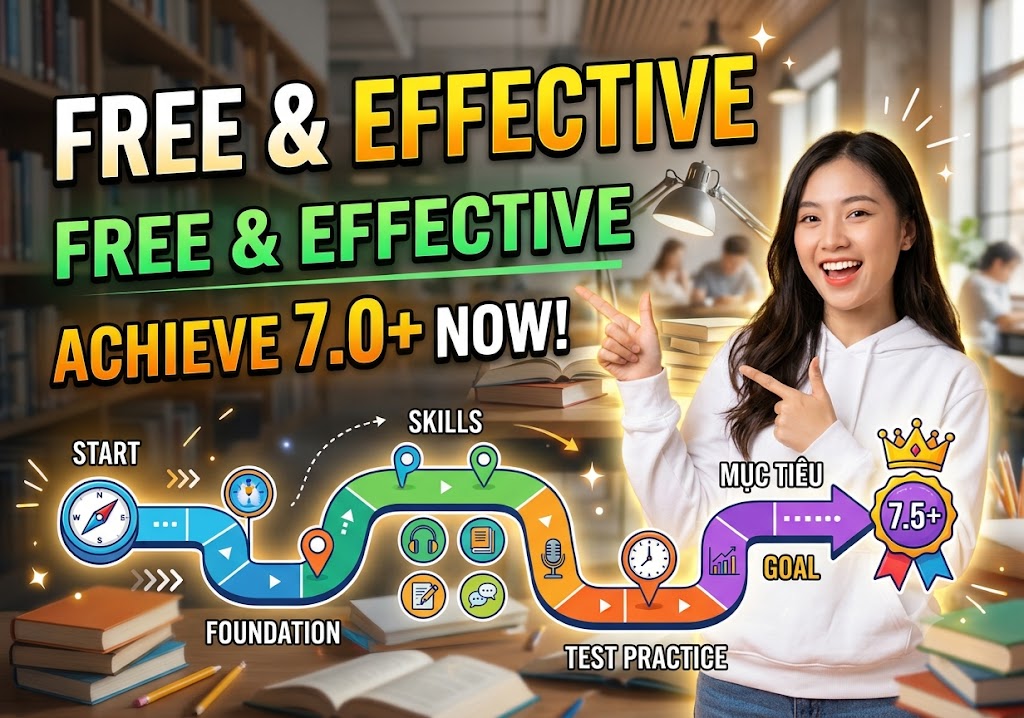
Are you looking to start your journey toward achieving an internationally recognized certificate but do not know where to begin? Self-study can absolutely deliver excellent results if you follow the right approach.
This article provides a comprehensive guide. Let’s explore the optimal IELTS study roadmap to help you boost your score.
The Foundation Stage for Learners with Little or No English Background
Focus on Strengthening Core Grammar
For those looking for an IELTS study roadmap for learners starting from scratch, grammar is the first building block. You do not need to learn every complicated structure.
Focus on mastering the 12 basic English tenses. In addition, you should understand sentence structures, relative clauses, and passive voice.
Build Vocabulary Around Familiar Topics
Vocabulary is the key to understanding test questions. At the beginning, you should learn words related to common topics such as family, hobbies, and work.
You only need to learn 10 to 15 new words each day. Prepare a small notebook to record new vocabulary and review it regularly.
Practise Correct Pronunciation from the Start
Correct pronunciation helps improve both your Listening and Speaking skills. Start by familiarizing yourself with the International Phonetic Alphabet (IPA).
You can spend 30 minutes a day practising the Shadowing method. Listening to and repeating after native speakers will help you develop greater flexibility in your mouth movements.

The Stage of Building Basic IELTS Skills
How to Practise Listening and Reading as a Beginner
Once you have established a foundation, following an IELTS study roadmap for beginners becomes easier. Start with short listening materials.
For Reading, choose short news articles or children’s stories. Develop the habit of understanding the main ideas before looking up words in a dictionary.
See also: A Guide to Improving Your Listening Band Score Quickly
Familiarize Yourself with the Speaking and Writing Test Formats
At this stage, you need to understand the structure of the actual test, including its different sections and the time allocated to each task.
For Writing, practise composing simple and compound sentences accurately. For Speaking, practise answering short questions naturally.
Image 1: A diagram showing how to allocate time across the four IELTS skills.
The Acceleration Stage: Improving Your Target Band Score
Strategies for Mastering Listening and Reading
To improve your score, you need to practise specific question types. In Listening, pay attention to common traps in the test.
For Reading, you must master two techniques: Skimming and Scanning. These skills help you locate information quickly within the 60-minute test period.
Upgrade Your Vocabulary and Improve Your Writing
At this stage, using advanced vocabulary and linking words becomes essential. Your writing should have a clear structure consisting of three main parts.
Practise writing complete essays and managing your time effectively. You should aim to spend 20 minutes on Task 1 and 40 minutes on Task 2.
Develop Natural Speaking Fluency Based on the Assessment Criteria
The Speaking test assesses your fluency and vocabulary. Try to expand your answers by providing reasons and examples.
You can record your speaking practice to identify mistakes. Listening to your recordings helps you adjust your intonation and correct grammatical errors in time.
The Final Stage: Practice Tests and Exam Preparation
Choose High-Quality Practice Test Materials
At this point, a well-structured IELTS study roadmap for studying at home requires you to practise with authentic test materials. The Cambridge IELTS book series is a suitable resource.
Take practice tests under strict time limits. This helps you become familiar with the test pace and reduce stress on exam day.
Analyze Your Mistakes After Each Practice Test
Doing more practice tests is less valuable than understanding exactly where you went wrong. After each test, spend an hour reviewing your incorrect answers.
Make notes of new vocabulary and grammatical structures that you misunderstood. Correcting mistakes helps you avoid repeating them in the future.

Tips for Achieving the Best Results Through Self-Study
Make the Most of Free Online Learning Resources
There are many resources available to support self-study today. You can easily access a free IELTS study roadmap for learners starting from scratch online.
Listening practice websites and educational channels are widely available. Choose reliable resources carefully to ensure that your learning remains systematic.
Image 2: Applications and websites that support effective IELTS self-study at home.
Build a Consistent Daily Study Schedule
Consistency is a decisive factor in your success. You should create a specific timetable for each skill throughout the week.
Spend at least two to three hours studying each day. Maintaining a regular routine is more effective than cramming large amounts of information into a short period.
Building a clear IELTS study roadmap is the key to successfully achieving your target score. Even if you start with a low level of English, persistence and the right methods can help you reach your goal. Begin your learning journey today and work toward the results you want!
See also: Tips for Managing Your Time Effectively During the IELTS Test
Frequently Asked Questions
How long does it take for someone starting from scratch to achieve a high IELTS score?
The time required to achieve a high score depends largely on your concentration and study methods. Generally, someone starting from scratch may need approximately 800 to 1,000 hours of serious study. If you study for three to four hours each day, the journey may take eight to ten months.
Consistently following a suitable IELTS study roadmap is a decisive factor in helping you achieve your target score.
Is it better to study IELTS at home or attend a language center?
The choice depends entirely on your self-discipline and budget. If you are highly disciplined and good at independent research, studying at home can save money and give you greater control over your schedule.
On the other hand, attending a language center provides an interactive learning environment, a structured curriculum, and detailed feedback from teachers. These advantages can help you improve faster and maintain motivation.
Where can I find a reliable free IELTS study roadmap?
You can find free IELTS study resources on established educational websites such as IELTS Simon, created by a former IELTS examiner, and IELTS Liz, which offers practical lessons.
In addition, the organizations that jointly own and administer IELTS, including IDP and the British Council, regularly provide official preparation materials and free practice resources.
Choose reliable sources carefully to build the most effective study plan for your needs.
Keyword:
- IELTS study roadmap at home
- IELTS study roadmap for learners starting from scratch
- IELTS study roadmap for beginners
- Free IELTS study roadmap for learners starting from scratch
- Free IELTS study roadmap
