
Are you wondering what examiners look for when assessing your speaking performance? Understanding the scoring criteria is the key to developing the right preparation strategy.
This article will break down the key factors that determine your score. Read on to discover how to impress examiners and maximize your performance!
Why Is It Important to Understand the IELTS Speaking Scoring Criteria?
When entering the examination room, many candidates focus solely on speaking at length. However, speaking at length without staying on topic will not necessarily improve your score.
IELTS examiners are trained to assess candidates according to strict standards. Understanding the IELTS Speaking scoring criteria helps you identify the areas you need to focus on.
You will learn which mistakes to avoid to prevent unnecessary deductions. As a result, you can confidently develop the most effective answering strategies.

The 4 IELTS Speaking Assessment Criteria You Must Know
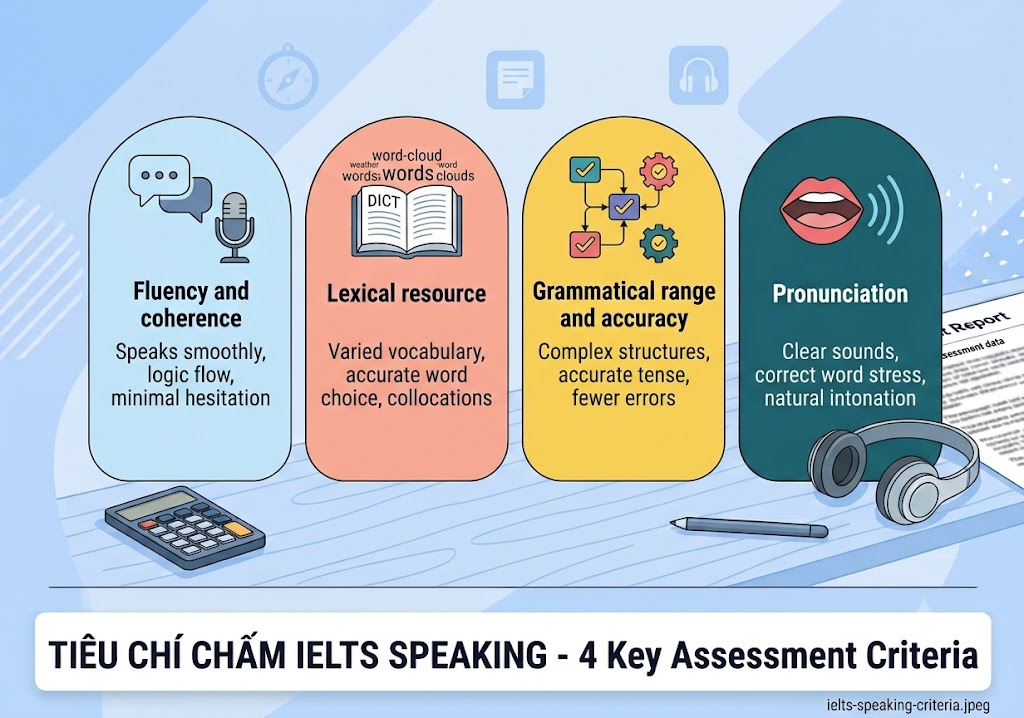
The IELTS test organizers have established four IELTS Speaking assessment criteria, each carrying equal weight. Each criterion accounts for 25% of your overall Speaking score.
[Image 1: A diagram illustrating the weighting of the four IELTS Speaking assessment criteria]
Understanding each criterion helps you allocate your study time and effort scientifically. Let’s explore each criterion in detail below.
Fluency and Coherence – The Ability to Speak Fluently and Coherently
This criterion assesses your ability to maintain a continuous flow of ideas and speak at an appropriate pace. Examiners consider whether you speak naturally or frequently pause and hesitate.
Coherence is demonstrated through the way you connect sentences and ideas. You should use linking words flexibly to guide your listener through your response.
To achieve a high score, avoid excessive self-correction and long pauses. Try to develop your ideas fully and organize your responses clearly.
Lexical Resource – A Rich and Varied Vocabulary
Lexical Resource evaluates the range and accuracy of your vocabulary. Candidates must use words appropriately according to the context and topic.
Using collocations and idioms naturally can significantly improve your band score. However, you should avoid forcing advanced vocabulary into your answers.
Learn to paraphrase when you cannot remember a specific word. This is a skill that examiners value highly.
Grammatical Range and Accuracy – Grammatical Variety and Accuracy
This criterion requires you to combine simple and complex sentences effectively. Examiners pay attention to how frequently you use advanced grammatical structures.
In addition to variety, accuracy is a crucial factor in determining your score. Tense errors and confusion between singular and plural nouns can lower your band score.
Try to control the grammatical structures you use to minimize mistakes. It is better to produce a simple sentence correctly than a complex sentence with serious errors.
Pronunciation – Accurate and Clear Pronunciation
Pronunciation does not mean that you must have exactly the same accent as a native speaker. The IELTS Speaking assessment criteria focus on how easily listeners can understand you.
You need to pronounce vowels and consonants correctly, especially ending sounds. Correct word stress and sentence stress are also extremely important.
See also: [A Guide to Self-Studying IELTS Effectively for Beginners]
In addition, natural intonation makes your speech more engaging. Avoid speaking in a monotonous tone that may make your responses sound boring.
Analyzing Band Scores Based on the IELTS Speaking Assessment Criteria
To gain a clearer understanding, let’s examine the differences between band scores. This will help you identify your current level and set realistic goals.
Each band score has specific requirements for every criterion that you need to meet.
Specific Requirements for Achieving Band 6.0 in Speaking
At this level, you can speak at length, although you may occasionally hesitate. You have sufficient vocabulary to discuss a range of familiar everyday topics.
In terms of grammar, you can use a combination of simple and complex sentences, but some errors remain. Listeners can generally understand your meaning, even if your pronunciation is not entirely accurate.
Specific Requirements for Achieving Band 7.0 in Speaking
To achieve this score, you need to speak comfortably without making excessive effort. Your vocabulary should include some less common expressions.
You should have good control of grammatical structures, with most sentences produced without errors. Your pronunciation should be clear, with effective stress and intonation to convey meaning and emotion.
Specific Requirements for Achieving Band 8.0+ in Speaking
This score requires a very high level of language proficiency. You should be able to maintain a steady, fluent pace and express ideas coherently with well-developed arguments.
[Image 2: A candidate confidently interacting with an examiner in the IELTS Speaking test room]
Your vocabulary should be used accurately and naturally, with a high level of sophistication. Grammatical errors should be infrequent, and your pronunciation should be highly effective and easy to understand.

aPreparation Strategies Based on the IELTS Speaking Assessment Criteria
Once you understand the assessment criteria, the next step is to develop a practical study plan. Apply the following tips to your daily practice.
Tips for Improving Fluency and Coherence
Develop the habit of recording your speaking practice and listening to it afterward to identify hesitation and pauses. This helps you recognize the topics that often leave you struggling for ideas.
Use linking phrases such as “In addition,” “However,” and “As a result” to connect your ideas. They help make your responses more logical and easier for listeners to follow.
How to Improve Your Vocabulary Naturally
Instead of memorizing individual words, learn vocabulary in phrases and topic-based groups. This approach helps you remember words longer and apply them more effectively in real conversations.
Read foreign newspapers and articles to learn natural expressions used by native speakers. Avoid overusing excessively formal vocabulary in everyday spoken English.
Correcting Grammatical Errors and Improving Pronunciation
Focus on mastering basic tenses before moving on to more complex grammatical structures. During practice, slow down slightly to control your ending sounds more accurately.
You can also use the shadowing technique by imitating English-language videos. This is an effective way to improve your intonation and speaking rhythm.
Understanding the structure and IELTS Speaking assessment criteria provides a solid foundation for your preparation journey. Focus on improving all four areas consistently to achieve sustainable progress in your band score. We wish you the best of luck and hope you achieve your desired results in your upcoming exam!
Frequently Asked Questions
Will examiners deduct points if I say something that is not true?
No. IELTS examiners assess your language proficiency based on vocabulary, grammar, pronunciation, and fluency. They do not verify whether your information is factually accurate.
If you encounter an unfamiliar topic, you can confidently invent a story or draw on someone else’s experience, as long as your response is logical, natural, and grammatically correct.
Does a regional accent affect my score?
No. IELTS examiners do not assess you based on your regional accent, whether it is British, American, or distinctly Vietnamese.
What matters is your pronunciation. As long as you pronounce words clearly, use appropriate stress and natural intonation, and remain easy to understand, you can achieve a high score in this criterion.
Will I be penalized if I speak for too short a time in Part 2?
Speaking for too short a time may negatively affect your score, particularly in Fluency and Coherence. Examiners may not have enough evidence to assess your ability to develop ideas and sustain your speech.
Therefore, try to speak continuously for one to two minutes, until the examiner signals you to stop, demonstrating your ability to speak at length naturally.
Keywords:
- IELTS Speaking assessment criteria
- IELTS Speaking marking criteria
- IELTS Speaking scoring criteria
- IELTS Speaking assessment criteria
- The 4 IELTS Speaking assessment criteria
- IELTS Speaking assessment criteriaư
