
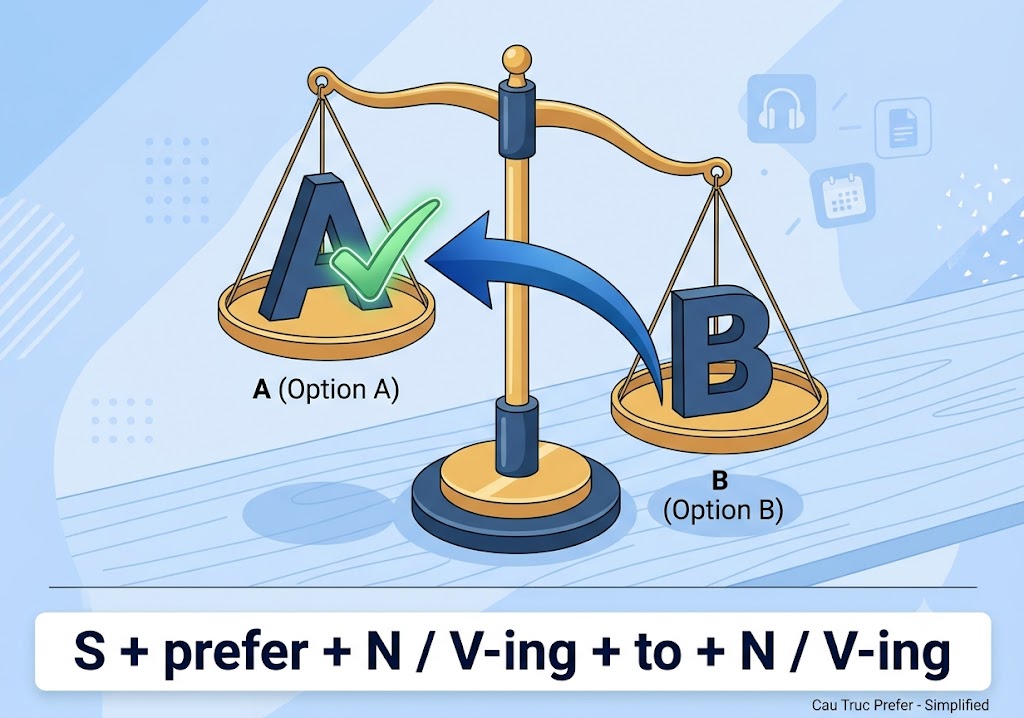
In this article, you will learn more about the different ways to use the prefer structure, with practical examples to help you avoid common mistakes.
What Is the Prefer Structure?
The prefer structure is used to express a preference between two or more choices. Compared with like, the verb prefer places greater emphasis on liking one thing more than another.
Examples:
- I prefer tea to coffee.
- She prefers reading to watching TV.
In these two sentences, the speakers do not simply express their likes; they also clearly indicate which option they prefer. This is an important reason why prefer is frequently used in everyday communication, especially when talking about habits, interests, or personal decisions.
Besides making direct comparisons, prefer can also describe an action that someone generally tends to choose.

The Prefer + To V Structure and How to Use It
The structure prefer + to V is used to describe an action that the speaker likes doing or generally tends to choose.
Formula:
S + prefer(s) + to + V
Examples:
- I prefer to study at night.
- He prefers to work alone.
This structure usually mentions only the preferred action without comparing it with another option in the same sentence. Therefore, it is suitable when learners want to express general preferences or habits concisely.
However, if you want to emphasize a comparison between two actions, you should use structures such as prefer V-ing to V-ing or prefer to V rather than V.
The Prefer + V-ing + To + V-ing Structure
The structure prefer + V-ing + to + V-ing is used to compare two actions and indicate that the speaker enjoys doing one more than the other.
Formula:
S + prefer(s) + V-ing + to + V-ing
Examples:
- I prefer reading books to watching TV.
- She prefers walking to driving.
This is one of the most common structures in sentence transformation exercises and basic grammar tests. The most important point is that both verbs following prefer and to must take the V-ing form to maintain parallel structure.
If one verb is in the V-ing form while the other is in the base form, the sentence is likely to contain a grammatical error. Therefore, when doing exercises, you should carefully check the verb forms in both parts before writing your answer.
The Prefer + To V + Rather Than + V Structure
The structure prefer + to V + rather than + V is used when the speaker wants to choose one action instead of another.
Formula:
S + prefer(s) + to + V + rather than + V
Examples:
- I prefer to stay home rather than go out.
- He prefers to eat at home rather than dine out.
Unlike the prefer V-ing to V-ing structure, this pattern uses the base form of the verb to express the comparison more concisely and clearly.
It frequently appears in written English, statements of opinion, and sentence transformation exercises. When using it, you should keep the two actions parallel and remember that the verb after rather than is commonly used in the bare infinitive form, without to.
The Would Prefer Structure and How to Use It
Would prefer is used to express a desire or preference in a specific situation, usually at the time of speaking.
Formulas:
S + would prefer + to + V
S + would prefer + to + V + rather than + V
Examples:
- I would prefer to go now.
- She would prefer to stay here.
- I would prefer to drink water rather than soda.
Unlike prefer, which generally describes preferences or habitual tendencies, would prefer emphasizes a choice associated with a particular situation.
Therefore, this structure is common in conversations when speakers want to make suggestions, respond to offers, or express decisions in the present. If you are talking about long-term habits, prefer is usually the more natural choice.

Simple Exercises
Exercise 1: Put the verbs in the correct form (prefer + to V)
Complete the sentences using the correct form of the verbs in brackets.
- I prefer ______ (study) in the morning.
- She prefers ______ (work) at home.
- They prefer ______ (eat) healthy food.
- He prefers ______ (go) by bus.
- We prefer ______ (learn) English online.
Exercise 2: Rewrite the sentences (prefer + V-ing + to + V-ing)
Rewrite each sentence using the required structure.
- I like reading books more than watching TV.
→ I ______________________________
- She likes walking more than driving.
→ She _____________________________
- They like cooking more than eating out.
→ They ____________________________
- He likes playing football more than playing basketball.
→ He ______________________________
- We like studying at night more than studying in the morning.
→ We ______________________________
Exercise 3: Choose the correct answer (prefer + to V + rather than + V)
- I prefer to stay home rather than ______.
- go out
- going out
- to go out
- She prefers to drink tea rather than ______ coffee.
- drink
- drinking
- to drink
- He prefers to work alone rather than ______ in a team.
- work
- working
- to work
- They prefer to travel by train rather than ______ by plane.
- go
- going
- to go
- We prefer to eat at home rather than ______ out.
- eat
- eating
- to eat
Detailed Exercise Answers
Exercise 1
- I prefer to study in the morning.
- She prefers to work at home.
- They prefer to eat healthy food.
- He prefers to go by bus.
- We prefer to learn English online.
Exercise 2
- I prefer reading books to watching TV.
- She prefers walking to driving.
- They prefer cooking to eating out.
- He prefers playing football to playing basketball.
- We prefer studying at night to studying in the morning.
Exercise 3
- A. go out
- A. drink
- A. work
- A. go
- A. eat
The prefer structure is an important part of English grammar that helps you express choices and preferences clearly. Once you master forms such as prefer to, prefer V-ing to V-ing, and would prefer, you can use them accurately in both everyday communication and exams.
Practise regularly to turn this knowledge into a natural language skill.
Frequently Asked Questions
Can the prefer structure be used with “than”?
In standard English, the verb prefer is not used with than to express a comparison. Instead, it generally takes to in structures such as prefer tea to coffee.
Using the wrong preposition can make a sentence sound unnatural or lead to errors in an exam. Therefore, learners should pay particular attention to this rule.
When should I use prefer and would prefer?
Prefer is used for general preferences and habits, while would prefer is used for choices in specific situations.
Beyond this basic distinction, usage also depends on the context of the conversation. Expressions of general preference tend to describe long-term or habitual choices, whereas would prefer expresses a desire at the time of speaking.
Therefore, learners should identify the situation clearly to choose the most appropriate and natural expression.
Can prefer be followed by to V?
Yes. This is a way to express a general preference. It is commonly used when speakers want to emphasize a particular action that they tend to choose in everyday life.
This structure makes sentences clear and easy to understand, and it is suitable for many basic communication contexts. However, it does not express a direct comparison unless additional elements are included.
Keyword:
- Prefer structure
- Prefer to structure
- Prefer grammar structure
- Would prefer structure
- Prefer rather than structure
- Prefer V-ing to V-ing structure
- Structures with prefer
- Prefer than structure
- Prefer to V structure
