
The Writing section is one of the most challenging parts of the IELTS examination for many candidates. Understanding the test format is the first step towards overcoming this challenge and improving your performance.
This guide provides a comprehensive overview of the IELTS Writing test. The practical strategies below will help you prepare more effectively, avoid common mistakes, and work towards your target band score.
Understanding the IELTS Writing Test Format
The IELTS Writing test has two versions: Academic and General Training. Both versions last 60 minutes and consist of two tasks.
You need to manage your time carefully to ensure that you complete both tasks. A common recommendation is to spend approximately 20 minutes on Task 1 and 40 minutes on Task 2.
Key Features and Requirements of Task 1
In IELTS Academic, Task 1 requires you to describe and summarise visual information, such as a chart, graph, table, map, or process diagram. You must write at least 150 words based on the information provided.
In IELTS General Training, Task 1 requires you to write a letter in response to a particular situation. Depending on the task, the letter may be formal, semi-formal, or informal.
Choosing the appropriate tone and addressing all the points in the instructions are essential for completing this task successfully.
Key Features and Requirements of Task 2
Task 2 in both test versions requires you to write an essay of at least 250 words in response to a question or issue.
You may be asked to present an opinion, discuss both sides of an argument, evaluate a problem and suggest solutions, or respond to a question involving advantages and disadvantages.
Task 2 carries twice the weight of Task 1 in the overall Writing score. Therefore, you should allocate sufficient time to developing clear arguments, supporting your ideas, and checking your work.

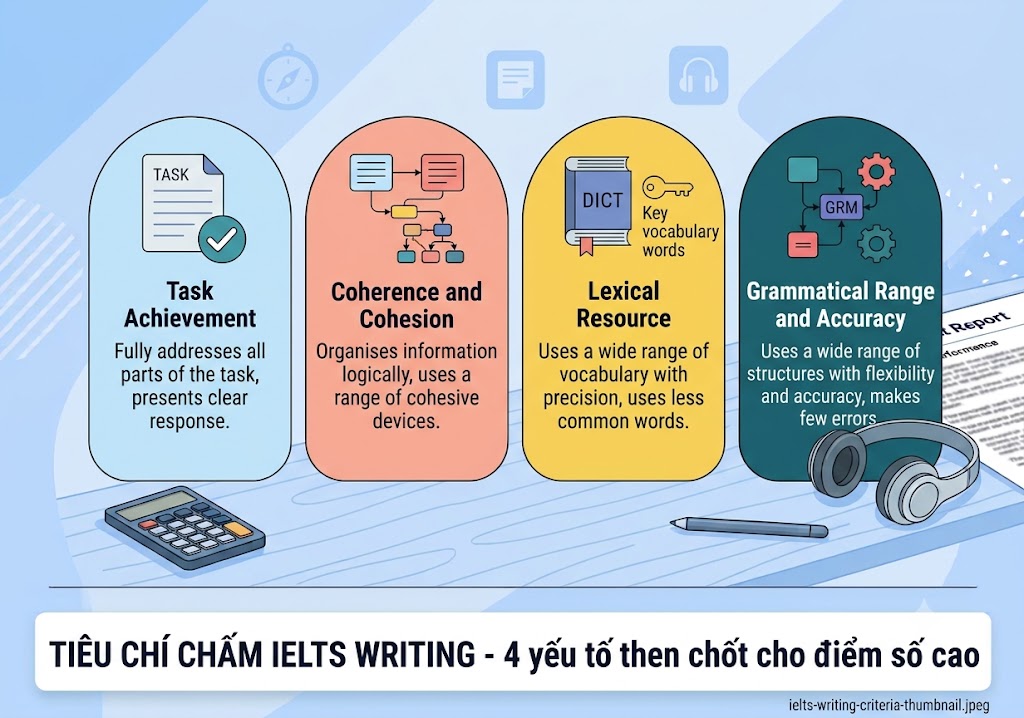
The Four Key IELTS Writing Assessment Criteria
To achieve a high band score, you need to understand what IELTS examiners assess in your writing. Each task is evaluated using four criteria, which contribute equally to that task’s score.
Developing all four areas is important because a weakness in one criterion can limit your overall performance.
Task Achievement, Task Response, and Coherence and Cohesion
The first criterion for Academic Task 1 is Task Achievement, while General Training Task 1 is assessed under the same criterion with requirements appropriate to letter writing. Task 2 is assessed using Task Response.
These criteria evaluate how effectively you address the task, present relevant information, develop your ideas, and support your position where required.
Coherence and Cohesion focuses on how clearly your ideas are organised and connected. Your writing should follow a logical structure, with paragraphs arranged in a meaningful order and linking expressions used naturally.
Related article: Common Linking Words and Phrases for IELTS Writing.
Lexical Resource and Grammatical Range and Accuracy
Lexical Resource assesses the range, appropriateness, and accuracy of your vocabulary. Using topic-related expressions and natural collocations can make your writing more precise and effective.
Grammatical Range and Accuracy evaluates your ability to use different grammatical structures correctly. You should practise combining simple and complex sentences while maintaining grammatical accuracy.
Pay attention to spelling, articles, prepositions, verb tenses, and subject–verb agreement. Reducing recurring errors can help improve the clarity and quality of your writing.
How to Crack the IELTS Writing Test Effectively
Learning to write independently requires a clear study plan and consistent practice. Rather than attempting complete essays immediately, beginners should first build their vocabulary, strengthen their grammar, and learn how to develop ideas logically.
Once you understand the fundamentals, you can gradually move on to timed writing practice and more complex essay topics.
Analyse the Question and Plan Before Writing
One of the most common mistakes candidates make is starting to write immediately after reading the question.
Instead, spend approximately three to five minutes identifying the keywords, understanding the task requirements, and planning your main ideas.
A clear outline helps you organise your introduction, body paragraphs, and conclusion. It also reduces the risk of going off topic or repeating the same arguments.
For Task 2, make sure each body paragraph develops one central idea supported by an explanation or a relevant example.
Practise Regularly and Learn from Your Mistakes
Aim to complete several writing tasks each week, gradually introducing the time limits used in the actual examination.
After finishing each task, review your work carefully. Ask a qualified IELTS teacher or an experienced tutor for feedback when possible.
Identify recurring mistakes in grammar, vocabulary, paragraph organisation, and argument development. Keeping a record of these errors will help you monitor your progress and focus on areas that need improvement.
High-Quality Resources for IELTS Writing Test Online Practice
Many online platforms provide resources to help learners develop their writing skills. Choosing reliable materials can save time and help you focus on the requirements of the IELTS examination.
Sample essays can be useful for understanding how to organise ideas, develop arguments, and use appropriate vocabulary. However, you should select resources carefully and avoid assuming that every online model answer is accurate or represents an official band score.
Use Automated Grammar-Checking Tools
Online grammar and spelling checkers can help identify common errors involving articles, prepositions, punctuation, and verb forms.
These tools are particularly useful for independent learners who want to review their writing before submitting it for feedback.
However, automated tools cannot reliably evaluate every aspect of an IELTS essay, including the relevance of arguments, the depth of analysis, or how fully the task has been addressed.
Use them as a preliminary checking step rather than relying on them as your only source of feedback.
Learn from Reliable IELTS Writing Test Samples
High-quality IELTS Writing test samples can demonstrate how to organise paragraphs, support arguments, and express ideas clearly.
Study the structure and language of strong model answers, and note useful sentence patterns and topic-related collocations that you can adapt to your own writing.
Avoid memorising entire essays. Questions may differ, and memorised responses may fail to address the specific task. Instead, develop the ability to apply useful language and writing techniques flexibly.

Recent IELTS Writing Test Topics and Trends
IELTS Writing questions cover a broad range of social, educational, environmental, technological, and economic issues.
Preparing for different themes can help you generate relevant ideas more quickly. However, no topic list can guarantee which questions will appear in your examination.
Rather than relying on predictions, develop the skills needed to analyse unfamiliar questions and construct logical arguments.
How to Approach Technology-Related Topics
Technology-related questions may explore the effects of artificial intelligence on employment, the role of digital tools in education, or the impact of technological development on society.
Build a vocabulary bank covering relevant concepts, but focus on understanding how to use each expression accurately in context.
Avoid making overly emotional or one-sided claims. Consider different perspectives and support your arguments with logical explanations and relevant examples.
Education and Sustainable Development as Common Themes
Education-related questions may address online learning, educational equality, or differences between generations. Environmental topics may focus on climate change, sustainable development, and individual or government responsibility.
Although these subjects are familiar to many candidates, a high-quality essay still requires clear reasoning and well-developed ideas.
Using specific examples can make your arguments more convincing, provided that the examples are relevant and accurately presented.
For Task 2, aim to write enough to address the question fully while maintaining a clear structure. There is no official maximum word limit, but excessively long essays can increase the risk of errors and leave insufficient time for checking.
Mastering the IELTS Writing test requires consistent practice, a clear understanding of the assessment criteria, and an effective preparation strategy.
By learning the test format, developing your vocabulary and grammar, planning your answers carefully, and reviewing your mistakes, you can steadily improve your writing performance.
Keep practising with reliable resources, seek constructive feedback, and focus on expressing your ideas clearly and accurately. Start today and work towards achieving your target IELTS band score.
Frequently Asked Questions (FAQs)
1. Should I use sophisticated vocabulary in the IELTS Writing test?
Not necessarily. Using advanced vocabulary incorrectly or in an unnatural context can weaken your writing. Examiners value appropriate, precise, and flexible language. Focus on accurate word choice and natural collocations rather than memorising difficult words.
2. Will I lose marks if I write more than the minimum word count?
There is no automatic penalty for exceeding the minimum word count. However, writing excessively long answers may lead to repetition, additional errors, and poor time management. Focus on addressing the task fully and maintaining clear, well-organised arguments.
3. How can I improve my writing speed during the exam?
Practise under timed conditions and spend three to five minutes planning your ideas before writing. A clear outline helps you maintain a logical flow and avoid unnecessary pauses. Completing regular timed writing tasks will also help you become more comfortable with the examination pace.
Keyword:
- how to crack the ielts writing test
- ielts writing test online
- ielts writing test sample
- recent ielts writing test
