
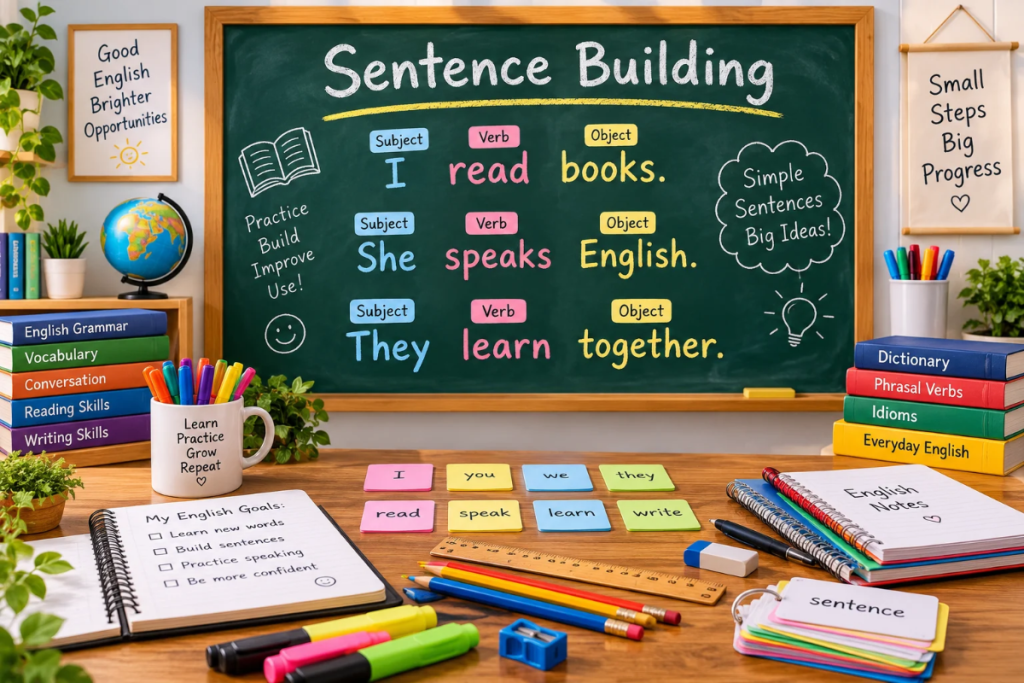
Learning Grade 1 English Grammar helps children build a strong foundation in English. At this stage, children begin to recognize common words, understand simple sentence structures, and use basic expressions in everyday situations. Instead of memorizing complicated rules, they should learn grammar through familiar examples, pictures, songs, games, and short conversations.
This guide introduces essential grammar topics for first graders, including personal pronouns, the verb to be, articles, singular and plural nouns, demonstratives, colors, numbers, and simple questions. Parents can also find practical learning tips and exercises with answers to help children review what they have learned.
What Is Grade 1 English Grammar?
Grade 1 English Grammar covers the basic rules children need to understand and produce simple English sentences. These rules help them introduce themselves, describe objects, ask questions, talk about their preferences, and follow simple instructions.
At this level, children typically learn to:
- Recognize and use common personal pronouns.
- Understand basic sentences with am, is, and are.
- Introduce themselves and greet other people.
- Use a and an before singular countable nouns.
- Distinguish between singular and plural nouns.
- Identify objects using this and that.
- Ask and answer simple questions about colors, numbers, and personal preferences.
- Use familiar expressions with like and can.
The goal is not to memorize every grammar rule. Children should gradually learn how words work together to communicate simple ideas.
Essential Grade 1 English Grammar Rules

Personal Pronouns in Grade 1 English Grammar
Personal pronouns replace people’s names or the names of things. They help children create short sentences without repeating the same noun.
| Pronoun | Meaning | Example |
| I | Tôi | I am Tom. |
| You | Bạn | You are my friend. |
| He | Anh ấy, cậu ấy | He is Ben. |
| She | Cô ấy, bạn nữ ấy | She is Anna. |
| It | Nó | It is a cat. |
| We | Chúng tôi, chúng ta | We are happy. |
| They | Họ, chúng | They are students. |
Examples:
- I am Lily.
- He is my brother.
- She is my teacher.
- It is a dog.
- We are friends.
Learning tip: Use picture cards featuring different people, animals, and objects. Ask children to choose the correct pronoun for each picture. This activity helps them connect English words with familiar situations.
The Verb “To Be”: Am, Is, and Are
The verb to be is one of the most important topics in Grade 1 English Grammar. Children use it to introduce themselves, describe people, and identify objects.
The three basic forms are am, is, and are.
| Subject | Verb | Example |
| I | am | I am seven. |
| He | is | He is happy. |
| She | is | She is nice. |
| It | is | It is a book. |
| You | are | You are kind. |
| We | are | We are friends. |
| They | are | They are students. |
Remember these basic patterns:
- I am + name, age, or description.
- He/She/It is + noun or adjective.
- You/We/They are + noun or adjective.
Examples:
- I am Peter.
- She is my sister.
- It is red.
- They are happy.
At first, children can practice affirmative sentences. Once they become familiar with these patterns, parents can introduce simple negative sentences and questions, depending on the child’s learning materials.
Introducing Yourself in English
Introducing yourself is a practical way to apply basic grammar. Children can learn short sentences that are useful at school and when meeting new friends.
Common sentence patterns:
- My name is + name.
- I am + name.
- I am + age.
Examples:
- My name is Lucy.
- I am Jack.
- I am seven years old.
Children can practice by taking turns introducing themselves to parents, siblings, or classmates. They can also use a toy or puppet as a conversation partner.
Greetings and Farewells
Greetings are among the first expressions children learn when studying English.
| Expression | Meaning |
| Hello! | Xin chào! |
| Hi! | Chào! |
| Good morning! | Chào buổi sáng! |
| Good afternoon! | Chào buổi chiều! |
| Good evening! | Chào buổi tối! |
| Goodbye! | Tạm biệt! |
| Bye-bye! | Tạm biệt! |
Example conversation:
A: Hello!
B: Hi!
A: What’s your name?
B: My name is Emma.
A: Goodbye, Emma!
B: Bye-bye!
Encourage children to practice these expressions in everyday situations. Short role-playing activities can make learning more natural and memorable.
Using “A” and “An”
The articles a and an are used before singular countable nouns. Children can learn them through familiar objects and pictures.
Use a before a consonant sound:
- a book
- a cat
- a dog
- a pencil
Use an before a vowel sound:
- an apple
- an egg
- an orange
- an umbrella
Examples:
- It is a book.
- This is a cat.
- It is an apple.
- I have an egg.
For first graders, start with common words that are easy to illustrate. The basic distinction is based on sound, not simply the first letter of a word.
Singular and Plural Nouns
A singular noun refers to one person, animal, or thing. A plural noun refers to more than one.
For many common nouns, children can form the plural by adding -s.
| Singular | Plural |
| book | books |
| cat | cats |
| dog | dogs |
| pencil | pencils |
| apple | apples |
Examples:
- It is a book.
- They are books.
- I have one pencil.
- I have two pencils.
Use real objects to demonstrate the difference. Show one pencil and then two pencils, asking the child to identify what has changed. This makes the grammar concept easier to understand.
Using “This” and “That”
The words this and that help children identify objects.
- This refers to one object that is near the speaker.
- That refers to one object that is farther away.
Examples:
- This is a pen.
- This is my book.
- That is a chair.
- That is a tree.
Parents can place objects at different distances and ask children to describe them.
For example, hold a pencil and say, “This is a pencil.” Then point to a chair across the room and say, “That is a chair.”
Asking Questions About Objects
Children can learn simple questions to identify familiar things.
Useful question patterns:
- What is this?
- What is that?
- Is this a book?
- Is that a cat?
Example conversation:
A: What is this?
B: It is a pencil.
A: Is that a dog?
B: Yes, it is.
These questions help children practice vocabulary and sentence structure together. Pictures, toys, and classroom objects are useful materials for this activity.
Colors in Grade 1 English Grammar
Colors help children describe objects using short sentences. They can learn color vocabulary and practice it with the verb to be.
| Color | Meaning | Example |
| Red | Đỏ | It is red. |
| Blue | Xanh dương | The bag is blue. |
| Yellow | Vàng | It is yellow. |
| Green | Xanh lá | The tree is green. |
| Black | Đen | The cat is black. |
| White | Trắng | The paper is white. |
| Pink | Hồng | The flower is pink. |
| Orange | Cam | The ball is orange. |
Practice sentences:
- My bag is blue.
- The apple is red.
- It is a yellow pencil.
- The flower is pink.
A simple color-hunting game can help children remember the words. Ask them to find something red, blue, or green in the room and describe it in English.
Asking “How Many?”
The question “How many…?” is used to ask about the number of people or things. It is commonly practiced with plural nouns and numbers.
Basic pattern:
How many + plural noun + are there?
Examples:
- How many books are there?
- How many pencils are there?
- How many apples are there?
Children can answer with a number and a noun:
- Two books.
- Three pencils.
- Five apples.
Depending on the child’s level, parents can also introduce short answers such as “There are three pencils.” Use objects that children can count themselves to make the activity more engaging.
Using “Like” to Talk About Preferences
The verb like helps children talk about the things they enjoy.
Basic patterns:
- I like + noun.
- I like + plural noun.
Examples:
- I like apples.
- I like cats.
- I like books.
- I like bananas.
Children can also practice simple questions:
A: Do you like cats?
B: Yes, I do.
A: Do you like apples?
B: No, I don’t.
These examples can be adapted to familiar topics such as food, animals, toys, and games. Let children talk about their real preferences instead of asking them to memorize unrelated sentences.
Using “Can” to Talk About Abilities
The word can expresses ability. It is often used with familiar action verbs.
Basic pattern:
Subject + can + verb.
Examples:
- I can swim.
- I can sing.
- I can run.
- I can dance.
- A bird can fly.
Children can also learn to ask simple questions:
- Can you swim?
- Can you sing?
- Can you run?
Example conversation:
A: Can you dance?
B: Yes, I can.
A: Can you fly?
B: No, I can’t.
Action games are useful for this grammar point. Children can act out an activity while saying the corresponding English sentence.
Using “My” and “Your”
The words my and your show ownership or a relationship with something.
- My means “của tôi.”
- Your means “của bạn.”
Examples:
- This is my book.
- This is my bag.
- Is this your pencil?
- What is your name?
Children can practice by pointing to their own belongings and asking about objects that belong to other people.
These expressions also reinforce familiar sentence patterns, including this is, is this, and simple questions.
Common Classroom Commands
Children often hear short instructions in English lessons. Learning these expressions helps them understand their teacher and participate in classroom activities.
| English command | Vietnamese meaning |
| Stand up. | Đứng lên. |
| Sit down. | Ngồi xuống. |
| Open your book. | Mở sách ra. |
| Close your book. | Đóng sách lại. |
| Listen. | Lắng nghe. |
| Look. | Nhìn. |
| Repeat. | Nhắc lại. |
| Be quiet. | Giữ trật tự. |
| Come here. | Lại đây. |
Parents can give simple instructions during home practice. For example, say “Stand up” and let the child perform the action. Then switch roles and ask the child to give an instruction.
Asking and Answering Questions About Age
Talking about age gives children another opportunity to use numbers and familiar sentence patterns.
Useful expressions:
- How old are you?
- I am seven years old.
- I am six.
Example conversation:
A: How old are you?
B: I am seven years old.
A: How old is your brother?
B: He is eight years old.
For beginners, focus on understanding the question and giving a simple answer. Children can practice with their actual age and the ages of family members.
How to Help Children Learn Grade 1 English Grammar at Home
Learning Grade 1 English Grammar is more effective when children have regular opportunities to hear and use English. Parents do not need to turn every lesson into a formal study session. Short, enjoyable activities can help children gradually become familiar with basic sentence structures.

Practice for a Short Time Every Day
Young learners may find long study sessions tiring. Start with around 10–15 minutes of focused practice, adjusting the duration to the child’s attention span.
For example:
- Day 1: Practice personal pronouns and am, is, and are.
- Day 2: Review a and an with pictures.
- Day 3: Practice colors and object descriptions.
- Day 4: Ask and answer questions about numbers.
- Day 5: Review greetings and self-introductions.
The schedule can be adjusted to match the child’s school lessons and textbook.
Use Pictures, Toys, and Everyday Objects
Visual materials make abstract grammar rules easier for young learners to understand.
Parents can use:
- Flashcards showing people, animals, and objects.
- Toys for practicing this, that, and colors.
- Books and pencils for singular and plural nouns.
- Food pictures for sentences with like.
- Action cards for sentences with can.
For example, show a picture of a dog and ask, “What is this?” Help the child answer, “It is a dog.” Then ask, “What color is it?” to encourage another short sentence.
Learn Grammar Through Games and Songs
Games and songs give children opportunities to repeat English expressions without feeling that they are doing a difficult grammar exercise.
Some useful activities include:
- Guess the object: Describe an object and let the child guess what it is.
- Color hunt: Ask the child to find objects of different colors.
- Counting game: Count toys, pencils, books, or other familiar items.
- Action game: Give instructions such as “Stand up,” “Sit down,” and “Clap your hands.”
- Role-play: Practice greetings and self-introductions with dolls or puppets.
Choose activities that match the child’s interests and repeat useful language naturally.
Review Mistakes Without Creating Pressure
Children may confuse am, is, and are, forget plural endings, or use a instead of an. These mistakes are a normal part of learning.
Instead of correcting every error immediately, parents can repeat the sentence in the correct form and encourage the child to try again.
For example:
Child: “She are happy.”
Parent: “Yes, she is happy!”
This approach provides a correct example while keeping the conversation positive.
Grade 1 English Grammar Exercises With Answers
The following exercises help children review common grammar patterns. Encourage them to complete each activity before checking the answers.
Exercise 1: Choose “Am,” “Is,” or “Are”
Fill in each blank with the correct form of the verb to be.
- I ___ seven years old.
- She ___ my sister.
- They ___ happy.
- It ___ a pencil.
- We ___ friends.
- He ___ a student.
- You ___ kind.
- I ___ Anna.
Answers:
- am
- is
- are
- is
- are
- is
- are
- am
Exercise 2: Choose “A” or “An”
Complete each sentence with a or an.
- It is ___ apple.
- This is ___ book.
- I have ___ egg.
- It is ___ dog.
- This is ___ orange.
- I see ___ cat.
Answers:
- an
- a
- an
- a
- an
- a
Exercise 3: Complete the Sentences
Use the words in the box to complete each sentence.
Word box: my – blue – can – like – is – are
- This ___ a pencil.
- I ___ apples.
- I ___ swim.
- The bag is ___.
- This is ___ book.
- They ___ students.
Answers:
- is
- like
- can
- blue
- my
- are
Exercise 4: Put the Words in the Correct Order
Rearrange the words to make complete sentences.
- am / I / seven
- is / This / a / book
- happy / She / is
- like / I / cats
- can / He / run
- name / My / Tom / is
Answers:
- I am seven.
- This is a book.
- She is happy.
- I like cats.
- He can run.
- My name is Tom.
Exercise 5: Complete the Conversation
Fill in the blanks with suitable words.
A: Hello! What is your name?
B: My name ___ Lucy.
A: How old are you?
B: I ___ seven years old.
A: Do you ___ cats?
B: Yes, I do.
A: Can you swim?
B: Yes, I ___.
Answers:
- is
- am
- like
- can
Exercise 6: Choose the Correct Answer
Choose the best answer for each question.
- ___ is my brother.
- A. He
- B. She
- C. They
- It is ___ orange.
- A. a
- B. an
- C. are
- How many pencils are there? There are three ___.
- A. pencil
- B. pencils
- C. a pencil
- ___ you sing?
- A. Can
- B. Is
- C. Am
- What color is the grass? It is ___.
- A. blue
- B. green
- C. pink
Answers:
- A. He
- B. an
- B. pencils
- A. Can
- B. green
Building a Strong Foundation With Grade 1 English Grammar
Grade 1 English Grammar introduces children to the basic structures they need for early communication in English. By practicing pronouns, the verb to be, articles, nouns, colors, numbers, and simple questions, children can gradually learn to form meaningful sentences.
The most important thing is to make learning manageable and enjoyable. Use short practice sessions, familiar objects, simple conversations, and exercises that match the child’s level. With regular review and encouragement, children can become more confident using English at home and in the classroom.
Frequently Asked Questions About Grade 1 English Grammar
What grammar topics should Grade 1 students learn?
Common beginner topics include personal pronouns, am/is/are, greetings, self-introductions, a/an, singular and plural nouns, this/that, colors, numbers, and simple sentences with like and can. The exact topics may vary depending on the textbook and curriculum.
How can children learn Grade 1 English Grammar more easily?
Children can learn through pictures, songs, flashcards, games, and short conversations. Practicing one grammar point at a time and connecting it to familiar situations can make learning easier to understand.
How long should first graders study English grammar each day?
A short session of around 10–15 minutes can be a useful starting point. Parents should adjust the duration based on the child’s concentration, learning needs, and school schedule.
Are grammar exercises enough for first graders?
Exercises help children review rules, but they should also listen to and use English in simple conversations. Combining exercises with speaking, listening, pictures, and games provides more opportunities to apply what they learn.
Where can parents find Grade 1 English Grammar worksheets?
Parents can look for worksheets in their child’s school materials, textbook resources, and educational learning websites. Choose materials that match the child’s curriculum and include clear instructions, age-appropriate vocabulary, and answer keys when available.
Keywords:
- Grade 1 English Grammar Exercises
- Grade 1 English Grammar Worksheets
- Grade 1 English Grammar Rules
- Grade 1 English Vocabulary
- Basic English Grammar for Kids
