

Grade 4 English Review helps students consolidate the vocabulary, grammar, and communication skills they have learned throughout the school year. By reviewing key topics regularly, students can improve their reading, listening, speaking, and writing skills while becoming more confident in using English.
This guide provides a comprehensive Grade 4 English Review, including vocabulary by topic, essential grammar rules, common sentence patterns, practice exercises with answers, and practical study tips for students and parents.
Why Is Grade 4 English Review Important?
Grade 4 is an important stage in primary English education. Students gradually move beyond learning individual words and begin using complete sentences to describe people, talk about daily routines, ask questions, and express their preferences.
A regular Grade 4 English Review helps students:
- Remember essential vocabulary: Review words related to family, school, animals, food, weather, hobbies, and everyday activities.
- Understand grammar rules: Practice verb forms, pronouns, questions, prepositions, and sentence structures.
- Improve communication: Use common English expressions in familiar situations.
- Develop four language skills: Strengthen listening, speaking, reading, and writing.
- Prepare for tests: Identify knowledge gaps and become more familiar with different exercise formats.
Rather than memorizing everything at once, students should review small amounts of content consistently and apply what they learn through exercises.
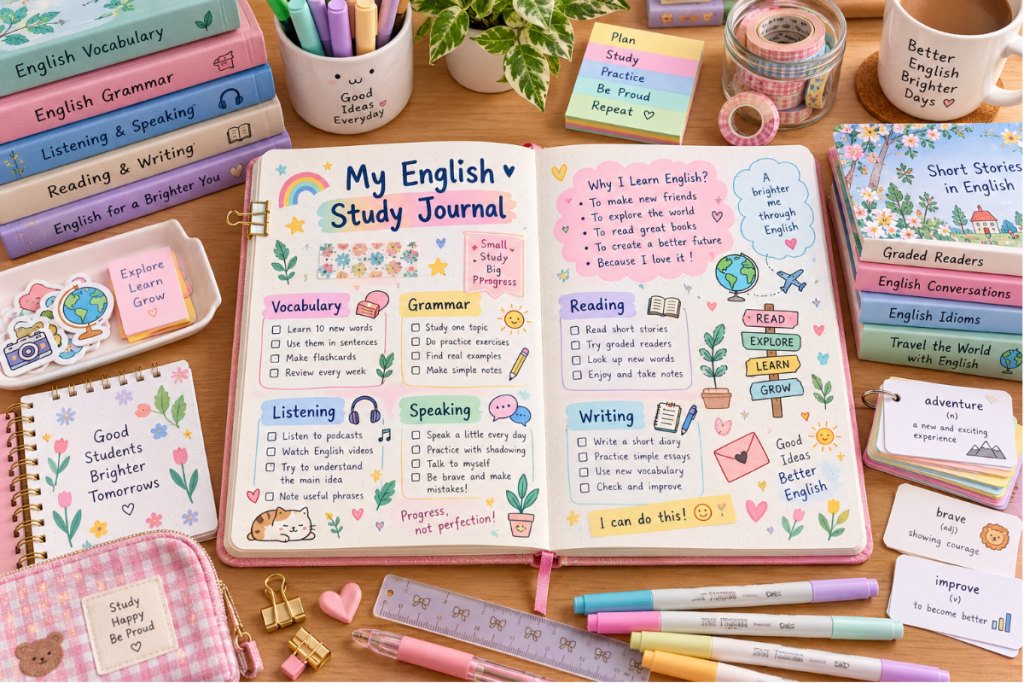
Grade 4 English Review: Essential Vocabulary by Topic
Learning vocabulary by topic helps students connect new words with familiar situations. The following sections cover common vocabulary areas for Grade 4 English learners.
Family and People
| English word | Vietnamese meaning |
| Father | Bố, cha |
| Mother | Mẹ |
| Brother | Anh/em trai |
| Sister | Chị/em gái |
| Grandfather | Ông |
| Grandmother | Bà |
| Cousin | Anh/chị/em họ |
| Family | Gia đình |
Example sentences:
- This is my mother.
- I have one brother and one sister.
- My grandfather is very kind.
School and Classroom
| English word | Vietnamese meaning |
| Classroom | Phòng học |
| Teacher | Giáo viên |
| Student | Học sinh |
| Blackboard | Bảng đen |
| Notebook | Vở ghi |
| Ruler | Thước kẻ |
| Eraser | Cục tẩy |
| Library | Thư viện |
Example sentences:
- My classroom is big.
- I have a new notebook.
- We read books in the library.
Jobs and Occupations
| English word | Vietnamese meaning |
| Teacher | Giáo viên |
| Doctor | Bác sĩ |
| Nurse | Y tá |
| Farmer | Nông dân |
| Worker | Công nhân |
| Driver | Tài xế |
| Pilot | Phi công |
| Singer | Ca sĩ |
Example sentences:
- My mother is a teacher.
- My uncle is a farmer.
- A pilot flies an airplane.
Animals
| English word | Vietnamese meaning |
| Dog | Chó |
| Cat | Mèo |
| Rabbit | Thỏ |
| Elephant | Voi |
| Monkey | Khỉ |
| Tiger | Hổ |
| Giraffe | Hươu cao cổ |
| Bird | Chim |
Example sentences:
- I have a small cat.
- Elephants are big animals.
- Monkeys can climb trees.
Food and Drinks
| English word | Vietnamese meaning |
| Rice | Cơm, gạo |
| Bread | Bánh mì |
| Noodles | Mì |
| Chicken | Thịt gà |
| Fish | Cá |
| Milk | Sữa |
| Juice | Nước ép |
| Water | Nước |
Example sentences:
- I eat rice every day.
- She likes orange juice.
- I would like a glass of water.
Weather and Seasons
| English word | Vietnamese meaning |
| Sunny | Có nắng |
| Rainy | Có mưa |
| Windy | Có gió |
| Cloudy | Có mây |
| Hot | Nóng |
| Cold | Lạnh |
| Spring | Mùa xuân |
| Summer | Mùa hè |
Example sentences:
- It is sunny today.
- I like summer because it is warm.
- What is the weather like today?
Hobbies and Daily Activities
| English word or phrase | Vietnamese meaning |
| Read books | Đọc sách |
| Play badminton | Chơi cầu lông |
| Ride a bike | Đi xe đạp |
| Listen to music | Nghe nhạc |
| Draw pictures | Vẽ tranh |
| Watch television | Xem tivi |
| Get up | Thức dậy |
| Go to school | Đi học |
Example sentences:
- I like reading books.
- She plays badminton after school.
- I get up at six o’clock every morning.
Places and Appearance
| English word | Vietnamese meaning |
| Park | Công viên |
| Hospital | Bệnh viện |
| Supermarket | Siêu thị |
| Cinema | Rạp chiếu phim |
| Tall | Cao |
| Short | Thấp, lùn |
| Young | Trẻ |
| Friendly | Thân thiện |
Example sentences:
- I go to the park with my family.
- The hospital is near my school.
- My best friend is friendly and helpful.
Grade 4 English Review: Essential Grammar Rules
Grammar helps students arrange words correctly and express their ideas clearly. These important structures are useful for reviewing common primary English topics.
The Verb “To Be”
The verbs am, is, and are are used to describe people, things, feelings, and conditions.
| Subject | Verb “to be” | Example |
| I | am | I am happy. |
| He / She / It | is | She is my friend. |
| You / We / They | are | They are students. |
Negative sentences:
- I am not tired.
- He is not at home.
- We are not late.
Questions:
- Are you a student? — Yes, I am.
- Is she your sister? — No, she isn’t.
The Present Simple Tense
The present simple is used to talk about habits, daily routines, and facts.
Affirmative sentences:
- I go to school every day.
- They play football after school.
- She likes apples.
Remember that verbs usually take -s or -es with he, she, and it.
Negative sentences:
- I do not like coffee.
- He does not play tennis.
Questions:
- Do you like English?
- Does she walk to school?
Use do with I, you, we, and they, and does with he, she, and it when forming present simple questions and negatives.
Can and Cannot
Use can to express ability. Use cannot or can’t to express inability.
Structure: Subject + can/cannot + base verb.
Examples:
- I can swim.
- She can ride a bike.
- He cannot play the piano.
- Can you speak English? — Yes, I can.
Do not add -s to the verb after can. For example, say “She can sing,” not “She can sings.”
Personal Pronouns and Possessive Adjectives
Personal pronouns replace nouns, while possessive adjectives show ownership.
| Personal pronoun | Possessive adjective | Example |
| I | My | My name is Anna. |
| You | Your | What is your name? |
| He | His | His bag is blue. |
| She | Her | Her dress is pink. |
| It | Its | The dog is wagging its tail. |
| We | Our | Our classroom is clean. |
| They | Their | Their house is big. |
Students should remember that possessive adjectives usually come before a noun.
Singular and Plural Nouns
Most countable nouns form their plural by adding -s or -es.
- Book → Books
- Pen → Pens
- Box → Boxes
- Bus → Buses
Some nouns have irregular plural forms:
- Child → Children
- Man → Men
- Woman → Women
Examples:
- I have two books.
- There are three children in the park.
Prepositions of Place
Prepositions describe where a person or object is located.
| Preposition | Vietnamese meaning | Example |
| In | Trong | The pen is in the bag. |
| On | Trên | The book is on the desk. |
| Under | Bên dưới | The cat is under the table. |
| Behind | Phía sau | The ball is behind the door. |
| Next to | Bên cạnh | The school is next to the park. |
| In front of | Phía trước | The car is in front of the house. |
Students can practice these expressions by describing objects in their classrooms or bedrooms.
Questions With “What,” “Where,” “Who,” and “When”
Question words help students ask for specific information.
| Question word | Use | Example |
| What | Things or information | What is your name? |
| Where | Places | Where do you live? |
| Who | People | Who is that girl? |
| When | Time | When is your birthday? |
| How | Manner or condition | How are you? |
| How many | Number of countable things | How many books do you have? |
Students should pay attention to word order when forming questions.
“There Is” and “There Are”
Use there is with a singular noun and there are with plural nouns.
Examples:
- There is a book on the desk.
- There are three pencils in my bag.
- Is there a park near your house?
- Are there any students in the classroom?
These structures are useful when describing rooms, schools, and places.
The Present Continuous Tense
The present continuous is used to describe actions happening now.
Structure: Subject + am/is/are + verb-ing.
Examples:
- I am reading a book.
- She is playing badminton.
- They are watching television.
Questions:
- What are you doing?
- Is he listening to music?
Students should learn to distinguish between daily habits in the present simple and actions happening at the moment in the present continuous.
Grade 4 English Review: Common Communication Patterns
Learning complete expressions helps students communicate naturally in everyday situations.
Introducing Yourself
- Hello! My name is Linda.
- I am nine years old.
- I am from Vietnam.
- Nice to meet you!
Asking About Family and Friends
- Who is that? — That is my brother.
- How many people are there in your family? — There are four people in my family.
- What does your mother do? — She is a teacher.
Talking About Hobbies
- What do you like doing? — I like reading books.
- Can you swim? — Yes, I can.
- What is your favorite sport? — My favorite sport is badminton.
Talking About Food and Weather
- What would you like? — I would like some bread.
- What is the weather like today? — It is sunny.
- What is your favorite food? — My favorite food is chicken.
Students can practice these conversations with classmates, family members, or teachers. Repeating short dialogues and changing a few words each time helps them use the patterns more confidently.
Grade 4 English Review: Practice Exercises With Answers
The following exercises help students check their understanding of vocabulary, grammar, and sentence structure.
Exercise 1: Choose the Correct Answer
Choose the best answer for each sentence.
Question 1: My sister _____ nine years old.
- am
B. is
C. are
D. be
Question 2: They _____ football after school.
- plays
B. playing
C. play
D. is play
Question 3: She _____ swim very well.
- can
B. cans
C. does
D. is
Question 4: The book is _____ the table.
- under
B. happy
C. sunny
D. teacher
Question 5: There _____ two cats in the garden.
- is
B. am
C. are
D. be
Question 6: What _____ your name?
- am
B. is
C. are
D. do
Question 7: He _____ like carrots.
- don’t
B. doesn’t
C. isn’t
D. aren’t
Question 8: I _____ reading a story now.
- am
B. is
C. are
D. do
Question 9: _____ is your birthday?
- Who
B. Where
C. When
D. How many
Question 10: My brother has two _____.
- pencil
B. pencils
C. penciles
D. a pencil
Exercise 2: Complete the Sentences
Fill in each blank with the correct form of the word in brackets.
- She _____ my best friend. (be)
- I _____ to school every morning. (go)
- Tom _____ cartoons after dinner. (watch)
- They _____ playing in the garden now. (be)
- My father _____ drive a car. (can)
- There _____ a ruler in my schoolbag. (be)
- We _____ not like rainy weather. (do)
- The children _____ happy today. (be)
Exercise 3: Put the Words in the Correct Order
Rearrange the words to make complete sentences.
- name / is / My / Peter
- every / school / go / I / day / to
- can / My / swim / sister
- the / is / under / cat / table / The
- doing / are / What / you / ?
- books / There / three / are / desk / the / on
Exercise 4: Read the Passage and Answer the Questions
Read the passage carefully.
Hello! My name is Anna. I am nine years old. I live in a small house with my parents and my younger brother. I go to school from Monday to Friday. My favorite subject is English because I like learning new words. In my free time, I read books and ride my bike. Today is Sunday, and I am playing badminton with my brother in the park.
Answer the questions.
- How old is Anna?
- Who does Anna live with?
- What is her favorite subject?
- What does she do in her free time?
- What is Anna doing today?
Answer Key
Exercise 1: Multiple choice
- B — is
- C — play
- A — can
- A — under
- C — are
- B — is
- B — doesn’t
- A — am
- C — When
- B — pencils
Exercise 2: Complete the sentences
- is
- go
- watches
- are
- can
- is
- do
- are
Exercise 3: Word order
- My name is Peter.
- I go to school every day.
- My sister can swim.
- The cat is under the table.
- What are you doing?
- There are three books on the desk.
Exercise 4: Reading comprehension
- Anna is nine years old.
- She lives with her parents and her younger brother.
- Her favorite subject is English.
- She reads books and rides her bike.
- She is playing badminton with her brother in the park.
How to Practice Listening, Speaking, Reading, and Writing
A complete Grade 4 English Review should cover all four language skills. Students can use short, age-appropriate activities to practice each skill regularly.
Listening Practice
Students can listen to short conversations, classroom instructions, descriptions of people, or passages about daily activities.
Useful activities include:
- Listening and choosing the correct picture.
- Matching spoken words with pictures.
- Listening and filling in missing words.
- Listening to a short passage and answering simple questions.
After listening, students can repeat key sentences to practice pronunciation and remember useful expressions.
Speaking Practice
Speaking practice helps students use vocabulary and grammar in real situations.
Suggested activities include:
- Introducing themselves and their families.
- Describing their favorite animals.
- Talking about their daily routines.
- Asking and answering questions about hobbies.
- Practicing short dialogues with a partner.
Students should focus on expressing their ideas clearly before worrying about speaking quickly.
Reading Practice
Reading short passages helps students recognize familiar vocabulary and understand sentence structures.
They can practice by:
- Reading short stories and identifying the main idea.
- Matching descriptions with pictures.
- Answering questions about people, places, and activities.
- Choosing the correct word to complete a passage.
Encourage students to look at the surrounding sentences when they encounter an unfamiliar word.
Writing Practice
Writing activities help students apply grammar and vocabulary independently.
Suitable tasks include:
- Writing five sentences about themselves.
- Describing their family or best friend.
- Writing about their favorite food.
- Describing their daily routine.
- Completing sentences with the correct words.
For example, students can write a short paragraph about their school, using simple sentences such as “My school is big,” “I have many friends,” and “I like my English teacher.”
Effective Ways to Study English in Grade 4
Consistent practice is often more useful than trying to memorize a large amount of information in one sitting.
Review a Small Amount Every Day
Set aside approximately 15–20 minutes for English practice, adjusting the duration to the child’s needs and attention span.
A simple routine might include:
- Five minutes reviewing vocabulary.
- Five minutes practicing grammar.
- Five minutes completing exercises.
- Five minutes listening to or speaking English.
Use Flashcards and Pictures
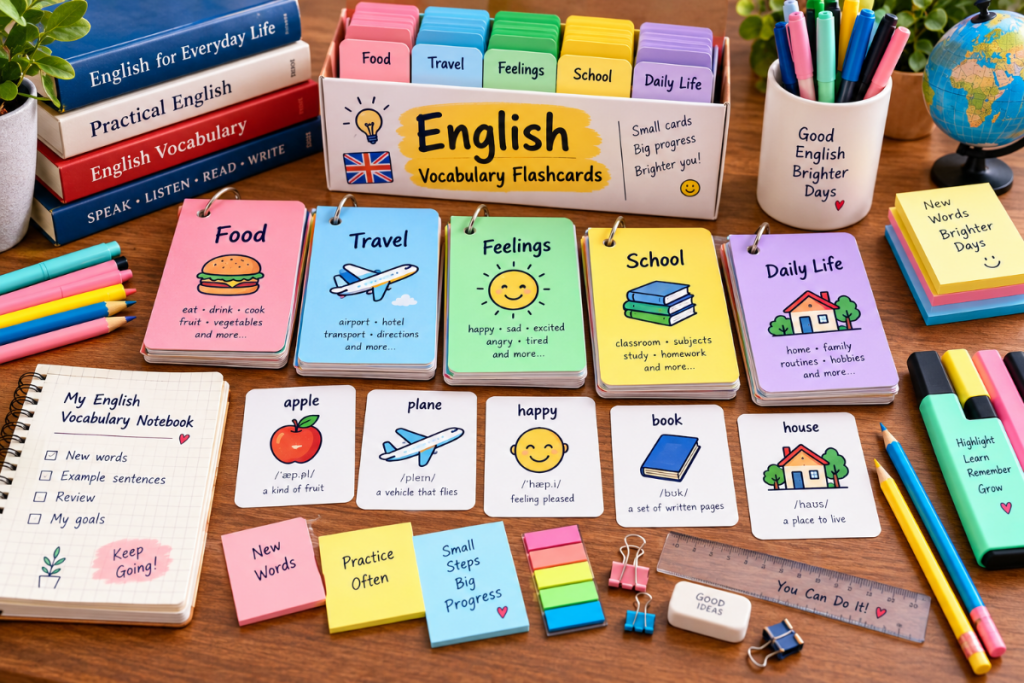
Flashcards can help students remember words by connecting English vocabulary with images and meanings. Parents can ask children to name objects, describe pictures, or use each word in a sentence.
Practice With Real-Life Situations
Use English during familiar activities, such as describing food at mealtimes, naming objects at home, or talking about the weather.
For example, ask, “What is the weather like today?” or “Where is your schoolbag?” These questions allow children to practice English in context.
Review Mistakes and Try Again
When students answer incorrectly, help them understand why the answer is wrong. Ask them to identify the relevant grammar rule, then complete a similar question.
Keeping a small notebook of common mistakes can make future review sessions more focused.
Get Support When Necessary
Parents can help children establish a study routine, review vocabulary, and encourage speaking practice. If a child consistently struggles with particular skills, additional guidance from a teacher or a structured English course may help address those learning needs.
For families exploring English programs for children, VUS offers English learning options that parents can research to determine whether a particular course matches their child’s age, current level, and learning goals.
Frequently Asked Questions About Grade 4 English Review
What should students study in a Grade 4 English Review?
Students should review vocabulary, basic grammar, common sentence patterns, and the four skills: listening, speaking, reading, and writing. The exact topics may vary depending on the textbook and school curriculum.
How can students remember English vocabulary more easily?
Students can group words by topic, use flashcards, practice pronunciation, and write simple sentences with new words. Reviewing vocabulary regularly helps reinforce memory.
What grammar topics should Grade 4 students practice?
Useful topics include the verb to be, the present simple, can/cannot, personal pronouns, possessive adjectives, singular and plural nouns, prepositions of place, question words, there is/there are, and the present continuous where it is included in the student’s curriculum.
How often should students review English?
Short, regular sessions throughout the week can help students retain knowledge. The best schedule depends on the child’s workload, attention span, and current English level.
How can parents help children review English at home?
Parents can ask simple questions in English, read short passages together, use flashcards, listen to age-appropriate audio, and encourage children to speak without fear of making mistakes. Positive feedback and consistent practice can make learning more enjoyable.
Build Confidence With a Regular Grade 4 English Review
A structured Grade 4 English Review helps students reinforce essential vocabulary, understand grammar, and apply English in familiar situations. By combining topic-based vocabulary, sentence practice, exercises with answer keys, and activities for all four language skills, students can identify areas for improvement and prepare more confidently for classroom assessments.
The key is to practice consistently, review mistakes, and use English in meaningful everyday contexts. With suitable materials and encouragement from parents and teachers, students can gradually build a stronger foundation for future English learning.
Keywords:
- Grade 4 English Exercises
- Grade 4 English Grammar
- Grade 4 English Vocabulary
- Grade 4 English Practice Tests
- Grade 4 English Revision
