
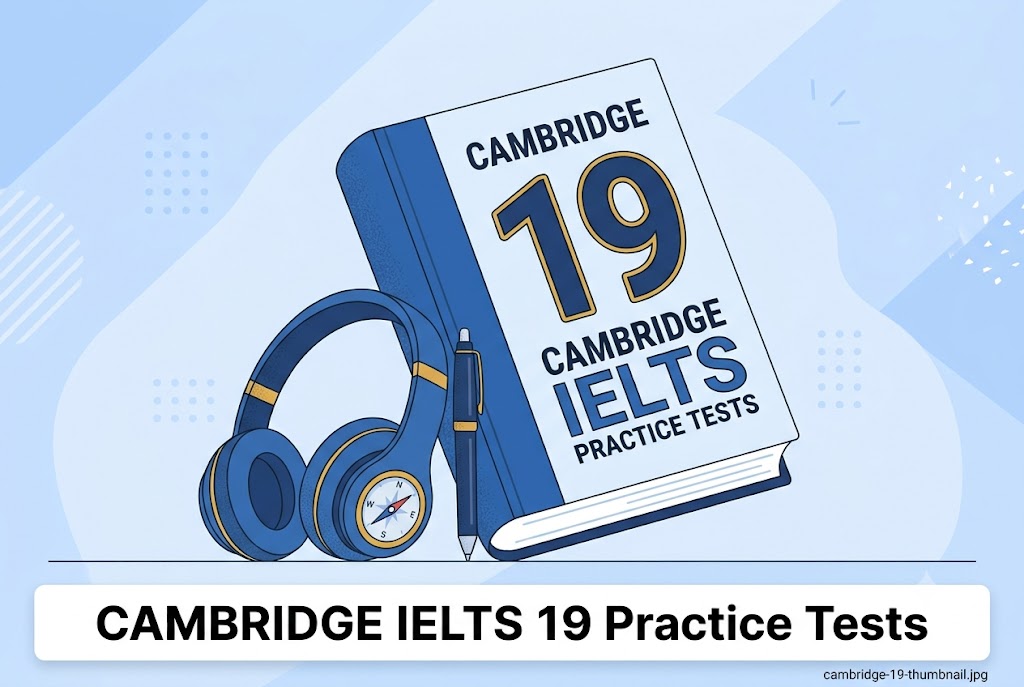
Cambridge 19 is part of the Cambridge IELTS preparation series published by Cambridge University Press. It provides practice tests designed to familiarise candidates with the IELTS format and help them develop the skills required for effective examination performance.
The Academic edition contains four practice tests covering Listening, Reading, Writing, and Speaking. Learners can use these materials to assess their current abilities, practise different question types, and develop effective time-management strategies.
IELTS Cambridge 19 is particularly useful for learners who already have an English foundation and want to focus on structured exam preparation. Beginners can also use the book, but they may benefit from additional grammar, vocabulary, and pronunciation practice before attempting complete tests.
Cambridge 19 is a preparation resource, not an official IELTS certificate. Practice scores can provide useful information about your current performance, but they cannot guarantee a particular result in the actual examination.
Is Cambridge 19 Difficult?
The difficulty of Cambridge 19 depends on your English proficiency, vocabulary range, comprehension skills, and familiarity with IELTS question types.
Listening can be challenging when speakers paraphrase information, correct themselves, or introduce distracting details. Reading requires efficient comprehension and time management. Writing demands relevant arguments and accurate language, while Speaking requires candidates to communicate clearly and develop their answers naturally.
Rather than judging the entire book as easy or difficult, identify the question types that cause you to lose marks. Understanding your recurring mistakes provides a more useful starting point for improvement than simply completing more tests.
 Tổng quan về cuốn sách Cambridge 19 mới
How to Use Cambridge 19 PDF Effectively
Many learners search for Cambridge 19 PDF because digital materials are convenient for studying on a computer or tablet. When looking for resources, prioritise authorised publishers and legitimate booksellers, and check the applicable usage permissions.
Before beginning, ensure that your materials include the practice tests, answer keys, Listening audio, and transcripts where available.
Follow these steps to make your preparation more productive:
- Step 1: Take a diagnostic test. Complete one test under timed conditions to establish your starting point.
- Step 2: Record your mistakes. Classify incorrect answers by skill, question type, and underlying cause.
- Step 3: Analyse the evidence. Find the relevant information in the recording or passage rather than simply memorising the answer key.
- Step 4: Practise strategically. Focus on recurring weaknesses before attempting another test.
- Step 5: Evaluate your progress. Compare results across multiple practice tests and adjust your study plan accordingly.
Completing tests without reviewing mistakes can limit progress. Careful analysis helps you understand what went wrong and how to avoid repeating the same errors.
Cambridge 19 Listening Test 1: How to Practise Effectively
When practising Cambridge 19 Listening Test 1, begin by reading the instructions and using the preparation time to predict the type of information required. Answers may include names, numbers, nouns, adjectives, or short phrases.
During your first attempt, complete the test without pausing the recording or looking up unfamiliar words. Check your answers afterwards and identify the reasons for incorrect responses.
Common difficulties include failing to recognise paraphrases, losing concentration after missing an answer, confusing singular and plural forms, making spelling mistakes, and exceeding the permitted word limit.
Replay the sections containing incorrect answers. If you still cannot understand the recording, consult the transcript to identify unfamiliar vocabulary and pronunciation patterns. Then listen again without reading the transcript to check your independent comprehension.
Cambridge 19 Listening Test 2: A Better Error-Analysis Method
When working on Cambridge 19 Listening Test 2, follow the same cycle of listening, checking answers, and analysing mistakes. However, focus on why each answer was incorrect rather than concentrating only on the number of correct responses.
If you frequently miss information, practise maintaining concentration and moving quickly to the next question. If familiar words sound unfamiliar in the recording, review pronunciation, word stress, and connected speech. For multiple-choice questions, pay attention to how speakers rephrase information or change their opinions.
Keep a vocabulary notebook containing useful expressions and paraphrases from each test. Reviewing these expressions regularly can help you recognise equivalent meanings more quickly.
Avoid reading the transcript before your first attempt because doing so may give you an unrealistic impression of your listening ability.
How to Improve the Four IELTS Skills with Cambridge 19
Listening: Develop Accuracy and Concentration
IELTS Listening assesses your ability to understand spoken English in different contexts. Candidates need to identify specific details, follow conversations, and recognise equivalent expressions.
Practise predicting the information required, listening for meaning, and checking spelling carefully. After each test, review unfamiliar phrases and replay the sections containing important information.
Reading: Improve Comprehension and Time Management
IELTS Reading requires candidates to identify main ideas, locate specific information, and understand relationships between arguments.
Practise skimming for general meaning and scanning for relevant details instead of translating every sentence. Before selecting an answer, locate the supporting evidence in the passage.
For True, False, Not Given questions, distinguish between statements that contradict the text and statements that are not addressed by it. A statement is not automatically False simply because the passage does not mention it.
Writing: Develop Clear and Relevant Responses
IELTS Writing is assessed using official criteria that include Task Achievement or Task Response, Coherence and Cohesion, Lexical Resource, and Grammatical Range and Accuracy, depending on the task.
Analyse the question before writing, plan your main ideas, and support your arguments with relevant explanations or examples. Leave enough time to check grammar, vocabulary, punctuation, and paragraph organisation.
Avoid memorising complete model essays and reproducing them regardless of the question. Effective writing requires a relevant response and accurate language rather than unnecessarily complicated vocabulary.
Speaking: Communicate Naturally and Coherently
IELTS Speaking is assessed using four criteria: Fluency and Coherence, Lexical Resource, Grammatical Range and Accuracy, and Pronunciation.
Practise answering questions by stating your main point, explaining your reasons, and adding examples where appropriate. Recording your responses can help you identify unclear pronunciation, excessive hesitation, and recurring grammatical errors.
Rather than memorising complete answers, develop ideas around common topics and practise adapting them to different questions.
How Is the IELTS Overall Band Score Calculated?
The IELTS Overall Band Score is calculated by averaging the Listening, Reading, Writing, and Speaking scores. The result is rounded according to the official IELTS rounding rules.
For example, if your scores are 7.0 in Listening, 6.5 in Reading, 6.0 in Writing, and 7.0 in Speaking, the average is 6.625. Your Overall Band Score is therefore 6.5.
An average ending in .25 is rounded up to the next half band, while an average ending in .75 is rounded up to the next whole band.
These rules apply to the Overall Band Score, not directly to the conversion of correct answers into Listening or Reading bands. The number of correct answers required for a particular band can vary between tests, so online conversion charts should be treated as estimates.
A Practical Study Plan for Cambridge 19
Your study plan should reflect your current English level, target band, and available preparation time.
- Stage 1: Assess your level. Complete one test under timed conditions and identify your weakest skill.
- Stage 2: Strengthen your foundations. Review grammar, vocabulary, pronunciation, and reading techniques where necessary.
- Stage 3: Practise individual skills. Focus on recurring mistakes and challenging question types.
- Stage 4: Complete full practice tests. Simulate examination conditions and practise time management.
- Stage 5: Evaluate your progress. Compare results across several tests and adjust your preparation strategy.
The time required to improve depends on your starting level, target score, study frequency, and the quality of feedback you receive. No fixed schedule can guarantee the same improvement for every candidate.
Common Mistakes to Avoid When Using IELTS Cambridge 19
Some candidates complete numerous practice tests without analysing their incorrect answers. Others memorise vocabulary without learning how to use it naturally or concentrate on Listening and Reading while neglecting Writing and Speaking.
Another mistake is treating a practice score as a guaranteed prediction of an official IELTS result. Actual performance depends on your abilities, preparation, concentration, and examination conditions.
Maintain a study journal that records each mistake, its cause, and the action needed to correct it. For Writing and Speaking, feedback from a qualified teacher can help identify weaknesses that are difficult to recognise independently.
 Lưu ý khi làm bài reading test 2
Why Is Cambridge 19 Useful for IELTS Candidates?
Cambridge 19 helps learners become familiar with the exam format, practise essential skills, and develop a structured study routine. However, the book is a preparation resource rather than an official IELTS certificate.
An IELTS result may be required for university admission, employment, or immigration, depending on the receiving organisation. Candidates should confirm the required score, accepted test type, and validity requirements directly with the relevant institution or authority.
Use Cambridge 19 as part of a broader preparation strategy that combines practice tests with targeted language development and regular feedback.
Cambridge 19 can be a valuable resource for candidates who want to practise all four IELTS skills and become familiar with the examination format. To make meaningful progress, combine timed practice with careful error analysis and targeted revision. With a structured study plan, Cambridge 19 can support more effective preparation for the IELTS examination.
Frequently Asked Questions (FAQs)
1. Who should use Cambridge 19?
Cambridge 19 is suitable for learners with an English foundation who want to practise IELTS questions. Beginners may need additional grammar, vocabulary, and pronunciation study.
2. Where can I find Cambridge 19 PDF?
Look for authorised publishers and legitimate booksellers that provide official materials. Check usage permissions before downloading or sharing digital files.
3. How should I practise Cambridge 19 Listening Test 1?
Complete the test without pausing the recording, check your answers, and replay difficult sections. Use the transcript to identify mistakes before listening again independently.
4. Can Cambridge 19 Listening Test 2 improve my listening skills?
Yes, it can support improvement when combined with targeted practice and error analysis. Replaying difficult sections and reviewing paraphrases can improve listening accuracy.
5. Can Cambridge 19 predict my official IELTS score?
Practice scores provide an indication of your current performance but cannot guarantee your official result. Your actual score depends on your skills and examination performance.
6. Is Cambridge 19 enough for IELTS preparation?
One book is rarely sufficient for every learner. Combine Cambridge 19 with targeted language study, Writing and Speaking practice, and feedback from qualified teachers.
Keyword:
- Cambridge 19 test 1
- Cambridge 19 reading test 1
- Cambridge 19 listening test 3
- Cambridge 19 reading test 2
